A practice test is worth nothing until it is reviewed, and most reviews are worth nothing because they stop at the correct answer. Every wrong answer has one of four causes, and each cause has a different repair. Reading the solution fixes only one of them. This is the log, the classification, and the weekly cycle that turns practice into progress.
Why the score is the least useful number on the page
CEE’s published rules for its 2026 Online National Semi-Finals describe the marking of a written NEC round precisely: “+10 points for each correct response, 0 points for each incorrect response, and 0 points for no response,” with a total of 45 minutes for 45 four-option multiple-choice questions and no books, notes, calculators or internet permitted. Formats are set by the competition and change yearly, so confirm your own round officially — but that scheme has a property worth dwelling on.
A blank and a wrong answer score identically. So a raw score of 260 out of a possible 450 tells you nineteen questions went missing and absolutely nothing about why. It cannot distinguish between a student who has never met monopolistic competition, a student who knew the answer and misread “increase” as “decrease”, a student who understood the concept but could not apply it to an unfamiliar scenario, and a student who knew all of it and ran out of minutes at question 38.
Those are four different students with four different next weeks. Treating them the same — “review your mistakes, do another paper” — is why students plateau after their third practice test. The improvement does not come from doing more tests. It comes from the twenty minutes after each one.
The four causes, and the questions that separate them
The classification below is our own teaching framework rather than an official rubric, but it is diagnostic rather than descriptive: each branch is a question you can genuinely answer about your own paper, and the answer determines what you do next.
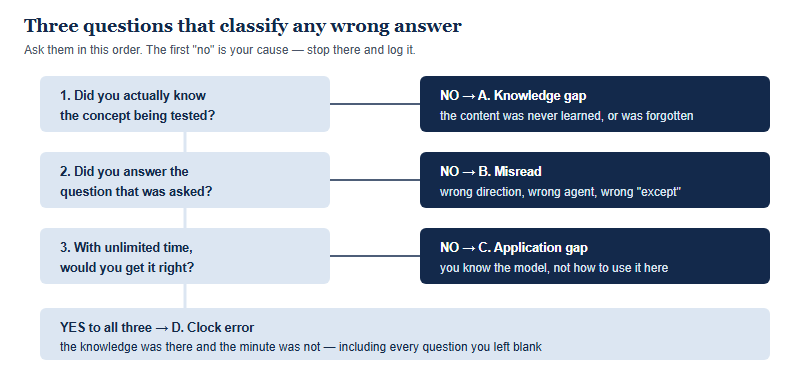
Two notes on using the tree honestly. First, be strict at question one: “I sort of knew it” is a no. Second, resist the pull towards cause D. Blaming the clock feels better than admitting a gap, and it is the most over-diagnosed cause in every log we have read.
One cause, one repair — and they are not interchangeable
The whole point of classifying is that the repairs differ. Re-reading a solution is the correct treatment for exactly one of the four.
| Cause | What it looks like | The repair | How long it takes | What does not work |
|---|---|---|---|---|
| A. Knowledge gap | You cannot explain the concept to a classmate afterwards, even with the answer in front of you | Learn the topic properly from your textbook or course, then return to the question days later | Days to weeks; this is real study | Memorising this particular question and its answer |
| B. Misread | On seeing the answer you say "oh, it said fall" — you knew the economics entirely | A mechanical habit: underline the direction word, the agent, and any "not" or "except" before looking at the options | Two to three weeks of deliberate practice | Resolving to "be more careful", which is not an instruction |
| C. Application gap | You can state the model but freeze when it appears in an unfamiliar scenario or with unfamiliar wording | Collect five to eight different questions on the same concept and do them together, so you meet the concept in several costumes | One focused session per concept | Doing one more full mixed paper and hoping the topic reappears |
| D. Clock error | Correct on review in thirty seconds; blank or rushed on the day, and clustered in the last third of the paper | Timed sets of ten questions with a hard stop, then a review of where the minutes actually went | Ongoing, measured weekly | Doing full-length papers untimed, which trains the wrong thing entirely |
Our own teaching framework, per Hanlin. It is not an official CEE or CNEC rubric and carries no standing in the competition.
Cause D deserves one specific note. Because blanks and wrong answers score identically under CEE’s published scheme, a blank is not a neutral outcome — it is a cause-D miss that happens to be easy to spot. Log your blanks. They are the clearest evidence you have about where your pacing broke, and a paper with eleven blanks in the final ten minutes is telling you something a paper with eleven scattered errors is not. How you then handle the clock in the room is a separate discipline; here, the blank is a diagnostic, not a strategy.
The log itself: five columns, and nothing more
Elaborate logs get abandoned in week three. The version that survives a season has five columns and takes about fifteen seconds per entry:
- Date and paper — so you can see whether an item is a repeat.
- Question reference — enough to find it again, not a transcription. Never copy question text from a paper you do not own the rights to.
- Concept — in three or four words. "Tax incidence, inelastic demand", not "micro".
- Cause — a single letter: A, B, C or D. This is the column that does the work.
- Status — open, or the date you re-tested it and got it right cold.
That last column is the one students leave out, and it is the one that makes the log a tool rather than a diary. An entry stays open until you have answered the same item correctly on a later day without warning. Until then, the mistake has not been repaired — it has only been read about.
Keep it in one place for the whole season. The value compounds: by January the log tells you which concepts you have got wrong three times, which is information no single paper can give you and no score report will ever surface.
The weekly cycle
One timed set, one classification pass, one repair block, one cold re-test. In a busy term that is comfortably under three hours, and it beats four hours of untimed papers with no review attached.
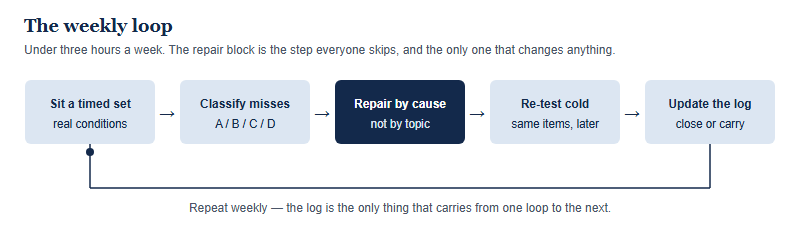
Two rules keep the loop honest. The re-test must be cold — a different day, no warning, mixed in with other items — because recognising a question you reviewed yesterday is not the same as knowing it. And the repair block must be organised by cause, not by topic: if you have six cause-B misses spread across elasticity, GDP and exchange rates, they are one problem in three costumes, and drilling the reading habit fixes all six at once.
How to tell whether the log is working
Three numbers, checked monthly, tell you more than your scores do:
- Repeat-cause rate. Of this month’s misses, how many are the same cause on the same concept as a previous month? Falling is the goal. Flat means you are logging but not repairing.
- Cause mix drift. A healthy season starts A-heavy and becomes C- and D-heavy. If you are still mostly cause A in February, the problem is content coverage and no amount of practice papers will substitute for learning the syllabus.
- Blank count and where it clusters. Falling blanks in the final third is the cleanest evidence that pacing work is landing.
In our own coaching the most common pattern in a student’s first log is a badly skewed classification: nearly everything marked D, almost nothing marked C. That is our own observation across cohorts rather than a measured statistic, and it usually corrects itself the first time a student re-does a missed question untimed and discovers they still cannot do it. That single experiment reclassifies half a log.
A last piece of scope. This protocol is built for the written, timed rounds, where the unit of failure is a question with a right answer. The live stages work differently — a team presentation cannot be classified into A, B, C or D, and its review needs a rubric rather than a log. Our guide to the rounds sets out which stages are written and which are performed, and if you are in the division with the widest content span, the Adam Smith breakdown is the map of what your cause-A entries will be drawn from. Students preparing instead for an economics essay prize need a different instrument again: drafts and feedback, not timed sets.
Questions students ask about reviewing practice tests
How long should reviewing a practice test take?
Roughly as long as sitting it. Twenty to forty minutes of classification and repair after a timed set is the working ratio.
Is it better to do more papers or review them properly?
Review. Extra papers repeat the same errors; classification tells you which of four different repairs each error needs.
Do blank answers matter if they are not penalised?
Yes. Under CEE's published scheme blanks and wrong answers both score zero, so a blank is a pacing signal worth logging.
When can I close an entry in the error log?
Only after re-testing the same item cold on a later day and getting it right without warning or preparation.
Published by the NEC (CNEC) editorial desk, operated by Hanlin Education for China-based international-school students. Official rules are set by the competition and change yearly — confirm current details on councilforeconed.org and through the official CNEC channels. Errors are corrected within 7 working days.