Alongside the competition rounds, the 2027 CNEC outline sets out a club programme: a five-step path from club recruitment and certification through to a summer leadership summit, and a September to November online leaderboard called Super Econ. It runs in exactly the weeks you are registering and starting qualifying-test preparation, which makes it the most commonly mishandled part of the autumn.
This is not a round. It sits in a separate strand of the programme, and treating it as though it were scored in December is how students lose the term. Here is what the club track actually contains, what it does not tell you, and how to decide whether to give it your September.
What the club programme is, and where Super Econ now sits
If you are working from guides written before the 2027 outline appeared, you will have read that CNEC runs seven rounds and that Super Econ is one of them. That is no longer how the current outline is organised. The 2027 outline lists five rounds — the Qualifying Test, Critical Thinking, the Quiz Bowl, the new OX-BP Debate Sessions and U20 Youth Voice — and it places Super Econ in the club programme section, described as a September-to-November online leaderboard activity rather than a competition round. Our stage-by-stage guide to the 2027 rounds sets out which of the five appears at which stage.
Two precisions matter here, because students draw the wrong conclusion in both directions. Super Econ has not been withdrawn — it is present in the outline, in a different place, with a different function. And a summary document that does not list something is not the same as an announcement that the thing has ended: the 2027 outline also does not list Econ Lab or Econ Immersion, and we are careful not to describe either as cancelled. What we can say is what the outline shows, which is a five-round competition structure and a club strand running beside it.
The practical consequence is simple. Nothing in the club strand is what the December preliminary tests. At the preliminary, the round that runs is the Qualifying Test — an individual written paper covering micro, macro and international economics. Leaderboard standing in October does not sit that paper for you.
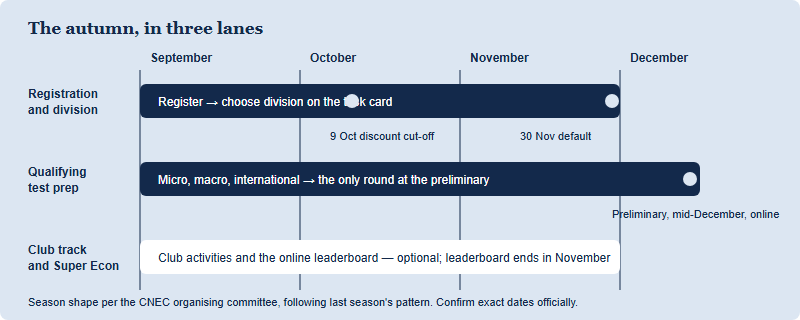
Your autumn has three lanes, and only one is scored in December
From the organising committee, and following last season’s pattern, the season shape is: registration across September to November, the preliminary round online in mid-December, the China national round in March with the venue still to be announced, and global sites in the United States in May and June, the United Kingdom in July, Hong Kong SAR in August, and Singapore to be confirmed. Exact dates are set officially each season, so confirm before you plan travel or leave.
Inside the autumn, three separate things are competing for the same weeks.
| Lane | Window | What it decides | Cost of skipping it |
|---|---|---|---|
| Registration and division choice | September to November | Whether you compete at all, in which division, and with whom | Severe and irreversible. Miss the division choice and the registration defaults into the hardest track on 30 November |
| Qualifying-test preparation | September to mid-December | The only round that runs at the preliminary, and therefore whether your season continues past December | Severe. Nothing else in the autumn substitutes for it |
| Club activity and the Super Econ leaderboard | September to November | Club-strand participation, the club leader path, and a showcase route the outline places at the China round | Low for this season’s result. Higher if you are trying to build a team culture that outlives one cohort |
The 30 November point in lane one deserves emphasis, because it lands in the middle of the leaderboard window and it is the single most expensive date in the CNEC calendar for an unprepared student. Division is chosen on the task card after you register, and a registration with no division chosen by 30 November defaults into Adam Smith — the advanced track, which sets no entry bar and is recommended for students who have completed both micro and macro. We have written separately about what the Adam Smith division actually demands. Do not let a busy club October be the reason you arrive there by accident.
The five-step club path, in the order the outline sets it out
The club programme is written as a progression rather than a single event: club recruitment and certification, then running club activities, then competing against economics clubs from around the country, then a showcase of results at the China national round, and finally attending the annual summer leadership summit, which the outline describes as an in-person event. The outline also refers to refreshed club material packs and to establishing an economics interest club where none exists.
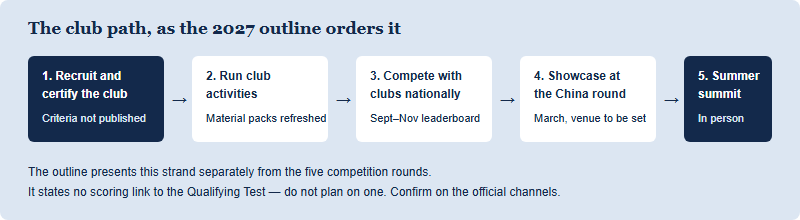
Step three is where the Super Econ leaderboard sits, and step four is the part most students overlook: the outline places a club results showcase at the China national round in March. Whether attending that showcase depends on advancing through the competition is not stated, so ask rather than assume. If your reason for running a club is to be in the room in March, get that answer in writing before you build a term around it.
The money and the deadlines that actually bite this autumn
Registration costs are set for the preliminary round, and the discount windows are the part that moves. Per the organiser’s published fee structure for the preliminary:
| Item | Amount | Deadline | Status as of early September |
|---|---|---|---|
| Preliminary registration fee | RMB 698 per person, online | Within the registration window | Standing |
| Early-bird reduction | RMB 80 off per person | 31 August 2026 | Closed |
| Returning-user reduction | RMB 50 off per person | 23:59 on 9 October 2026 | Open — the live deadline this autumn |
| Combining reductions | The early-bird and other reductions are stated as combinable | — | Only relevant where both windows are open |
One note on team registration that catches cross-school groups. Where a team is assembled from more than one school, the outline requires the team affiliation to be set in the registration interface, and it is that affiliation which carries the team honour; individual certificates continue to show each student’s own school. If your club is the thing holding a cross-school team together, sort the affiliation at registration rather than arguing about it afterwards.
Who should run a club this autumn, and who should not
The club track is genuinely valuable for a narrow set of students, and a distraction for a larger one. Our coaching view, offered as judgement rather than as a rule:
- Worth it: schools with no economics course. If nobody teaches micro or macro at your school, a certified club with a material pack and a weekly slot is the most reliable structure you can build. The alternative is solitary reading that quietly stops in October.
- Worth it: years 9 to 11 building something that outlasts one cohort. A four-person team is hard to assemble from scratch every year. A club that recruits in September is how a school stops starting over.
- Worth it: students who need a reason to talk economics aloud. The live team rounds later in the season reward fluency under time pressure, and a weekly club is cheap practice for it.
- Skip it: first-time entrants whose December is not secure. If your qualifying-test preparation is behind, the leaderboard is the first thing to drop. It is optional; the preliminary is not.
- Skip it: exam-year students in a heavy autumn. Internal assessments and predicted-grade work do not move because a leaderboard opened.
- Skip it: anyone treating leaderboard standing as a substitute for the paper. The outline shows no scoring bridge between them.
One further boundary, in keeping with how we write about this competition generally: evaluate the club track on whether the activity is worth doing and whether it improves your economics. We make no claim about what club participation, leaderboard standing or any competition result does for a university application. This is a test-and-team competition, structurally unlike the essay prizes some students enter in the same year, and we set out that comparison in our guide to NEC against the essay competitions.
What the outline does not say about the club track
Listed plainly, so you ask precise questions during the registration window rather than guessing: the outline we are working from does not publish club certification criteria, a minimum membership size, a club fee if one exists, the scoring rules or entry mechanism for the Super Econ leaderboard, whether leaderboard standing carries into any competition round, or whether the March showcase is open to clubs whose teams did not advance.
The safe planning assumption is the conservative one. Treat the club strand as a parallel activity with its own value, keep the December Qualifying Test as the thing your autumn is actually organised around, and confirm every date, fee and eligibility rule on the official channels before you commit a term to it. Rules are set each season and they change.
Frequently asked questions
Has Super Econ been cancelled?
No. In the 2027 outline it appears under the club programme as a September-to-November online leaderboard activity, rather than among the five competition rounds.
Does the club leaderboard affect my competition result?
The outline presents the two strands separately and states no scoring link. Do not plan on one; confirm on the official channels.
What runs at the December preliminary round?
The Qualifying Test, an individual written paper covering micro, macro and international economics. Confirm the date officially each season.
Which registration discount is still open this autumn?
The returning-user reduction of RMB 50 per person, until 23:59 on 9 October 2026. The early-bird window closed on 31 August 2026.
Published by the NEC (CNEC) editorial desk, operated by Hanlin Education for China-based international-school students. Official rules are set by the competition and change yearly — confirm current details on councilforeconed.org and through the official CNEC channels. Errors are corrected within 7 working days.