
The NEC tests business cycles and the AD-AS model by asking you to do three things in sequence: locate the economy in its cycle (boom or recession), identify which curve has shifted to put it there (aggregate demand, short-run aggregate supply, or long-run aggregate supply), and match the corrective policy to that phase. Get the diagnosis right and the policy answer follows. Most marks are lost not on the economics but on confusing a demand shock with a supply shock, or recommending the wrong policy for the phase.
This guide stays on one macro engine: the aggregate demand – aggregate supply (AD-AS) framework and the business cycle it explains. It is not a tour of fiscal tools or central-bank mechanics — those sit in our companion pieces — and it is not about long-run growth drivers either. It is about the diagnostic model that examiners build scenario questions around. The National Economics Challenge is run by the Council for Economic Education (CEE, founded 1949), spans microeconomics, macroeconomics and the world economy, and draws roughly 10,000 students a year in the United States. The China National Round, CNEC, has been operated by Hanlin (SKT) since 2016 across 20+ provinces and 300+ schools, and is the official path from China into the NEC global rounds. The economics standard below comes from the CEE; the exact rounds, question counts and formats for your division can change season to season, so confirm those on the official CNEC channels.
The business cycle: four phases, two gaps
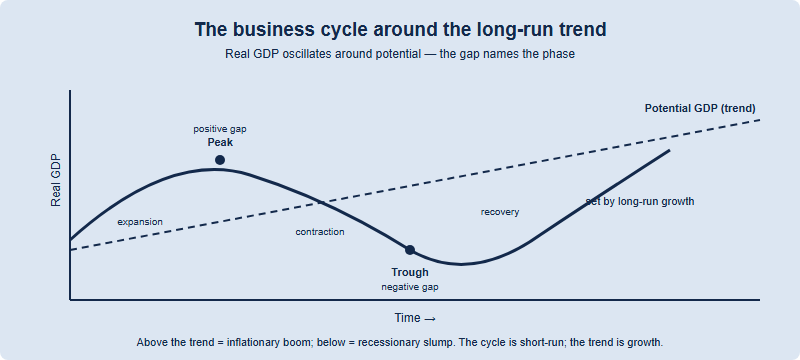
The business cycle is the recurring short-run fluctuation of real output around its long-run trend. It moves through four phases — expansion, peak, contraction (recession), and trough — before the next expansion begins. The cycle is a short-run phenomenon: the trend line it oscillates around is set by long-run growth, which is a different mechanism entirely. NEC scenario items reward students who keep that distinction clean, because the policy logic for a temporary slump is the opposite of the policy logic for slow trend growth.
The single concept that organises the whole framework is the output gap — the difference between actual real GDP and potential (full-employment) GDP. When you can name the gap, you can name the phase, and the phase implies both the symptoms and the cure.
- Positive output gap (inflationary / boom). Actual GDP is above potential. Symptoms: unemployment below its natural rate, rising wage and price pressure, an economy running hot. The risk is accelerating inflation.
- Potential output (full employment). Actual equals potential. Unemployment sits at its natural rate; there is no demand-side pressure pushing prices up or down. This is the trend the cycle returns to.
- Negative output gap (recessionary / slump). Actual GDP is below potential. Symptoms: cyclical unemployment above the natural rate, idle capacity, weak price pressure. The risk is a prolonged downturn.
| Cycle phase | Output gap | Unemployment vs natural rate | Inflation pressure | Policy stance implied |
|---|---|---|---|---|
| Expansion / boom (peak) | Positive (above potential) | Below | Rising | Contractionary — cool demand |
| At potential | Zero | At natural rate | Stable | Neutral |
| Contraction (recession) | Negative (below potential) | Above | Weak / falling | Expansionary — support demand |
| Trough | Negative, widest | Highest | Weakest | Expansionary — stimulate recovery |
The AD-AS model: which curve actually moved?
AD-AS is the model that explains the cycle. Plot the price level on the vertical axis and real output on the horizontal. Aggregate demand (AD) slopes down: total spending by households, firms, government and the foreign sector (C + I + G + NX) at each price level. Short-run aggregate supply (SRAS) slopes up: with sticky wages and input prices, a higher price level makes production more profitable. Long-run aggregate supply (LRAS) is vertical at potential output: in the long run the economy produces what its resources and technology allow, regardless of the price level. Equilibrium is where the curves cross, and the position of that crossing relative to LRAS tells you the output gap.
The high-value skill the NEC tests is attributing a change to the correct curve. A booming or slumping economy looks different depending on whether demand moved, short-run supply moved, or potential itself moved — and the policy response differs accordingly. The classic trap is the supply shock: an oil-price spike shifts SRAS left, raising the price level and cutting output at the same time (stagflation), which a demand-side reading cannot explain. Knowing what shifts each curve is the difference between a clean answer and a guess.
| Curve | What shifts it right (out) | What shifts it left (in) | Effect on price level & output |
|---|---|---|---|
| Aggregate demand (AD) | Higher C, I, G or NX; tax cuts; rate cuts; confidence | Lower spending; tax rises; rate hikes; pessimism | Both move the same way (P and Y rise or fall together) |
| Short-run AS (SRAS) | Lower input/energy costs; lower wages; productivity | Cost-push shocks (oil, wages, supply chains) | P and Y move opposite ways — the supply-shock signature |
| Long-run AS (LRAS) | More capital, labour, technology, institutions | Loss of resources or capacity | Potential output itself moves — this is growth, not the cycle |
One distinction examiners probe repeatedly: a shift in LRAS is not part of the cycle at all — it is growth, a change in potential output. A scenario that increases capital, the labour force or technology is moving the trend line, not creating a boom. Treating “more investment” as a temporary demand stimulus when the question is really about long-run capacity is one of the most common cross-topic errors, and it is exactly the seam where this guide meets our economic-growth deep dive.
Matching policy to the phase: the diagnose-then-prescribe routine
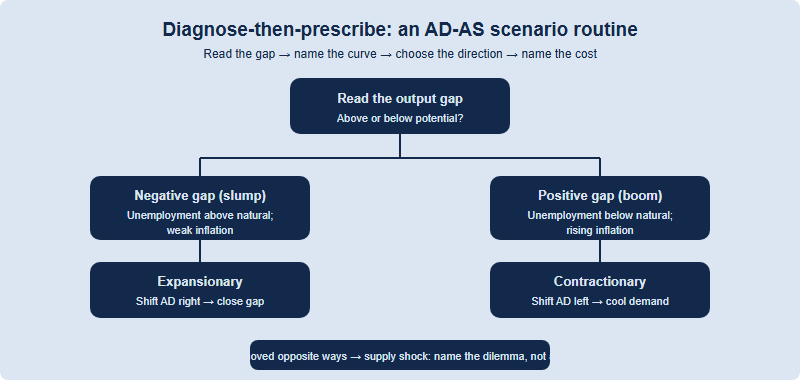
Once you can read the gap and name the curve, policy is a short logical step — but only if you prescribe to the phase, not to a reflex. The core rule is symmetry: a negative output gap calls for expansionary policy to shift AD right and close the gap from below; a positive output gap calls for contractionary policy to pull AD left and cool an overheating economy. The mechanics of how those policies work — spending versus taxes, or the central bank’s rate channel — are covered in our fiscal-policy and monetary-policy guides; here the focus is choosing the right direction for the phase in front of you.
- Diagnose the gap. Is actual output above or below potential? Read the symptoms in the stem — unemployment relative to the natural rate, the direction of inflation, capacity use.
- Identify the curve. Did AD shift, or is this a supply shock? If price and output moved the same way, suspect demand; if they moved opposite ways, suspect SRAS.
- Prescribe by direction. Negative gap → expansionary (shift AD right). Positive gap → contractionary (shift AD left). For a supply shock, name the policy dilemma rather than a clean fix.
- State the trade-off. The strongest answers name the cost — demand stimulus can stoke inflation; tightening can raise unemployment. A response with no trade-off rarely earns full credit.
The supply shock is where weaker answers collapse, so handle it deliberately. An adverse SRAS shift raises prices and raises unemployment together, which means demand-side policy can only address one problem by worsening the other: stimulate to fight the slump and you add to inflation; tighten to fight inflation and you deepen the slump. The sophisticated NEC answer does not pretend there is a costless cure — it names the dilemma and points toward supply-side or structural responses that ease the constraint over time. Recognising that a single demand lever cannot fix a supply problem is a recurring discriminator between mid and top scripts.
Where business-cycle and AD-AS items show up across the NEC rounds
This framework is not confined to one round; it recurs across the competition in different formats, which is why mastering it pays a high return. In the Qualifying Test it appears as multiple-choice items that hinge on a single distinction — demand versus supply shift, or the right direction of policy for a gap. In the faster rounds it becomes recall under pressure, and in the analytical and case-style rounds it becomes a structured argument where naming the trade-off separates strong scripts from adequate ones. The exact round line-up — Qualifying Test, Super Econ, Quiz Bowl, Critical Thinking, Econ Lab, Econ Immersion and the U20 Youth Voice — and which apply to your division are set by the organiser and can change season to season, so confirm the current structure on the official CNEC channels.
A practical drill: take any current macro headline — a rate decision, a growth surprise, an energy-price move — and run it through the routine. Which curve moved? Which way does the gap go? What policy direction follows, and at what cost? Doing this on live events trains exactly the scenario reasoning the NEC rewards, and it is far more durable than memorising a diagram in the abstract.
A first-party note from running the China round
As the officially authorized China test centre (CNEC) for the NEC, the AD-AS gap we see most often in Chinese international-school students is not the model itself — AP, IB and A-Level courses teach the curves well — it is the diagnostic step. Students can draw a leftward AD shift on demand, but freeze when a scenario hides whether demand or supply moved, or when “more investment” is really a long-run capacity story rather than a short-run boom. The two highest-return habits we coach are: always read the output gap before reaching for a policy, and treat price-and-output moving in opposite directions as a flashing sign of a supply shock. We confirm every format detail — rounds, question counts, timing — against the CEE standard and the official CNEC materials each season rather than assuming last year’s structure holds, and we’d encourage every team to do the same. For the current syllabus, schedule and rules to practise against, start from the CNEC home page.
FAQ
What is the AD-AS model in one line?
It plots the price level against real output, with downward AD, upward short-run AS, and vertical long-run AS at potential, to explain booms and recessions.
How do I tell a demand shift from a supply shift?
If the price level and output move the same way, suspect aggregate demand; if they move in opposite directions, it is a short-run supply shock.
What policy fits a recession versus a boom?
A recession (negative output gap) calls for expansionary policy to shift AD right; a boom (positive gap) calls for contractionary policy to cool demand.
Is a shift in long-run aggregate supply part of the cycle?
No. An LRAS shift changes potential output — that is long-run growth, a different mechanism from the short-run cycle. Confirm syllabus scope on official CNEC channels.
Published by the NEC / CNEC editorial desk, operated by Hanlin Education as the officially authorized China National Economics Challenge (CNEC) test center. The NEC is run by the Council for Economic Education, which sets the official rules — always confirm current dates, divisions, fees and awards on the official CNEC channels. Any error will be corrected within 7 working days.