
Choosing your NEC division comes down to three honest inputs: how much economics you have already studied, whether you can field a committed team of four, and what you want the result to signal. As a rule of thumb, Pre suits newcomers, David Ricardo suits students mid-way through a formal economics course, and Adam Smith suits AP/IB-Economics-level students and returning competitors. This guide gives you a framework to decide — not a deep dive into any one track.
Start with the question the division actually answers
The National Economics Challenge (NEC) is run by the Council for Economic Education (CEE), founded in 1949, and reaches roughly 10,000 US students a year. In China, the official National Round is the CNEC, operated by Hanlin (SKT) since 2016 across 20+ provinces and 300+ schools — the only official path from China to the NEC global rounds. The three divisions are not three difficulty levels of the same exam; they describe different starting points. Picking well means matching the division to where a student genuinely is, not to where they would like to be by spring.
All three divisions test economics in a shared family of content — microeconomics and macroeconomics — with the international/world economy weighted more heavily as you move up. The decision is therefore less about “can I do harder questions” and more about three structural fits: subject coverage you have realistically studied, team format you can actually staff, and the academic story you want the entry to tell. Hold those three in mind as you read the rest.
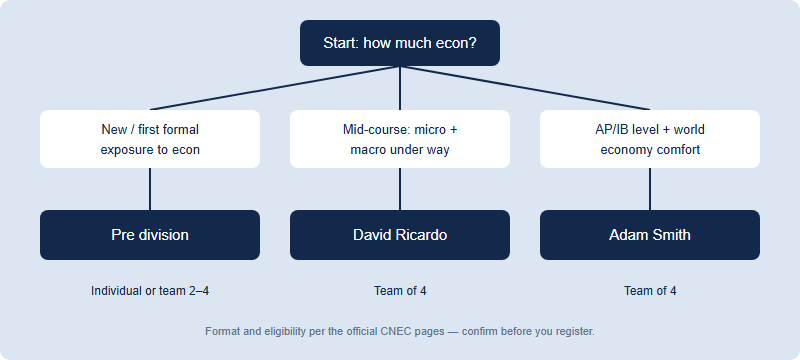
The three inputs, in order of priority
When families ask us which division to enter, the wrong first question is “which one looks most impressive.” The right sequence is experience, then team, then goal — because the first two are facts and the third is strategy. Work through them in that order and the choice usually makes itself.
- Experience (the gatekeeper). Be candid about how much micro and macro a student has actually been taught — not what they could cram. Pre is built as an on-ramp for students new to formal economics; David Ricardo assumes you are working through a course; Adam Smith additionally leans on the world/international economy that comes later in most syllabi.
- Team (the constraint). David Ricardo and Adam Smith are entered as a team of four. Pre can be entered individually or as a small team of 2–4. If you cannot reliably field four committed students, that single fact narrows the field before any content question.
- Goal (the tie-breaker). Only after experience and team should “what do I want this to signal” decide a close call — for example, a strong Year 11 student weighing a confident Ricardo finish against a stretch Adam Smith entry.
Notice the order protects students from the most common mistake: jumping a division because the name sounds better, then spending the season underwater on content they were never taught. A clean result one tier down almost always reads better than a struggling result one tier up.
A first-party pattern worth naming: across CNEC cohorts, the two decisions that go wrong most often are mirror images of each other. The first is an over-reach — a capable individual or pair stretching into a team division and then scrambling to recruit a fourth member who never really commits. The second is an under-reach — a course-completing team defaulting to Pre because it feels “safe,” when David Ricardo would have matched their study and given a stronger entry. Both come from skipping the experience-then-team sequence above. If you find yourself justifying a division by its prestige rather than by a student's taught content and a staffed team, that is the signal to step back to the framework before you register on the CNEC site.
A side-by-side you can decide from
The table below collapses the framework into the variables that actually move the decision. Treat the “best fit” column as a starting hypothesis to pressure-test against a specific student, not a label to apply on sight.
| Decision variable | Pre | David Ricardo | Adam Smith |
|---|---|---|---|
| Positioning | Entry / on-ramp | Intermediate | Advanced |
| Subject load | Micro + macro | Micro + macro | Micro + macro + world economy |
| Team format | Individual or 2–4 | Team of 4 | Team of 4 |
| Typical best fit | New to formal economics | Mid-way through a course | AP/IB level, returning competitors |
| Main risk if mis-chosen | Under-challenged | Format gap (no 4th member) | Drowning in unstudied world-economy content |
One nuance worth stating plainly: the jump from David Ricardo to Adam Smith is not just “harder questions” — it is an added subject (the world economy) carrying real weight. That is why a student comfortable with micro and macro can still be the wrong fit for Adam Smith if international economics is genuinely new to them. Conversely, a returning team that already met the world economy last season often finds Adam Smith the natural next step rather than a leap.
Worked examples: how the framework lands
Frameworks earn their keep on real cases. Here is how the same three inputs resolve four common CNEC profiles we see from international-school students. Names of rounds, dates and exact eligibility always sit with the official CNEC channels — these examples are about fit logic, not fixed rules.
- Grade 9, first economics elective, two keen friends. Experience is early, and they cannot field four. Pre — entered as a small team — lets them compete without pretending to a course they have not finished.
- Grade 11, mid-IB Economics, a stable group of four. Micro and macro are under way but the international unit is incomplete. David Ricardo matches the content they have actually covered, with the right team format.
- Grade 12, completed AP Microeconomics and Macroeconomics, returning from last year. Experience, team and goal all point up. Adam Smith is the honest fit, and the world-economy weighting plays to their strength.
- Strong Grade 10, ahead of the syllabus, but world economy untouched. A genuine tie-break. Here the safer first season is David Ricardo to win on covered content, then step up to Adam Smith once the international material is in hand.
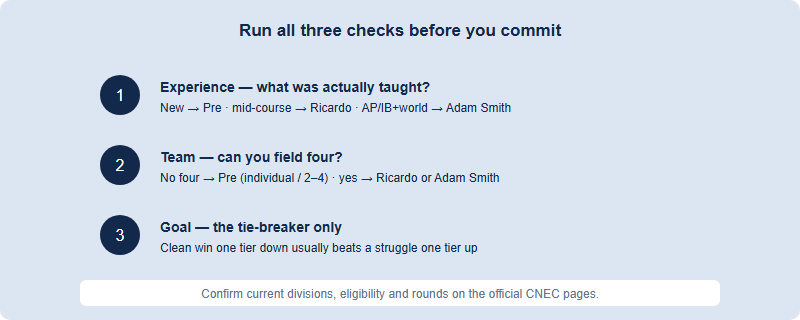
Sanity checks before you register
Once a hypothesis is on the table, run these final checks. Each one is a place where students quietly slip into the wrong division — and each is fixable before registration closes rather than after.
- Confirm the facts, don't assume them. Eligibility (grades and the under-20 cap), exact team sizes, fees, the round line-up and award structure are set officially. Verify the current season on the official CNEC channels rather than copying last year's figures.
- Match content to the calendar, not just the brain. If a student will have covered the world economy by competition time, Adam Smith may fit; if that unit lands after the contest, it does not yet.
- Stress-test the team's fourth seat. A team of four that is really three-plus-a-name is a weaker entry than a solid Pre attempt. Decide honestly.
- Plan the multi-year arc. Many of the strongest CNEC students progress across seasons — Pre or Ricardo first, Adam Smith later. Choosing slightly conservatively in year one keeps the upward story intact.
For single-division detail once you have decided, read our dedicated explainers on the NEC / CNEC site, and use the home page to navigate the round-by-round and preparation guides. The seven rounds (Qualifying Test, Super Econ, Quiz Bowl, Critical Thinking, Econ Lab, Econ Immersion and U20 Youth Voice) sit on top of whichever division you enter — so getting the division right first makes every later prep decision easier.
Frequently asked questions
Is a higher NEC division always the better choice for admissions?
No. A confident result in the right division reads better than a weak result in a harder one. Fit beats label.
Can I enter the Pre division on my own?
Pre allows an individual or a small team of 2–4, unlike David Ricardo and Adam Smith, which are teams of four. Confirm on the official CNEC pages.
What really separates David Ricardo from Adam Smith?
Both cover micro and macro; Adam Smith adds the world/international economy with real weight, so it suits students who have studied it.
How do I confirm this year's divisions and eligibility?
The CEE sets the official rules and CNEC runs the China round; always check the current divisions, dates and fees on the official CNEC channels.
Published by the NEC / CNEC editorial desk, operated by Hanlin Education as the officially authorized China National Economics Challenge (CNEC) test center. The NEC is run by the Council for Economic Education, which sets the official rules — always confirm current dates, divisions, fees and awards on the official CNEC channels. Errors are corrected within 7 working days.