
The NEC U20 Youth Voice round is a presentation event: you take a position on an economic issue that matters to young people, ground it in real economic reasoning, and deliver it as a clear, persuasive talk rather than a quiz answer. You win it by choosing a sharp, defensible stance early, supporting it with one or two solid economic mechanisms, and presenting with structure, evidence and composure — not by naming the most theory.
Most NEC guides — including several already on our own site — list all seven rounds and move on. This one stays on a single event: U20 Youth Voice, the round where the skill being tested shifts from “do you know economics” to “can you stand up and make an economic case.” The National Economics Challenge is run by the Council for Economic Education (CEE, founded 1949) and draws roughly 10,000 students a year in the United States across microeconomics, macroeconomics and world economics. The China National Round (CNEC) has been operated by Hanlin (SKT) since 2016, across 20+ provinces and 300+ schools, and is the official path from China into the NEC global rounds. The economic standard below comes from the CEE; the exact U20 format, timing, topic release and weighting can change season to season and division to division, so confirm those on the official CNEC channels before you build a plan around them.
What the U20 Youth Voice round is really testing
U20 Youth Voice is the round that asks you to be an economic communicator, not just an economic solver. Where the Qualifying Test rewards accuracy and the Critical Thinking round rewards reasoning you can defend under live questioning, Youth Voice rewards a prepared point of view: you choose, or are given, an economic issue with a generational angle — youth unemployment, the cost of higher education, housing affordability, automation and entry-level jobs, climate policy and growth — and you make the case for a position on it. The content still sits inside the same syllabus as every other round: micro, macro and the world economy. What changes is that the deliverable is a presentation, judged on how clearly and convincingly you connect an economic principle to a problem your peers actually live with.
That distinction trips up strong test-takers. Plenty of Chinese international-school students arrive with excellent textbook economics, clear the knowledge rounds comfortably, and then under-perform here because they treat Youth Voice as “say everything I know about the topic.” It is the opposite. A presentation that lists six causes of youth unemployment and recommends nothing is weaker than one that picks a single, well-argued lever and defends it. Because the precise task design — whether a topic is pre-released, how long you speak, whether it is individual or team, whether there is Q&A — can vary by year and division, treat the method below as the durable part and verify the mechanics on the official CNEC pages.
Build a position before you build slides
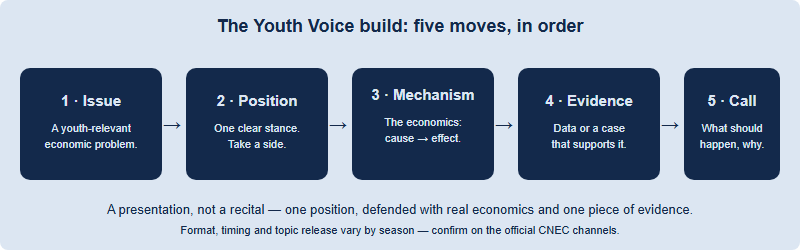
The most common failure in Youth Voice is a presentation that is informative but goes nowhere — lots of context about the problem, no clear answer. Fix it by writing your position in one sentence before you touch a slide deck or notecard: “Youth unemployment in [setting] is best addressed by [lever], because [economic mechanism].” Everything else in the talk exists to support that sentence. If a slide, statistic or anecdote does not advance the position, it is decoration, and decoration eats the clock you need for argument. Take a genuine side; a balanced “on the one hand, on the other hand” survey reads as indecision, and indecision is hard to score highly in a round literally called Youth Voice.
Ground that position in economics a judge can recognise. The strength of Youth Voice is that the topics are emotive and relatable; the trap is letting the talk become an opinion piece with no economic spine. Pick one or two core tools and use them properly: supply and demand to explain why a price or wage moves, elasticity to explain how strongly people respond, opportunity cost and incentives to explain behaviour, externalities to justify intervention, the labour market to frame jobs and wages. One mechanism explained cleanly — “a minimum-wage rise lifts pay for some workers and, depending on demand elasticity for labour, can reduce hours for others” — beats five economic terms dropped without a chain. And every economic case rests on assumptions; name your main one and why it is reasonable, because a stated assumption is a strength while a hidden one is a gap a judge will spot.
| Layer of the talk | What it must do | Common mistake | The fix |
|---|---|---|---|
| Hook (first 20 seconds) | Make the issue feel real and urgent to peers | Opening with a textbook definition | Lead with a concrete cost or person, then name the issue |
| Position | State your single stance in one sentence | Staying neutral; hedging across options | Commit to one lever and one reason |
| Economic mechanism | Show the cause-and-effect that backs the stance | Asserting outcomes with no chain | Name one model and walk each step out loud |
| Evidence | Anchor the claim with data or a case | Vague “studies show” with no specifics | One credible figure or example you can source |
| Call to action | Say what should change and end cleanly | Trailing off; no recommendation | One sentence: the lever, and the gain it buys |
Deliver it: structure, evidence and composure
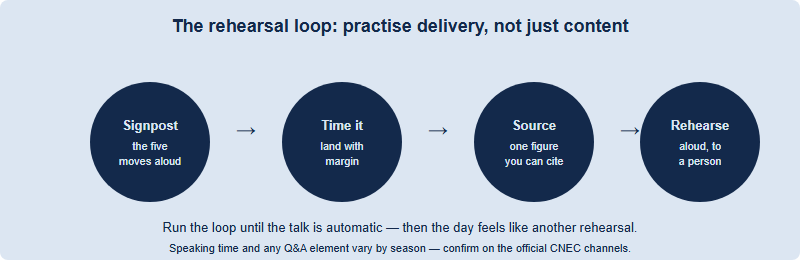
However a given season runs the U20 Youth Voice round, the same delivery principles apply: a strong economic position communicated as a flat, rambling read loses to a clear position delivered with structure and conviction. Signpost out loud so a listener never has to guess where you are — “Here is the problem; here is my position; here is the economics behind it; here is the evidence; here is what I recommend.” That spoken structure does double duty: it keeps you on your own build, and it makes you easy to follow and easy to score. Practise the talk against a clock until you land inside the time window with margin, because over-running and getting cut off mid-recommendation is one of the most avoidable ways to lose marks. Rehearse out loud, standing, ideally to another person — reading silently hides the pacing and filler problems that only surface when you speak.
Composure is the other half of the score, and it is trainable. If there is a question-and-answer element — confirm whether your division has one on the official CNEC channels — treat a challenge as a chance to show range, not a threat: anticipate the obvious objection while you prepare, concede the part that is genuinely fair, then hold your position with your strongest reason. Conceding a real trade-off does not weaken you; pretending it does not exist is what looks naive. Handle data honestly too — one figure you can actually source beats an impressive-sounding number you cannot, and a judge who senses an invented statistic will discount everything after it. The most transferable part of all this is that universities reward exactly these moves: interviews, supervisions and seminars all test whether you can take a position, support it with evidence, and defend it gracefully, which is why our CNEC preparation resources are built around rehearsed, spoken practice rather than silent reading.
A first-party note from running the China round
Across the CNEC, the most predictable place we see teams gain or lose ground in U20 Youth Voice is delivery, not economics knowledge. Students who can ace a multiple-choice paper often under-rehearse speaking, so the first time they present a position aloud is on the day — and the pacing, the filler words and the missing recommendation all show. Two habits separate the strong presentations we see from the forgettable ones. First, a position written in one sentence before any slides exist, so the whole talk pulls in one direction. Second, deliberate spoken rehearsal weeks ahead — timed, standing, in front of a coach or teammate who pushes back — so composure is built rather than hoped for. Allocating real time to how you present, not just what you know, is one of the highest-leverage decisions a team makes on the path through the China round and on toward the NEC global rounds. For the current divisions, formats and timelines, always check the official CNEC channels, since these are set by the organiser and can change each season.
Frequently asked questions
What is the NEC U20 Youth Voice round?
A presentation event where you take an economically grounded position on an issue affecting young people and deliver it persuasively, rather than answering quiz-style questions.
How is Youth Voice different from the Critical Thinking round?
Critical Thinking defends an open-ended argument under live questioning; Youth Voice is a prepared presentation, judged on how clearly you build and deliver a position.
How should I prepare a Youth Voice presentation?
Write your position in one sentence first, support it with one or two economic mechanisms and one sourced figure, then rehearse aloud and against a clock.
How long is the round and is there Q&A?
Speaking time, topic release and any Q&A element vary by season and division. Confirm the current U20 rules on the official CNEC channels.
Published by the NEC / CNEC editorial desk, operated by Hanlin Education as the officially authorized China National Economics Challenge (CNEC) test center. The NEC is run by the Council for Economic Education, which sets the official rules — always confirm current dates, divisions, fees and awards on the official CNEC channels. Any errors are corrected within 7 working days.