
Winning the live, timed rounds of the National Economics Challenge (NEC) is less about who knows the most and more about how four people behave in the seconds after a question lands. The strongest teams run three pre-agreed mechanics: a quiet signalling system so two people never answer over each other, a fast disagreement protocol that resolves a split before time runs out, and one person who owns the final commit on every contested call.
Why live-round collaboration is its own skill
The NEC, run by the Council for Economic Education (CEE, founded 1949), tests microeconomics, macroeconomics and the world / international economy and reaches roughly 10,000 students a year in the United States. Several of its rounds are live and time-pressured rather than solo written papers, and that changes the problem entirely. In a written test you fail by not knowing an answer; in a fast team round you can fail while every fact you need is sitting in the room — because nobody committed in time, two people talked at once, or a quiet disagreement burned the clock.
This article assumes the work that comes before competition day is already done. Who you recruit is a separate decision; which subject each person owns and how that maps to rounds is another; how you run weekly group practice is a third. Here the focus is narrower and rarely written down: the in-the-moment choreography of four people answering together against a clock. It is the layer that turns a well-prepared roster into points, and the layer that most teams never rehearse because solo revision feels more productive than practising a hand-off.
The CNEC — the China National Round, operated by Hanlin (SKT) since 2016 across 20+ provinces and 300+ schools, and the only official path from China to the NEC global rounds — sees the same pattern every cycle: the gap between a good team and a great one at the table is almost never raw knowledge. It is composure and coordination under time. Before locking any tactic below, confirm the current round list, timing and rules on the official CNEC channels, because formats are organiser-defined and can change by season and division.
Communication norms: talk less, signal more
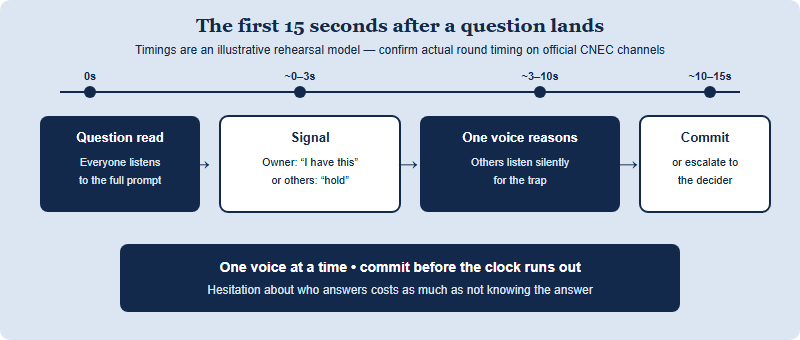
The first failure of an unrehearsed team in a live round is noise. A question is read, three people start reasoning aloud at once, and the genuinely correct voice gets lost in the cross-talk. The fix is counter-intuitive: under time pressure, a team should speak less and rely on a small set of agreed signals so information moves without everyone broadcasting at the same time.
Design a tiny vocabulary of signals before the event and drill it until it is automatic. It does not need to be elaborate — three or four gestures cover almost everything a fast round demands. The goal is that a teammate can communicate “I'm confident, route to me,” “I'm unsure, don't rely on me here,” or “wait, I see a problem” without spending words the clock cannot spare.
| Signal | Meaning | When it is used |
|---|---|---|
| Hand flat on table | “I have this — route it to me” | The subject owner is confident and ready to lead the answer |
| Open palm / small pause gesture | “Hold — I see a problem” | Someone spots an error or a trap before the team commits |
| Slight head shake | “Not my strand / I'm unsure” | Quietly passes the lead on without saying it aloud |
| Tap + nod to a teammate | “You take it” | Explicit, silent hand-off to the right owner |
Two norms make the signals work. First, one voice answers at a time — whoever is signalled to lead says the answer, and the others stay quiet unless they flash the “hold” signal. Second, the supporting members listen for the trap, not the glory: their job in that moment is to catch the error the leader might miss, not to compete to be the one who speaks. A team that internalises “talk less, signal more” converts faster and makes fewer self-inflicted mistakes than one that debates every question in the open.
Resolving disagreement before the clock does
Sometimes two teammates genuinely disagree on the answer, and the clock is moving. This is where unrehearsed teams lose: they argue, or one person stubbornly insists, and the buzzer or the time limit decides for them. A live round is not the place to relitigate economic theory — it is the place to resolve and commit. The way to do that is to agree, in advance, exactly how a split gets settled fast.
A workable protocol has three steps, each capped to keep it short:
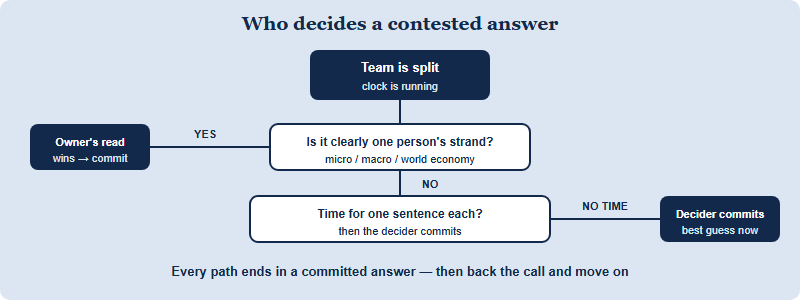
- One sentence each. Each side gives a single, compressed reason — “it's B because the tariff raises the domestic price” — not a full argument. If you cannot say it in one breath, you do not have time to say it.
- Defer to the strand owner. If the question sits in one person's subject, their read wins by default. The macro owner's call on a monetary-policy question carries more weight than a guess from outside the strand.
- If still split, the decider commits. When ownership does not break the tie, one pre-named person makes the final call and the team answers it — even if a member privately disagrees. A committed answer from the decider beats a perfect answer that arrives after time.
The emotional discipline matters as much as the steps. Agree as a team that being overruled is not personal: once the decider commits, everyone backs the call out loud and moves to the next question rather than sulking or re-arguing. The cost of a lingering disagreement is not just one question — it is the three questions afterward that the rattled team fumbles. Reset fast, and a wrong answer costs only its own points.
Notice what this protocol does not do: it does not try to guarantee the team is always right. Under time, the goal is the best decided answer, not consensus. Teams that chase unanimous agreement on every question run out of clock; teams that can disagree, resolve and commit in a few seconds keep pace and bank more answers overall.
Owning the split-second decision
The single most useful pre-event decision a team can make is naming who owns the commit — the call to lock an answer when time is nearly up and the team is not unanimous. This is not the captain by default, and it is not about being the best economist. The decider needs nerve under pressure, the judgment to read how confident the team actually is, and the willingness to be wrong on the record. Some teams appoint one decider for the whole event; others rotate it by round type, letting the relevant strand owner decide on their territory.
Decision ownership also means a clear rule for the clock. Agree a simple trigger — for example, “when the timer hits the last few seconds, the decider commits whatever we have, even a best guess” — so the team never freezes into a non-answer. In rounds where there is no penalty for a wrong answer, a committed guess strictly dominates silence; where rules differ, that calculus changes, so confirm the scoring and any wrong-answer penalty for each round on the official CNEC channels before deciding how aggressively to guess. The decider's job is to apply whatever that agreed rule is, instantly, without a fresh debate.
Rehearsing the choreography — and the mistakes to avoid
None of this survives contact with a real round unless you practise the choreography, not just the content. Build a few mock live rounds into your group sessions specifically to drill the mechanics: have one person fire questions while the team practises signalling, deferring and committing against a visible timer. You are not only checking whether they know the economics — you are checking whether the hand-offs are smooth and the commit happens on time. For how to structure those sessions overall, see the wider CNEC overview; the point here is to reserve part of that practice for pure coordination reps.
A handful of collaboration errors recur across teams new to the live format:
- Everyone talking at once. The most common and most fixable. Without a one-voice rule and signals, the right answer drowns in cross-talk.
- No named decider. When nobody owns the commit, contested questions die in indecision and the clock answers for the team.
- Re-arguing a settled call. Continuing to debate after the decider commits rattles the team into fumbling the next questions. Back the call and reset.
- Chasing consensus on everything. Insisting all four agree on every question burns time. Aim for the best decided answer, not unanimity.
- Never rehearsing hand-offs. Knowing the roles is useless if the team has only practised solo. Coordination is a drilled reflex, not a plan on paper.
Done well, live-round collaboration is the multiplier on everything else a team built in the months before: the recruiting, the role ownership, the study routine. Four prepared individuals who can signal, resolve and commit as one unit will out-score four equally prepared individuals who freeze, talk over each other, or argue past the buzzer — which is exactly why the NEC makes its hardest rounds a team event.
Frequently asked questions
How do you stop teammates answering over each other in a live round?
Agree a one-voice rule plus a few silent signals in practice, so the signalled owner answers while the others listen for traps rather than competing to speak.
What if two teammates disagree with seconds left?
One compressed sentence each, defer to the strand owner if it is their subject, and if still split the pre-named decider commits the call immediately.
Who should make the final call when the team is split?
A pre-named decider with composure under pressure — not necessarily the strongest economist. Some teams rotate the role by round or subject strand.
Should we guess when unsure in a live round?
It depends on whether that round penalises wrong answers. Confirm the scoring rules on the official CNEC channels, then set your clock-and-guess rule accordingly.
Published by the NEC / CNEC editorial desk, operated by Hanlin Education as the officially authorized China National Economics Challenge (CNEC) test center. The NEC is run by the Council for Economic Education, which sets the official rules — always confirm current dates, divisions, fees and awards on the official CNEC channels. Any error will be corrected within 7 working days.