
For an open-ended NEC problem, the reliable method is a four-step thinking framework you run on paper before you say a word: define the real question, model it with one chosen tool, evaluate the trade-offs each side faces, and conclude on balance. This is the analytical engine — how you reason through an unfamiliar prompt — not how you present it. Same four moves, any topic, every time.
Most NEC guides — including several already on our own site — survey divisions, schedules and the seven rounds, then stop. This one stays on a single skill: the analytical method you apply to an open-ended economic problem at your desk, before any presentation. A companion piece on our site covers delivering and defending that argument out loud; here we sit one level earlier, on the thinking itself. The National Economics Challenge is run by the Council for Economic Education (CEE, founded 1949) and draws roughly 10,000 students a year in the United States across microeconomics, macroeconomics and world economics. The China National Round, CNEC, has been operated by Hanlin (SKT) since 2016, across 20+ provinces and 300+ schools, and is the official path from China into the NEC global rounds. The economic standard below comes from the CEE; exact formats, weighting and timing change season to season, so confirm those on the official CNEC channels.
Why open-ended problems break recall-strong teams
An open-ended economics problem is not a question with a stored answer. You are handed a scenario — a proposed tax, a new subsidy, a shift in trade policy — and asked to analyse it, not to recall a definition. The content lives inside the same syllabus as every other NEC round: micro, macro and international economics. What changes is that no single memorised fact resolves the prompt. You have to build the answer from principles, in order, under a clock.
This is exactly where students with excellent textbook economics stall. Plenty of Chinese international-school students arrive having mastered AP or A-Level material, clear knowledge-heavy rounds comfortably, and then meet an open prompt with no obvious “right answer” and freeze — or, more commonly, write a sprawling response that names five concepts and resolves none. The cause is not a knowledge gap. It is the absence of a repeatable procedure for converting principles into a structured analysis. A team that drills definitions but never drills a method will keep producing answers that are full of economics yet short of an argument.
The fix is to treat analysis as a process with fixed steps, the way you would treat solving an integral or balancing a redox equation. You do not improvise the order; you run the framework. Below is the four-step version we teach teams preparing for the China round — durable across topics, and deliberately separate from delivery, which is a different skill for a different moment.
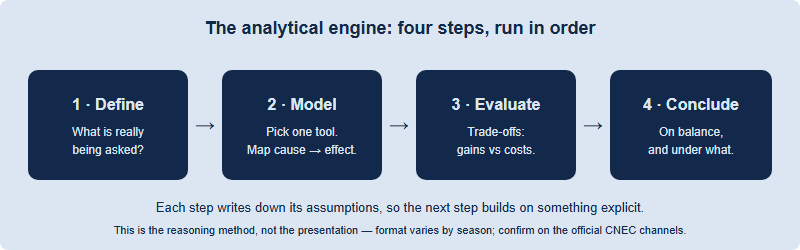
Step 1 & 2 — Define the real question, then choose one model
Define. The first mistake is answering the prompt you wish you had been given. Before modelling anything, restate the problem in one precise sentence: what is the actual decision, who are the agents, what is the time horizon, and is the question positive (what will happen?) or normative (what should be done?). “Should the city raise its minimum wage?” and “What happens to employment if the city raises its minimum wage?” demand different analyses; conflating them produces a muddled answer. Defining the question also exposes scope: a national policy and a single-market policy do not behave the same way, and naming which one you are analysing keeps you honest for the rest of the framework.
Model. Open-ended economics is tractable because almost every prompt maps to one of a small toolkit of standard models. The discipline is to choose one driver and commit, rather than gesturing at three. Supply and demand handles most price and quantity questions; elasticity tells you how sharply quantities respond; the production-possibilities and comparative-advantage frame handles trade; the multiplier and aggregate demand-supply frame handles macro shocks; marginal analysis handles “how much” decisions; externalities and public goods handle market-failure prompts. Pick the model that yields the cleanest causal chain for your defined question, then map cause to effect explicitly — name the curve that shifts, the direction it shifts, and the new outcome it implies.
| If the prompt is about… | Reach first for… | The chain it gives you |
|---|---|---|
| A price floor or ceiling, a tax or subsidy | Supply & demand + elasticity | Which curve shifts → surplus/shortage → who bears it |
| A tariff, quota or “should we trade?” | Comparative advantage / PPF | Opportunity cost → gains from trade → domestic winners & losers |
| A recession, stimulus or rate change | AD–AS + the multiplier | Which aggregate shifts → output & price level → lag & leakage |
| Pollution, a vaccine, a public park | Externalities / public goods | Private vs social cost → over/under-provision → corrective tool |
| “How many / how much should X do?” | Marginal analysis | Marginal benefit vs marginal cost → optimum where they meet |
Step 3 — Evaluate the trade-offs, not just the headline effect
Economics is the study of choices under scarcity, so an analysis that names only the intended effect is incomplete on its face. Step 3 is where you force out the other half of every claim. A minimum-wage rise may lift incomes for some workers and reduce hours for others, with the balance hinging on how elastic labour demand is. A tariff may protect a domestic industry and raise prices for consumers, shrink total surplus, and invite retaliation. A stimulus may close an output gap and arrive with a lag, leak into savings, or add to debt. You are not required to resolve every tension perfectly; you are required to see it, and to say which way the net effect leans given your model.
The professional habit that makes Step 3 robust is sensitivity: ask which assumption your conclusion depends on, and what would flip it. “This policy reduces consumption if demand is price-elastic; if demand is inelastic, the effect is small and the burden falls mostly on consumers.” That single move — stating the hinge assumption and its alternative — turns a flat assertion into genuine economic reasoning. It is also the most efficient way to handle uncertainty: rather than pretend the data resolves the question, you make the conditionality explicit and show you understand what the answer is contingent on. Welfare framing helps here too — translating effects into who gains, who loses, and what happens to total surplus keeps the evaluation grounded in economics rather than opinion.
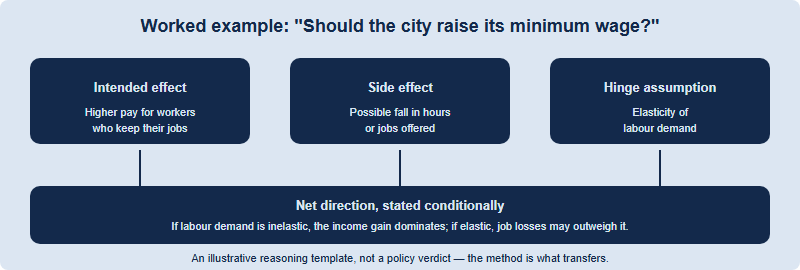
Step 4 — Conclude on balance, and stress-test before you commit
A conclusion is not a summary; it is a verdict. Step 4 returns to the question you defined in Step 1 and answers it directly, on balance, in one decisive sentence — then attaches the single assumption it most depends on. “On balance, a modest minimum-wage increase raises low-end incomes with limited employment cost, provided local labour demand is relatively inelastic” is a conclusion. “There are arguments on both sides” is not; it is a refusal to reason. The framework exists precisely so that, by the time you reach Step 4, you have earned a position rather than dodged one.
Before you lock it in, run a fast internal stress-test — the analytical equivalent of checking your work. Three questions catch most errors: Does my conclusion actually answer the question I defined, or a different one? Is each link in my causal chain a real mechanism, or did I assert an outcome? Have I named the assumption that, if reversed, would change my answer? This self-check is internal and silent; it is part of thinking, distinct from defending the argument aloud once you present it. Repeated case write-ups under time, each one stress-tested this way, are the most reliable preparation, and they are the structure our CNEC preparation resources are built around.
First-party note from running the China round. The teams that gain the most ground on open-ended problems are rarely the ones who know the most economics — they are the ones who run the same procedure every time. Students who only ever practise multiple-choice recall meet their first genuinely open prompt on the day, with no method to fall back on, and it shows in answers that are knowledgeable but unstructured. Teams that internalise a define-model-evaluate-conclude routine weeks in advance produce cleaner analysis under pressure, almost regardless of the specific topic. Drilling the framework — not just the content — is one of the highest-leverage decisions a team makes on the path through the China round.
Frequently asked questions
What is the four-step framework for open-ended NEC problems?
Define the real question, model it with one chosen tool, evaluate the trade-offs each side faces, then conclude on balance. Run the steps in order, every time.
How is this different from the Critical Thinking defense guide?
This covers the analytical thinking you do on paper; the defense guide covers presenting and defending that argument aloud. Two skills, two separate moments.
How do I choose the right economic model for a prompt?
Map the problem type to one standard tool — supply and demand, elasticity, comparative advantage, AD–AS, externalities or marginal analysis — and commit to the one that gives the cleanest causal chain.
Does this framework match the official NEC round format?
It is a durable reasoning method, not an official rule. Exact formats, weighting and timing change by season and division — confirm current details on the official CNEC channels.
Published by the NEC / CNEC editorial desk, operated by Hanlin Education as the officially authorized China National Economics Challenge (CNEC) test center. The NEC is run by the Council for Economic Education, which sets the official rules — always confirm current dates, divisions, fees and awards on the official CNEC channels. Any errors are corrected within 7 working days.