
Behavioral economics and decision-making under uncertainty show up in the National Economics Challenge (NEC) wherever a question moves past "what does a rational agent do?" into "what do real people do, and why?" Expect expected-value reasoning, risk versus uncertainty, and well-documented biases that bend the standard rational-choice model. Treat the depth below as concepts that can appear, and confirm the official scope on the CNEC channels.
Where behavioral economics fits in the NEC syllabus
The NEC is run by the Council for Economic Education (CEE), founded in 1949, and tests three subject pillars: microeconomics, macroeconomics, and the world / international economy. Roughly 10,000 US students take part each year. Behavioral economics is not a fourth pillar standing on its own; it lives inside microeconomics, as the part of consumer- and producer-theory that asks how individuals actually choose when outcomes are uncertain. So when you study demand, marginal analysis, or market efficiency, the behavioral layer is the "but humans deviate" commentary sitting on top.
This matters for how you prepare. The standard model assumes a rational agent who maximizes expected utility with stable, consistent preferences. Behavioral economics catalogues the systematic ways that assumption breaks: people overweight small probabilities, feel losses more than equivalent gains, and anchor on irrelevant numbers. A strong NEC competitor can hold both models in mind — derive the textbook prediction, then explain the behavioral deviation — rather than treating them as rivals.
For a refresher on the divisions and how the rounds escalate in difficulty, the CNEC home page is the anchor reference. Below we focus only on the behavioral / uncertainty slice, which is distinct from the strategic-interaction (game-theory) material covered elsewhere on this desk: game theory studies choices between players; behavioral economics studies how one decision-maker handles risk, probability, and their own cognitive shortcuts.
Expected value, risk, and the difference between risk and uncertainty
The quantitative backbone of this topic is expected value (EV): the probability-weighted average of every possible outcome. If a choice offers a 40% chance of +100 and a 60% chance of −50, its EV is (0.40 × 100) + (0.60 × −50) = 40 − 30 = 10. NEC rounds that include data interpretation or short calculations reward students who can set up an EV table cleanly and read the result without arithmetic slips.
But EV alone does not predict real behavior, and that gap is the heart of behavioral economics. Two distinctions do the heavy lifting:
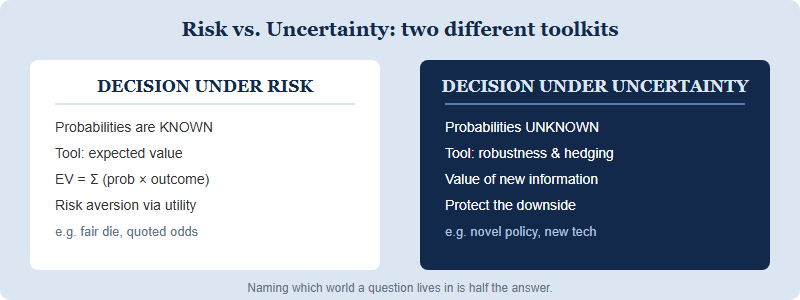
- Risk vs. uncertainty. Under risk, you know the probabilities (a fair die, a quoted odds). Under uncertainty (sometimes called Knightian uncertainty), you do not — there is no reliable probability to plug in. Policy questions about new technologies, pandemics, or untested regulation are uncertainty problems, and they cannot be solved by EV alone.
- Expected value vs. expected utility. A risk-averse person values a certain $50 more than a 50/50 gamble worth $50 in EV, because the utility of money is concave — each extra dollar adds less satisfaction. This is why insurance exists even though insurers profit on average.
A useful self-check: if a prompt gives you probabilities, it is a risk problem and EV / expected-utility logic applies. If it withholds them or asks about a genuinely novel event, name it as uncertainty and reason about robustness, downside protection, and information value instead of pretending you can compute a precise number. Inventing a probability the question never gave you is a classic avoidable error.
The biases most likely to surface — and how to use them
Behavioral economics is best known for a catalogue of cognitive biases. You do not need to memorize dozens; you need to recognize a handful precisely and deploy them where a question is clearly probing "why did people behave irrationally?" The most exam-relevant ones cluster around how we judge probability, value, and reference points.
| Concept | What it means | Where it can appear in an NEC prompt |
|---|---|---|
| Loss aversion | Losses feel roughly twice as painful as equivalent gains feel good | Why consumers resist price increases more than they welcome cuts; endowment effects |
| Anchoring | An initial number drags later estimates toward it, even when irrelevant | Pricing, salary negotiation, "was $200, now $120" framing |
| Availability heuristic | Vivid, recent events feel more probable than they statistically are | Over-insuring against rare disasters; demand shocks after news events |
| Present bias / hyperbolic discounting | We over-value immediate payoffs versus future ones, inconsistently | Under-saving, procrastination, why "default" enrolment lifts pension uptake |
| Framing effect | The same facts described as a gain vs. a loss change the choice | "90% survival" vs. "10% mortality"; tax framed as cost vs. forgone gain |
| Overconfidence / overweighting small probabilities | People misjudge the odds of rare events in both directions | Lottery demand alongside insurance demand by the same person |
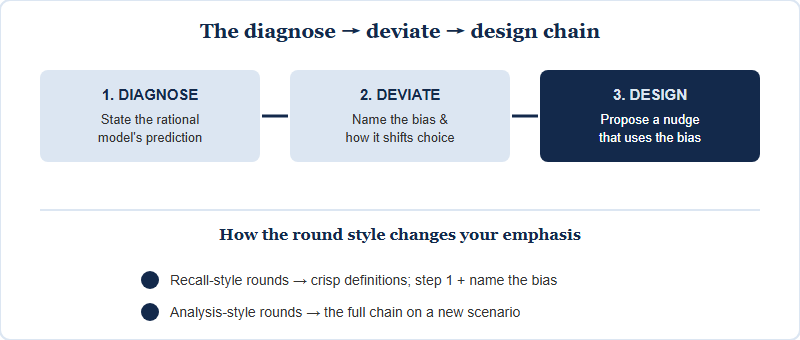
The exam-craft move is to diagnose then deviate. First state what the rational-agent model predicts; then name the specific bias and explain how it pushes behavior away from that prediction; finally, where relevant, note the policy lever (a "nudge" such as a smart default, clearer framing, or a cooling-off period) that works because of the bias. Listing biases without tying them to a prediction and a consequence reads as memorized trivia; the diagnose-deviate-design chain reads as economic reasoning.
One caution that doubles as a fact-check discipline: behavioral economics is an active research field, and many results carry caveats or have been re-examined. In a written or oral answer, it is safer to attribute strong claims ("losses loom about twice as large as gains") as findings from the behavioral literature rather than iron laws, and to avoid stating a specific magnitude as settled fact when the question does not supply one.
Which NEC rounds reward this thinking
The NEC runs seven rounds — Qualifying Test, Super Econ, Quiz Bowl, Critical Thinking, Econ Lab, Econ Immersion, and U20 Youth Voice. Behavioral and uncertainty material can surface anywhere economics does, but the style of each round changes how you should use it. Recall-style rounds reward crisp definitions; analysis-style rounds reward the diagnose-deviate-design chain on a fresh scenario.
Because the exact content, weighting, and format of each round are set by the organiser and can change year to year, do not treat the mapping above as a guarantee that any single round will feature a behavioral question. Use it to allocate practice, not to predict the paper. The current, authoritative breakdown of rounds and how China competitors progress to the global stage sits on the official CNEC site; always cross-check there before you lock in a study plan.
A first-party study sequence for the behavioral / uncertainty topic
From running CNEC, the China National Round of the NEC, since 2016 across 20+ provinces and 300+ schools, the desk has watched where international-school students gain and lose marks on this material. Three patterns recur, and each suggests a concrete practice habit.
- Lock the EV mechanics before the psychology. Students who can set up an expected-value table in under a minute free up attention for the harder behavioral interpretation. Drill 10–15 clean EV / expected-utility calculations first; the biases are far easier to discuss once the quantitative floor is solid.
- Build a six-bias vocabulary, not a thirty-bias one. Depth beats breadth. Knowing loss aversion, anchoring, availability, present bias, framing, and probability misweighting well enough to apply outperforms a long list you can only define.
- Practice the deviation explicitly. For each bias, write one sentence of the form: "A rational agent would X; because of [bias], real consumers instead Y; a policymaker could nudge with Z." That single template covers most of what an analysis round wants.
Pair this with the broader micro foundations — demand, elasticity, marginal analysis, market failure — because behavioral arguments are most persuasive when anchored to the standard model they modify. CNEC's preparation materials and past-paper style sets, available through the CNEC preparation resources, are organized so the behavioral layer reinforces, rather than replaces, the core microeconomics. The CEE sets the academic standard for what "counts" as a correct economic argument; Hanlin's role as the authorized China test center is to run the round and help students meet that standard.
Frequently asked questions
Is behavioral economics formally tested in the NEC?
It can surface inside the microeconomics pillar as choice under risk and bias. Treat it as in-scope-adjacent and confirm the official scope on the CNEC channels.
What is the difference between risk and uncertainty?
Under risk the probabilities are known, so expected value applies. Under uncertainty they are unknown, so you reason about robustness and downside instead.
How many biases should I actually study?
Six applied well beats thirty memorized: loss aversion, anchoring, availability, present bias, framing, and probability misweighting cover most prompts.
Does this overlap with game theory?
No. Game theory is strategic choice between players; behavioral economics is how a single decision-maker handles probability, value and their own biases.
Published by the NEC / CNEC editorial desk, operated by Hanlin Education as the officially authorized China National Economics Challenge (CNEC) test center. The NEC is run by the Council for Economic Education, which sets the official rules — always confirm current dates, divisions, fees and awards on the official CNEC channels. Any error is corrected within 7 working days.