
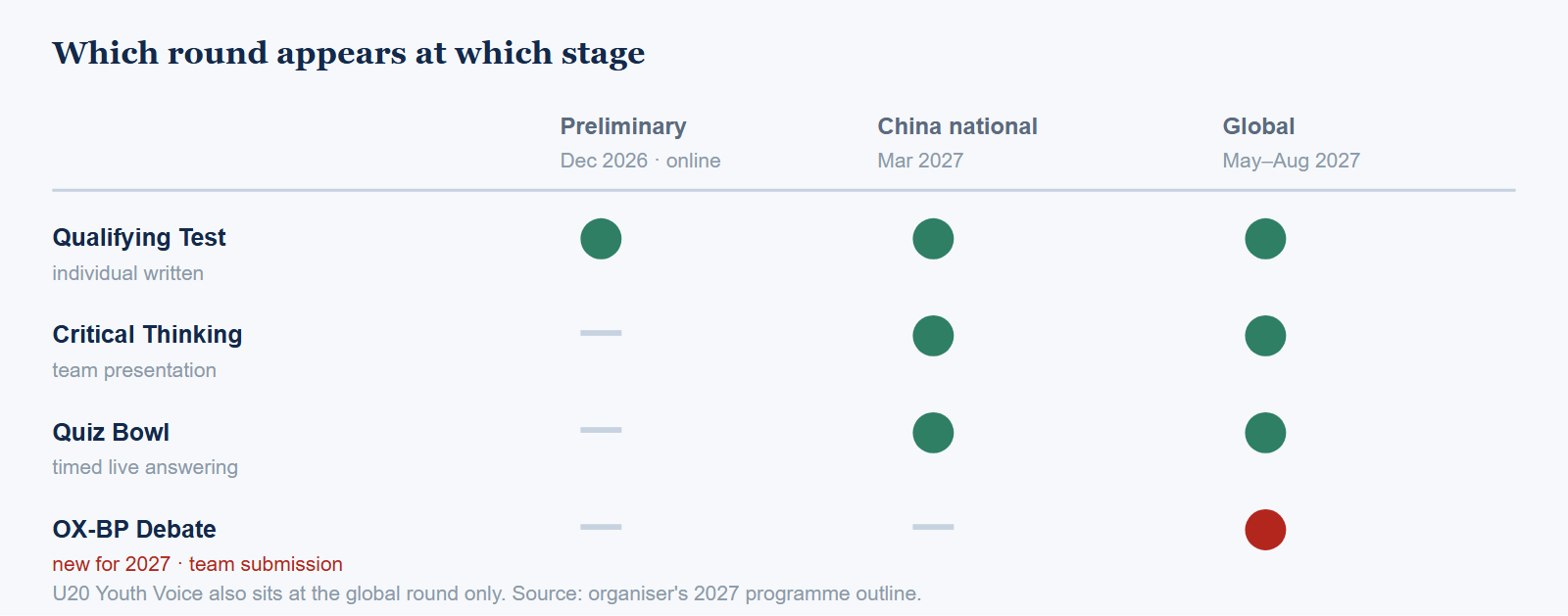
The 2027 CNEC programme outline lists five rounds, and they do not all happen at the same stage. The Qualifying Test runs at all three stages. Critical Thinking and the Quiz Bowl start at the China national round. The OX-BP Debate Sessions — new for 2027 — and U20 Youth Voice appear only at the global round. Knowing which stage you are actually training for matters more than knowing all five names.
This article has been rewritten against the organiser’s 2027 outline. The version that stood here described a seven-round line-up including Super Econ, Econ Lab and Econ Immersion. Two of those no longer appear in the published outline and one has moved out of the competition entirely — the section near the end sets out exactly what we can and cannot say about that.
What the 2027 outline lists, and where each round appears
| Round | Mode | Preliminary | China national | Global |
|---|---|---|---|---|
| Qualifying Test | Individual written | ✓ | ✓ | ✓ |
| Critical Thinking | Team presentation | — | ✓ | ✓ |
| Quiz Bowl | Timed live answering | — | ✓ | ✓ |
| OX-BP Debate Sessions (new) | Team submission | — | — | ✓ |
| U20 Youth Voice | Team presentation | — | — | ✓ |
The practical reading of that table is blunt: if you are sitting the December preliminary, you are training for one round. Everything else is a problem for the team that advances. Families who spend the autumn rehearsing presentations are preparing for March, not December — which is fine if that is a deliberate choice, and wasteful if it is not.
The Qualifying Test: the only round that decides December
Per the outline, the Qualifying Test is primarily objective questions covering microeconomics, macroeconomics and international economics, and it is described as testing not only knowledge but the ability to apply economics reasoning. It is the one round every entrant sits, at every stage.
Two things follow. First, syllabus breadth beats depth here — a team that knows nine topics fluently and three not at all loses more marks than one that knows all twelve reasonably. Second, the December sitting is where the Pre division’s individual entry is allowed; from the China round onward, entry is team-based. Our pacing and guessing guide covers how to work a timed objective paper without leaving marks on the table.
Critical Thinking: two different tasks with one name
This is the round most often misunderstood, because the task is not the same at the two stages where it appears. Per the outline:
- At the China national round — the team gathers its own material around a case and writes a report applying economic theory.
- At the global round — a timed, closed-book policy analysis.
Both end in a presentation and defence in front of judges. That difference matters for how you train: the China round rewards research discipline and the ability to structure an argument over days; the global round rewards being able to produce a defensible line of reasoning with no reference material and a clock running. A team that only ever practised the first will find the second uncomfortable. Our guide to defending Critical Thinking work covers the question-and-answer half, which is where prepared teams most often lose ground.
Quiz Bowl: recall speed under a buzzer
Per the outline, the Quiz Bowl puts top teams on stage for timed answering, testing economics background and, in the organiser’s framing, the limits of a team’s responsiveness. It is the round that most rewards drilling and lane assignment — deciding in advance who answers what — rather than deeper analysis. We break the format and a training routine down in our Quiz Bowl guide.
OX-BP Debate Sessions: the new global-round element
This is the significant addition for 2027, and it is a different kind of exercise from everything above. Per the outline it runs as a sequence at Oxford: an Academic Visit through the university’s historic buildings, a MasterClass with Oxford academics, and then Tutorial Forge — the tutorial-style session the organiser describes as where rough intuitions are repeatedly challenged and rebuilt into rigorous argument. The output is a Statement: the participant’s own reasoned economic position, drawn from the visit, the masterclass and the tutorial.
Two honest observations. It is listed as a team submission and appears only at the global round, so no team should be building a season around it before they have advanced. And because it is new, there is no track record to describe — we will not invent one. What we can say is that the format rewards a skill the other rounds do not directly test: holding a position under sustained questioning and then writing it down precisely.
U20 Youth Voice: the outward-facing round
Per the outline, U20 Youth Voice invites global youth teams to examine major economic issues, selecting the most influential voices and work for public presentation, with the strongest pieces receiving joint recommendation from academic and industry bodies. It is a team presentation at the global round only. Of the five, it is the one whose product most resembles something a student can point to afterwards.
What happened to Super Econ, Econ Lab and Econ Immersion
This deserves a straight answer, because our earlier guidance listed all three as competition rounds and readers will notice they are gone from the table above.
| Former round | Where it stands in the 2027 outline |
|---|---|
| Super Econ | Still runs, but in the club programme — an online leaderboard activity from September to November, not a competition round |
| Econ Lab | Not listed. We are not going to tell you it has been cancelled, because the outline is a summary document and its absence is not the same as a withdrawal |
| Econ Immersion | Not listed, on the same basis |
The distinction between “moved” and “unlisted” is worth keeping. Super Econ we can place precisely, because the outline names it under the club programme. Econ Lab and Econ Immersion we cannot — and the responsible thing is to say so rather than to fill the gap in either direction.
Building a round-aware training plan
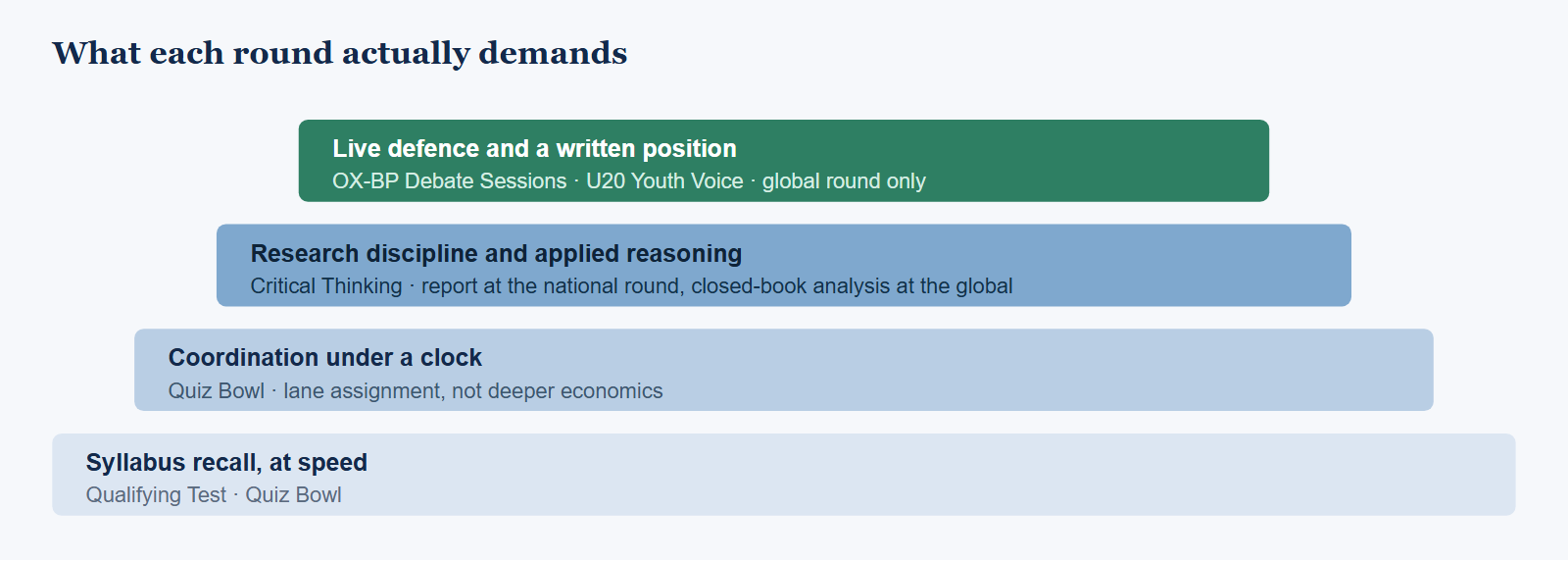
A plan that follows the table rather than the vocabulary looks like this. Autumn: the Qualifying Test is the only thing that decides whether your season continues, so breadth of syllabus is the whole job. December to March: if you advance, add the two team rounds — a case report you can research and structure, and buzzer drills with assigned lanes. Beyond March: the global-round elements become real, and the skill they need — holding a position under questioning — is the slowest of all to build, which is an argument for starting it the week you advance rather than the month before.
If you have not yet chosen a division, our guide to the 2027 divisions and team rules covers the entry requirements and the team-size rules that catch families out, including the fourth division added for 2027.
Frequently asked questions
How many rounds does CNEC have?
The 2027 programme outline lists five: the Qualifying Test, Critical Thinking, the Quiz Bowl, the OX-BP Debate Sessions and U20 Youth Voice. They do not all appear at every stage — only the Qualifying Test runs at all three.
Which rounds does the December preliminary include?
Per the outline, the Qualifying Test only. The team rounds begin at the China national round.
What are the OX-BP Debate Sessions?
A global-round element new for 2027, run at Oxford as an Academic Visit, a MasterClass and a Tutorial Forge, producing a written Statement. It is listed as a team submission.
Is Super Econ still a round?
Not in the 2027 outline. It appears there under the club programme as a September-to-November online leaderboard activity rather than a competition round.
Are Econ Lab and Econ Immersion still running?
They are not listed in the 2027 outline. That is not the same as a confirmed withdrawal, and we are not going to present it as one — confirm the definitive round list with the organiser.
This page is maintained by the CNEC-authorised test centre operated by Hanlin International Education. Round formats, sequence and weighting are set by the organising committee and are reviewed each cycle; the National Economics Challenge itself is run by the Council for Economic Education. Confirm the definitive 2027 line-up on the official CNEC channels before planning around any single round. Rewritten on 28 August 2026 against the organiser’s 2027 programme outline; the earlier version of this article described a seven-round line-up that outline no longer sets out.