
The short answer: the National Economics Challenge (NEC) is a timed, team-based test competition spanning microeconomics, macroeconomics and world economy, while the LSESU Economics Society Essay Competition and the Harvard International Economics Essay Competition (HIEEC) are individual long-essay competitions. They reward different skills, and the strongest applicants often do both.
Two different sports, both called "economics competition"
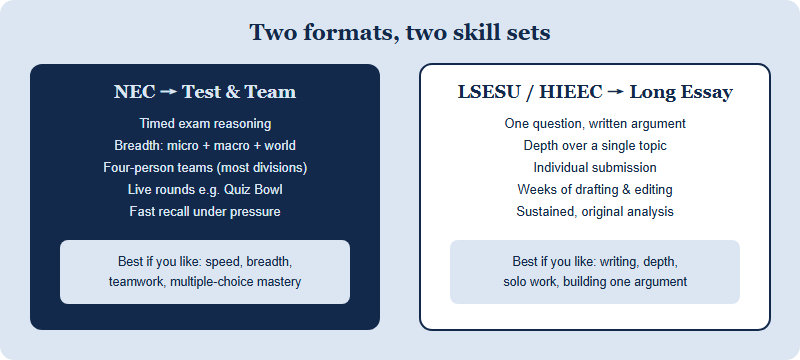
Students searching for economics competitions usually pile NEC, LSESU and HIEEC into one list and assume they are interchangeable. They are not. NEC measures how fast and accurately you can reason across breadth under exam conditions, and how well you perform as part of a four-person team. The essay competitions measure how deeply you can argue one question in writing, alone, over weeks.
NEC is run by the Council for Economic Education (CEE), founded in 1949, and reaches roughly 10,000 students a year in the United States. In China, the official China National Round is CNEC, operated by Hanlin (SKT) since 2016 across 20+ provinces and 300+ schools, and is the only official path from China onward to the NEC global rounds. The essay competitions, by contrast, are organised by university student societies (LSESU at the London School of Economics; HIEEC by the Harvard Undergraduate Economics Association). Exact divisions, dates, fees, eligibility and awards differ by competition and by year, so always confirm specifics on each competition's official channels.
What NEC actually tests (the test-and-team format)
NEC's academic backbone is the same three subject areas regardless of where you compete: microeconomics, macroeconomics and world/international economy. Where it differs sharply from an essay contest is in how you are assessed. NEC runs through a sequence of rounds rather than a single submitted document. Per the organiser’s 2027 outline, these include the Qualifying Test, Critical Thinking and the Quiz Bowl, with the OX-BP Debate Sessions and U20 Youth Voice at the global round. Some are individual-style timed assessment; others, like Quiz Bowl, are live and unmistakably a team event.
NEC is also organised by division, which lets students enter at a level that matches their experience. Per the organiser, there are three:
| Division | Level | Team structure (per the organiser) |
|---|---|---|
| Pre | Entry | Individual, or a team of 2–4 |
| David Ricardo | Intermediate | Must be a team of 4 |
| Adam Smith | Advanced (no entry barrier) | Team of 4 |
That structure matters for how you choose. If you thrive on rapid recall, enjoy switching between supply-and-demand graphs and macro policy in the same sitting, and want the camaraderie (and accountability) of a four-person team, NEC plays to your strengths. The flip side: you cannot hide a thin understanding behind one polished paragraph. NEC's breadth means weak spots in any of the three subject areas surface quickly under the clock. The exact number of rounds you face, their timing, scoring weights, fees and the route from CNEC to the global rounds are all set by the organiser and can change year to year, so treat the official CNEC schedule and rules as the authority.
What the essay competitions test (the long-essay format)
LSESU and HIEEC ask for something NEC never does: a single, sustained piece of written economic reasoning. You typically choose one prompt from a short list, then build an original argument supported by economic theory and evidence, within a word limit, over a period of weeks. There is no Quiz Bowl, no team, no multiple-choice speed test. The whole competition is your written argument and how well it holds together.
This rewards a different student profile. The essay competitions favour those who can narrow a broad question, take a defensible position, anticipate counterarguments, and write clearly under an editor's eye. Depth beats breadth: examiners want to see one idea developed rigorously rather than ten ideas mentioned. Specific eligibility (year groups and entry years), word limits, referencing styles, entry fees, deadlines and prize structures vary between LSESU and HIEEC and change each cycle, so confirm each on the respective official competition pages before you commit. (We do not reproduce any competition's prompt or model essays here; read the originals on the official sites.)
How to choose: match the format to your strengths
Rather than asking "which competition is more prestigious," ask "which format lets me show my best economics." A few honest self-checks:
- Do you score better on timed tests or on take-home writing? If exams are where you shine, lean NEC. If your best work appears after several drafts, lean essay.
- Do you want to compete with friends or solo? NEC's David Ricardo and Adam Smith divisions are four-person teams; LSESU and HIEEC are individual.
- Breadth or depth? NEC forces command of micro, macro and the world economy at once. The essays let you go deep on one question.
- What signal do you want for applications? NEC evidences exam-grade economics range and teamwork; a strong essay placement evidences independent research and writing. Universities read both as genuine economics commitment — just different facets of it.
Why they are complementary, not substitutes
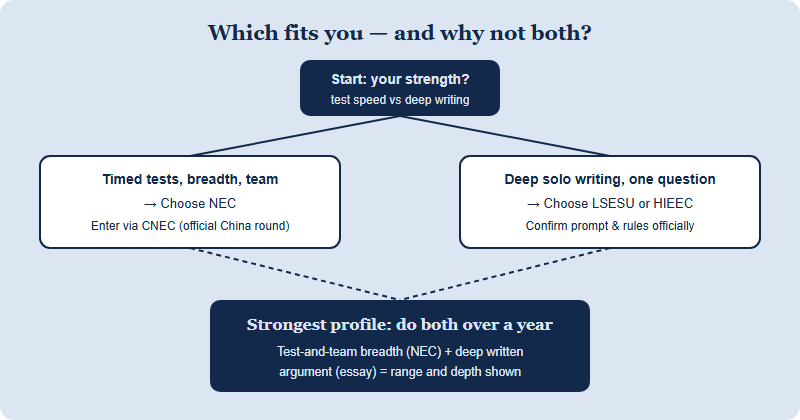
Here is the part most students miss: NEC and the essay competitions are not rivals competing for the same slot on your CV. They develop and demonstrate different muscles, and admissions readers can tell the difference. A student who places well in NEC and writes a strong competition essay has shown both exam-grade range across all of economics and the independent, sustained reasoning of a researcher. That combination is harder to fake than either signal alone.
They also fit together on the calendar. The disciplined breadth you build for NEC — clean command of micro models, macro policy and global trade — becomes raw material for an essay's evidence base. Conversely, the habit of constructing a careful written argument sharpens the Critical Thinking elements within NEC. Many serious economics applicants sequence them across a year: use one to build foundations and the other to show depth. The practical constraints — whether dates clash, eligibility overlaps, and what each entry costs — depend on the current cycle, so map them against the official NEC/CNEC schedule and each essay competition's timeline before committing to both.
| Dimension | NEC (test & team) | LSESU / HIEEC (long essay) |
|---|---|---|
| Core format | Sequence of timed rounds + live team events | One written essay on a chosen question |
| Solo or team | Team of 4 (Pre may be individual or 2–4) | Individual |
| Breadth vs depth | Breadth: micro + macro + world economy | Depth: one prompt, developed fully |
| Skill rewarded | Speed, recall, applied reasoning, teamwork | Argument, originality, writing, editing |
| China entry route | CNEC (official China National Round) | Apply per each competition's official process |
| Confirm officially | Divisions, rounds, fees, dates via CNEC/CEE | Word limit, eligibility, deadline, fees |
A first-party note from the CNEC desk
As the officially authorized China test center for the NEC, the CNEC desk sees this choice play out every cycle. The pattern we observe is consistent: students self-select badly when they pick on prestige rather than on format fit, then struggle in a competition that does not suit how they think. A student who freezes on timed multiple choice will not enjoy NEC's Quiz Bowl pace; a student who finds long solo writing draining will not flourish in a six-week essay. Our practical guidance is to start from your own working style, then layer in the second format the following term once you know what you are good at. For the official China-side calendar, divisions and registration, see the CNEC homepage; the CEE sets the underlying academic standard for the NEC, and named question-setters or judges cited elsewhere are organiser claims you should verify on official channels rather than take as our assertion.
Two related reads if you are mapping the wider economics landscape: how NEC differs from individual case-and-quiz style events, and how it sits alongside applied finance competitions, are both covered in our comparison guides on the CNEC site. This article focuses only on the test-vs-essay distinction; the essay competitions' own rules remain the authority for anything LSESU- or HIEEC-specific.
Frequently asked questions
Is NEC an essay competition?
No. NEC is a timed test-and-team competition across micro, macro and world economy. LSESU and HIEEC are the long-essay competitions. Confirm formats officially.
Should I do NEC or an essay competition?
Pick by working style: choose NEC for timed breadth and teamwork, an essay for deep solo writing. Many strong applicants do both across a year.
How do students in China enter NEC?
Through CNEC, the official China National Round operated by Hanlin since 2016 — the only official path from China to the NEC global rounds. Check current dates on the official CNEC site.
Do NEC and essay competitions count as the same thing for applications?
No. NEC signals exam-grade range plus teamwork; a strong essay signals independent research and writing. They complement rather than replace each other.
Published by the NEC / CNEC editorial desk, operated by Hanlin Education as the officially authorized China National Economics Challenge (CNEC) test center. The NEC is run by the Council for Economic Education, which sets the official rules — always confirm current dates, divisions, fees and awards on the official CNEC channels. Any errors will be corrected within 7 working days.