
If you learned economics partly in Chinese and now have to compete in English, your biggest National Economics Challenge (NEC) obstacle may not be the economics at all — it is the wording. The concepts you know as 边际、弹性、机会成本 arrive in English as marginal, elasticity and opportunity cost, and NEC questions are written in that vocabulary, timed, with multiple-choice distractors built from near-synonyms. This guide maps the term families that recur, the false friends that cost points, and a routine to close the gap before competition day.
Why the language gap is a real scoring problem, not a small one
NEC is fundamentally a test — a team economics competition assessing knowledge of microeconomics, macroeconomics and the world economy — and tests reward precise reading under time pressure. The Council for Economic Education (CEE), founded in 1949, sets the academic standard the challenge is built on, and its material is written in the technical register of a US college-level economics course. That means the difficulty for a Chinese international-school student is often bilingual: you have to recognise the concept, then map it onto an English label fast enough to answer within the clock.
Three things make the vocabulary load heavier than ordinary reading. First, economics reuses everyday words with restricted meanings — “demand” does not mean “want”, “capital” is not “money”, “investment” is not “buying shares”. Second, whole ideas hide inside single dense noun phrases such as deadweight loss or marginal propensity to consume. Third, the answer choices are engineered so that a plausible-sounding wrong word looks right if you translated loosely. Closing this gap is high-leverage: unlike learning new theory, it is finite, listable and fully learnable in a few focused weeks.
The term families that recur across micro, macro and world economy
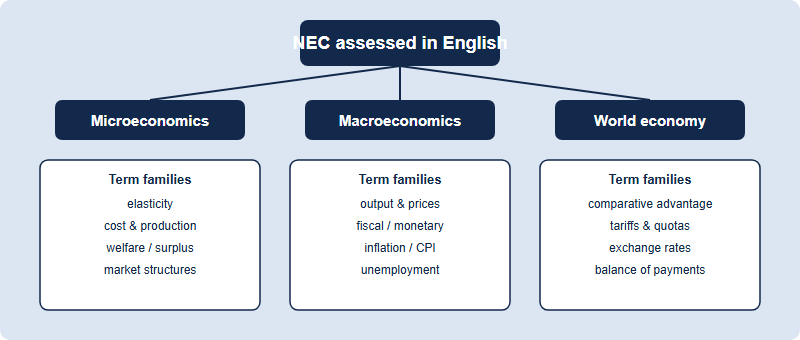
Rather than memorise a flat word list, group vocabulary into families that share a root idea. When you meet a new term, you slot it beside relatives you already own, which is how fluency — not just recognition — is built. The table below is a starting map, organised by the three subject areas NEC draws on; treat the exact syllabus weighting as something to confirm against the official framework on the CNEC home page and the CEE standards.
| Subject area | Term family (English) | Members you must recognise instantly | Common Chinese anchor |
|---|---|---|---|
| Microeconomics | Elasticity | price elasticity of demand (PED), elastic, inelastic, unit-elastic, cross elasticity, income elasticity | 弹性 / 需求价格弹性 |
| Microeconomics | Cost & production | fixed cost, variable cost, marginal cost, average total cost, economies of scale, diminishing returns | 成本 / 边际成本 / 规模经济 |
| Microeconomics | Welfare | consumer surplus, producer surplus, deadweight loss, allocative efficiency | 消费者剩余 / 无谓损失 |
| Macroeconomics | Output & prices | GDP, nominal vs real, aggregate demand, aggregate supply, output gap, CPI | 国内生产总值 / 名义与实际 |
| Macroeconomics | Policy | fiscal policy, monetary policy, expansionary, contractionary, the multiplier, crowding out | 财政政策 / 货币政策 / 挤出效应 |
| World economy | Trade | comparative advantage, terms of trade, tariff, quota, protectionism, balance of payments | 比较优势 / 关税 / 国际收支 |
The false-friend traps that turn known economics into wrong answers
The most painful lost marks come from words you think you know. English economics restricts everyday meanings, and a loose Chinese translation can flip an answer. Learn these deliberately, because NEC distractors are frequently built on exactly this confusion:
- Demand vs quantity demanded. “Demand” is the whole relationship (the curve); “quantity demanded” is one point at one price. A price change moves you along a curve (change in quantity demanded); a non-price change shifts the curve (change in demand). Mixing these is the single most common micro error.
- Investment. In macroeconomics, investment means firms buying new capital goods (machines, buildings, inventory), not a household buying stocks. Buying shares is a financial transfer, not GDP investment.
- Capital. Physical capital = tools and equipment used in production; it is not “money” (that is financial capital) and not “wealth” in general.
- Nominal vs real. Nominal is measured in current prices; real is adjusted for inflation. A question that gives you nominal figures and asks about “actual” or “true” changes is testing whether you deflate first.
- Elastic vs inelastic. Elastic = responsive (elasticity greater than 1 in absolute value); inelastic = unresponsive (less than 1). The words are close; the coefficients decide.
- Surplus. “Surplus” means the welfare gain (consumer/producer surplus) in one context and an excess of quantity supplied over demanded (a market surplus) in another. Read which one the sentence needs.
| You might read it as… | But in NEC it means… | Why the distractor works |
|---|---|---|
| “Demand went up” = people bought more | Could be a shift (more demand) or a move along (lower price) | The answer depends on the cause; loose reading picks the wrong one |
| Investment = buying financial assets | Firms buying physical capital goods | A choice about stock purchases looks correct but is not GDP investment |
| Capital = money | Productive equipment / tools | “Raising capital” wording tempts the financial reading |
| Real = “genuine” | Inflation-adjusted | You skip the deflation step and pick the nominal number |
A quiet advantage works in your favour here: much English economics vocabulary is transparent once you see the structure. Many terms are built from Latin and Greek roots and behave in predictable families — monopoly (single seller), oligopoly (few sellers) and monopsony (single buyer) share the “-poly/-psony” logic; inflation and deflation flip a shared root; elastic and inelastic differ only by a negating prefix. When you meet a new term, pause to break it into parts and connect it to relatives you already own. This turns memorisation into pattern recognition, which is faster and far more durable than rote lists — and it is a habit that keeps paying off as harder vocabulary appears in the advanced material.
A four-week build routine that produces fluency, not flashcard recognition
Recognition (“I’ve seen this word”) is not enough for a timed test; you need retrieval (“I can define it and use it in a sentence in English in two seconds”). Build that with short, daily, active practice rather than long passive reading. The routine below is a template — scale the weeks to how much time you have before your season, which you should plan against the official CNEC schedule; you can start from the season overview on the CNEC information pages.
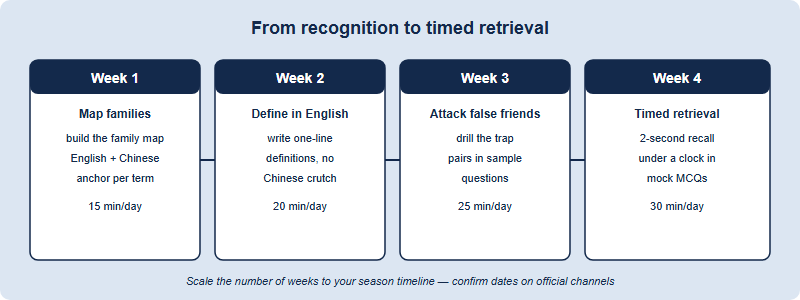
Two habits multiply the effect. Keep a personal error log of every term that fooled you in practice, with the correct English definition and the trap noted — this becomes your most valuable revision sheet because it is built from your own weaknesses. And practise saying the definition aloud in English, since NEC’s live team rounds (Quiz Bowl and the discussion-based components run in the China round per the organiser) demand that you speak the vocabulary, not just read it. If you are on a team, run a five-minute “term relay” where one member names a concept in Chinese and another must give the English term and a one-line definition — it turns bilingual mapping into a shared, fast reflex.
Frequently asked questions
Do I need native-level English to do well at NEC?
No. You need the technical economics register — a finite, learnable vocabulary — plus the ability to read questions accurately under time. That is far smaller than general fluency.
Should I study economics in Chinese or English?
Learn the concept in whichever is faster for you, but always attach the English label and an English one-line definition, because the assessment is in English.
Are the questions written by US economists?
The CEE sets the academic standard and question-setters are named by the organiser; treat specific attributions as “confirm on the official site” rather than assumed.
What is the fastest single win for an ESL competitor?
Drilling the “demand vs quantity demanded” and “nominal vs real” distinctions — they appear constantly and loose translation gets them wrong.
Published by the NEC (CNEC) editorial desk, operated by Hanlin Education for China-based international-school students. Official rules are set by the competition and change yearly — confirm current divisions, format, dates and eligibility on councilforeconed.org and the official CNEC channels. Any error will be corrected within 7 working days.