
The NEC tests supply and demand by asking you to predict how a single market shock moves equilibrium price and quantity — and the points are won or lost on one distinction: a change in the good's own price is a movement along a curve, while a change in any other determinant shifts the whole curve. Master that, read shortages and surpluses correctly, and you can reason through most micro questions in seconds.
Several NEC guides — including some already on our own site — survey all seven rounds and stop. This one stays inside one syllabus block: supply, demand and market equilibrium, the micro engine that recurs across the Qualifying Test, Quiz Bowl, Super Econ and Econ Lab. The National Economics Challenge is run by the Council for Economic Education (CEE, founded 1949) and draws roughly 10,000 students a year in the United States across microeconomics, macroeconomics and world economics. The China National Round (CNEC) has been operated by Hanlin (SKT) since 2016, across 20+ provinces and 300+ schools, and is the official path from China into the NEC global rounds. The economics below follows the CEE standard; exact round formats, weightings and timing change season to season, so confirm those on the official CNEC channels before you build a plan around them.
Why supply and demand is the highest-leverage micro to drill
Microeconomics is one of the three NEC subjects, and inside micro no topic earns its keep like supply, demand and equilibrium. It is the model the syllabus returns to constantly, and it is the foundation for everything that comes after it — elasticity, price controls, taxes, surplus and welfare all sit on top of the same diagram. A team that genuinely owns the supply-and-demand framework does not just answer supply-and-demand questions faster; it answers tax-incidence, minimum-wage and subsidy questions faster too, because every one of those is a supply-and-demand shift wearing a different label.
That is exactly why it rewards drilling. Many Chinese international-school students arrive with strong textbook economics from IB, A-Level or AP and can state the law of demand on cue. Where they lose NEC points is speed and precision under a clock: correctly identifying which curve moves, in which direction, and what that does to price and quantity at the same time. The good news is that this is a finite, learnable skill — there are only so many determinants and only so many shock patterns, and once you have internalised them, a question that looks like a paragraph collapses into a two-second diagram in your head.
| Sub-topic | The core idea NEC tests | What trips students up |
|---|---|---|
| Law of demand | Price up → quantity demanded down, other things equal | Confusing a price change with a demand change |
| Law of supply | Price up → quantity supplied up, other things equal | Forgetting “other things equal” is doing the work |
| Equilibrium | The price where quantity demanded equals quantity supplied | Treating it as fixed rather than the result of two curves |
| Shortage / surplus | How a non-clearing price self-corrects toward equilibrium | Mixing up which one a price ceiling vs floor creates |
| Curve shifts | A determinant other than own-price moves the whole curve | Shifting the wrong curve, or the right curve the wrong way |
The one trap that costs the most points: shift vs movement
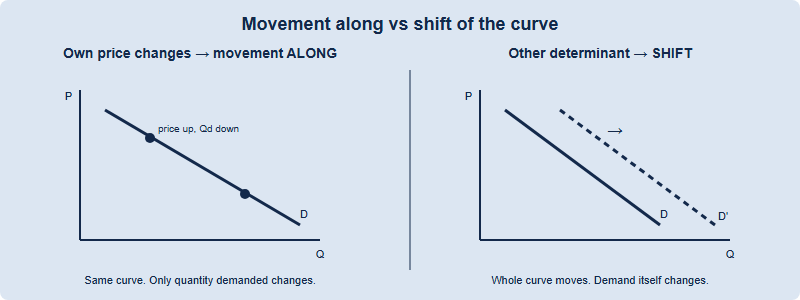
More NEC micro points are lost to the shift-versus-movement confusion than to any other single error, so make this reflexive. The rule is clean: a change in the good's own price causes a movement along a fixed demand or supply curve — that is a change in quantity demanded or supplied. A change in any other determinant — income, the price of a related good, tastes, expectations, the number of buyers, input costs, technology — shifts the entire curve and changes demand or supply itself. “Quantity demanded” moves along; “demand” shifts. The vocabulary is not pedantry; it is the answer.
Train the trigger words. If a question says the price of coffee rose and asks what happens to coffee, that is a movement along coffee's demand curve — quantity demanded falls, nothing shifts. If it says incomes rose, or tea (a substitute) got more expensive, or a frost hit the harvest, those are shifts — demand or supply moves bodily left or right. The fastest competitors hear the determinant in the prompt and immediately know whether they are sliding along a curve or relocating it, before they think about price at all.
Reading equilibrium: shortages, surpluses and how price clears
Equilibrium is the price where quantity demanded equals quantity supplied — the one price at which the plans of buyers and sellers are consistent. NEC questions rarely stop at “what is equilibrium”; they ask what happens when the price is not at equilibrium, or when a policy holds it away from there. Above equilibrium, quantity supplied exceeds quantity demanded and you get a surplus (excess supply), which pushes price down. Below equilibrium, quantity demanded exceeds quantity supplied and you get a shortage (excess demand), which pushes price up. The market self-corrects in the direction that closes the gap.
This is where price controls become a clean, high-frequency NEC pattern. A binding price ceiling (a legal maximum set below equilibrium, like rent control) creates a persistent shortage, because price cannot rise to clear the market. A binding price floor (a legal minimum set above equilibrium, like a minimum wage in the labour market) creates a persistent surplus — in the labour market, that surplus is unemployment. Students who memorise “ceiling = shortage, floor = surplus” but cannot say why get caught when the question reframes it; the durable version is to reason it from where the controlled price sits relative to equilibrium.
| Situation | Price relative to equilibrium | Result | Pressure on price |
|---|---|---|---|
| Free-market disequilibrium (high) | Above equilibrium | Surplus (Qs > Qd) | Falls toward equilibrium |
| Free-market disequilibrium (low) | Below equilibrium | Shortage (Qd > Qs) | Rises toward equilibrium |
| Binding price ceiling | Held below equilibrium | Persistent shortage | Blocked from rising |
| Binding price floor | Held above equilibrium | Persistent surplus | Blocked from falling |
How to reason fast: a four-step routine for any market shock
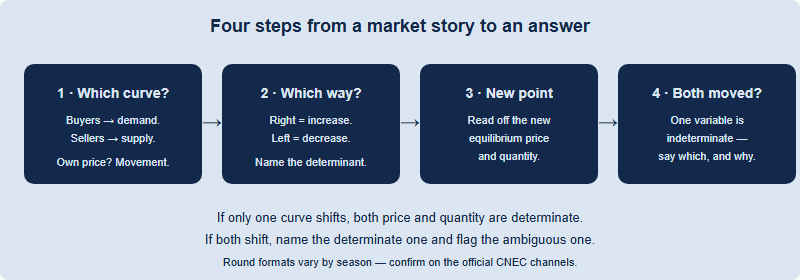
Most NEC supply-and-demand questions are a short story ending in “what happens to price and quantity?” You can answer almost all of them with the same four-step routine, run in order. One: identify which curve the shock hits — does it affect buyers (demand) or sellers (supply)? Two: decide the direction — does that curve shift right (increase) or left (decrease)? Three: read off the new equilibrium for price and quantity. Four: if both curves move at once, recognise that one of price or quantity is indeterminate without knowing the relative sizes of the shifts — and say so, because “it depends on which shift is larger” is often the correct, full-credit answer.
That fourth step is where stronger teams pull ahead. When supply and demand both shift, the variable on which they push the same way is determinate and the other is ambiguous. If demand rises and supply falls, price clearly rises but quantity could go either way; if demand rises and supply rises, quantity clearly rises but price is ambiguous. A team that confidently states “quantity is determinate, price is indeterminate here, because it hinges on the relative magnitudes” demonstrates exactly the precision the NEC rewards — and avoids guessing a direction the question deliberately left open.
Typical NEC question patterns — and the determinants behind them
Once you know the four-step routine, the question bank stops looking infinite. NEC supply-and-demand items cluster into a handful of recognisable shapes: a single-shift scenario (“a frost destroys part of the orange crop — what happens in the orange-juice market?”), a related-goods scenario testing substitutes and complements (“the price of petrol rises — what happens to the market for large cars?”), a double-shift scenario built to test whether you spot the indeterminate variable, and a price-control scenario asking you to locate the resulting shortage or surplus. Each one is the same diagram with a different determinant pushing on it.
So the fastest way to prepare is to over-learn the determinants until naming them is automatic. Demand shifts with income (normal vs inferior goods), the prices of related goods (substitutes and complements), tastes and preferences, expectations about future prices, and the number of buyers. Supply shifts with input costs, technology and productivity, expectations, the number of sellers, and relevant taxes or subsidies. When you can hear “incomes fell” and instantly think “demand left-shift, and if it's an inferior good the opposite,” you are reading prompts at competition speed. Drilling these against timed past-style questions — which is how our CNEC preparation resources are structured — is what converts textbook knowledge into NEC points.
| Curve | Determinant (non-price) | Worked trigger |
|---|---|---|
| Demand | Income (normal good) | Incomes rise → demand shifts right |
| Demand | Price of a substitute | Tea pricier → demand for coffee shifts right |
| Demand | Price of a complement | Petrol pricier → demand for large cars shifts left |
| Supply | Input costs | Wages rise → supply shifts left |
| Supply | Technology / productivity | Better tech → supply shifts right |
| Supply | Tax on producers | New per-unit tax → supply shifts left |
First-party note from running the China round. Across CNEC cohorts, the supply-and-demand block is where well-prepared, exam-strong students most often lose points they should keep — almost always to the shift-versus-movement slip or to forcing a direction on a variable the question left indeterminate. Teams that drill the four-step routine until it is automatic, and that practise saying “this variable is determinate, that one isn't, and here's why,” convert their textbook fluency into speed and accuracy under the clock. It is the single most reliable micro upgrade we see on the path through the China round.
Frequently asked questions
What is the difference between a movement along and a shift of a demand curve?
A change in the good's own price is a movement along the curve (quantity demanded). A change in any other determinant shifts the whole curve (demand).
Does a price ceiling cause a shortage or a surplus?
A binding price ceiling sits below equilibrium and causes a persistent shortage, because price cannot rise to clear the market. A binding floor causes a surplus.
What happens to price and quantity when both curves shift?
One variable is determinate and the other is indeterminate without knowing the relative sizes of the shifts. State which is which and explain why.
How heavily does the NEC test supply and demand?
It is core microeconomics and recurs across rounds, but exact formats and weightings change by season — confirm current details on the official CNEC channels.
Published by the NEC / CNEC editorial desk, operated by Hanlin Education as the officially authorized China National Economics Challenge (CNEC) test center. The NEC is run by the Council for Economic Education, which sets the official rules — always confirm current dates, divisions, fees and awards on the official CNEC channels. Any errors are corrected within 7 working days.