
Plenty of guides argue about whether the National Economics Challenge (NEC) helps your university application. Far fewer show you how to actually write about it — and that execution is where students either add real weight or waste a line on an empty name-drop. This guide is about the writing: how to frame NEC in a UK UCAS personal statement, how to phrase it in a US activities list and supplement, and how to do it honestly, because admissions readers can smell inflated claims instantly.
First, understand what NEC signals — and what it does not
NEC is a team economics competition assessing microeconomics, macroeconomics and the world economy, built on the academic standard of the Council for Economic Education (CEE), founded in 1949. Written well, it can signal genuine intellectual engagement with economics beyond the classroom, comfort with team problem-solving under time pressure, and initiative. What it does not do is guarantee anything: no competition secures admission, and readers discount claims that overstate. The job of your writing is to convert participation into evidence of thinking, not to present a trophy.
The two systems you are most likely writing for reward different things, so the same NEC experience should be described differently in each. Understanding that split is the whole game.
| System | What it primarily rewards | How NEC should read there | Length reality |
|---|---|---|---|
| UK — UCAS personal statement | Academic focus on your chosen subject; evidence of super-curricular thinking | A subject-driven example: what an NEC topic made you explore or question | One statement across all courses; every line must earn its place |
| US — activities list | Concise, verifiable impact and role over time | A tight entry: your role, the scope, and one concrete outcome | Very few characters per entry — ruthless concision |
| US — supplemental essays | Reflection, voice, intellectual curiosity, fit | A story or insight, only if NEC genuinely reveals something about you | Use sparingly; do not force it if a better example exists |
Writing NEC into a UCAS personal statement
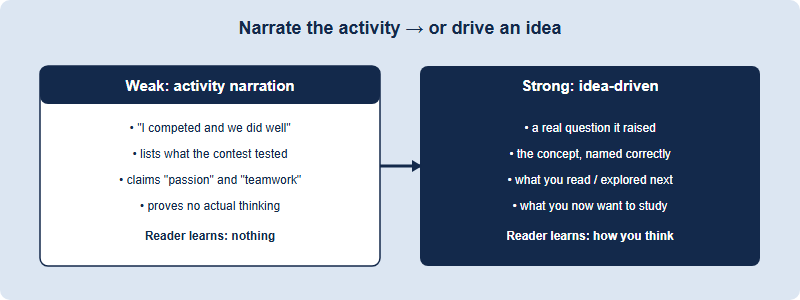
UCAS is subject-focused: the reader is an academic deciding whether you should study, say, economics at their department. So do not narrate the competition (“I took part in NEC and my team did well”). Instead, use NEC as a springboard into ideas — what a topic provoked, what you read next, what you now think. The competition is the trigger; your economic reasoning is the content.
Compare two approaches to the same experience:
- Weak (activity narration): “I competed in the National Economics Challenge, which tested micro, macro and world economy. It was a valuable experience that improved my teamwork and deepened my passion for economics.”
- Strong (idea-driven): “Preparing for the National Economics Challenge, a question on tariff welfare effects unsettled me: if protection helps domestic producers, why do economists still call it inefficient? Tracing the consumer-surplus loss and deadweight cost led me to read more on comparative advantage, and to wonder how the argument changes when an industry is strategically important — a tension I want to study further.”
The strong version proves you can think like an economist and want more; the weak version proves nothing and burns two precious lines. Notice the strong version names a real concept (tariff welfare, deadweight loss, comparative advantage) accurately — UK academic readers will spot a misused term, so only claim reasoning you genuinely did. Keep it brief: NEC should occupy a sentence or two that opens a line of thought, not a paragraph of description. And align it with your course: if you are applying for economics or PPE, this is a natural fit; if you are applying for something unrelated, a forced NEC mention can dilute your focus.
Writing NEC into a US activities list and supplements
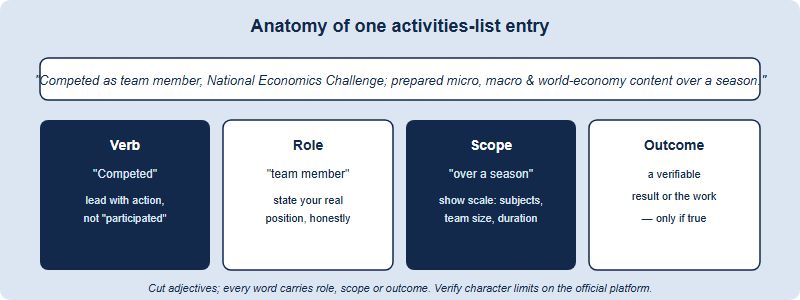
The US activities list is the opposite discipline: brutal concision. You have very few characters, so every word must carry role, scope or outcome. Lead with a strong verb, state your specific position, and include one concrete, honest detail — a role, a scale, a result — instead of adjectives. Confirm the exact character limits and current fields on the official application platform you are using, since those change.
| Element | Weak version | Stronger, concise version |
|---|---|---|
| Verb + role | “Participated in economics competition” | “Competed as team member, National Economics Challenge (Economics Challenge)” |
| Scope | “Studied economics topics” | “Prepared micro, macro & world-economy content across a season with a 4-person team” |
| Outcome | “Did well / gained experience” | State a verifiable result or role only if true; otherwise describe the work, not a claim |
It helps to see the anatomy of a strong entry: four parts, each doing one job, with adjectives cut. The diagram below breaks down a single activities-list line so you can build your own around whatever role and outcome you can honestly claim.
For a supplemental essay, only reach for NEC if it genuinely reveals something about you — a way of thinking, a collaboration that changed you, an idea that stuck. A “Why this major?” prompt is a natural home for the intellectual-spark version described above; a generic “meaningful activity” prompt works only if NEC really was meaningful relative to your other options. Do not manufacture a life-changing narrative from a competition; readers reward authenticity and penalise inflation. A useful test: if the same paragraph could be written by any student who merely signed up, it is not revealing enough — rewrite it around a specific moment, question or decision that only you experienced.
The honesty rules that keep your writing credible
Everything above collapses if a reader senses exaggeration, so hold to a few hard lines. State your role and results accurately — if you were one of four team members, say so; do not imply solo achievement, and do not upgrade a participation into a title you did not hold. Describe awards only at the level actually earned, and describe the competition’s standing without overclaiming: it is a well-regarded economics challenge, not a guarantee of anything, and admissions outcomes depend on your whole application. Name any concept accurately — a misused economics term does more damage than omitting it. Finally, get the competition’s identity right: NEC is a test / team competition in economics, distinct from essay competitions such as LSESU or HIEEC, so describe what it actually is. When in doubt about a specific fact — division names, structure, dates — verify it against the official framework rather than guessing; you can start from the CNEC information pages.
Remember that your written mention is not the only place NEC can surface, so keep your framing consistent everywhere. If you write in a UCAS statement that a tariff question sparked your interest in trade policy, be ready to discuss that at a UK interview — Oxbridge and other interview-based departments may probe exactly the claim you made, so only write what you can defend in conversation. Similarly, a teacher who coached or supervised your team can reference NEC in a recommendation letter; a brief, accurate word to that teacher about what you actually did helps them corroborate your account rather than contradict it. Consistency across statement, interview and reference is what makes the signal trustworthy.
Written with these rules, an NEC line does real work: it shows an admissions reader a student who engaged with economics beyond the syllabus, thought about hard questions, and can describe that honestly. That is a genuine, defensible signal — and it is entirely within your control to write it well.
Frequently asked questions
Should NEC go in my UCAS statement or just the activities section?
UCAS has no separate activities box — it is one statement, so weave NEC in as a subject-relevant example of your thinking, briefly.
Can I say NEC “guarantees” a stronger application?
No. Never claim guaranteed outcomes; admissions depend on your whole profile. Present NEC as evidence of engagement, not a promise.
How do I write it if I didn’t win an award?
Focus on the reasoning and the work, not a result — a well-described idea beats an empty claim, and honesty matters more than a medal.
Is NEC worth mentioning if I’m not applying for economics?
Only if it connects to your story; forcing an unrelated mention can dilute focus, especially in a subject-specific UCAS statement.
Published by the NEC (CNEC) editorial desk, operated by Hanlin Education for China-based international-school students. Official rules are set by the competition and change yearly — confirm current divisions, format, eligibility and application-platform limits on councilforeconed.org and the official CNEC channels. Any error will be corrected within 7 working days.