
Textbook mastery gets you through the multiple-choice foundation of the National Economics Challenge (NEC), but the applied, open-ended components reward something else: the ability to look at a real event — a central-bank decision, a tariff, a supply shock — and reason about it with the right model. That skill is not memorised; it is built by reading the world like an economist, week after week. This guide gives you a concrete system to do exactly that, so you walk into the harder rounds with real examples on tap.
Which NEC rounds actually reward real-world reasoning
NEC is a team economics competition testing microeconomics, macroeconomics and the world economy, and the Council for Economic Education (CEE), founded in 1949, sets the academic standard it is built on. Beyond the pure-recall foundation, the challenge includes applied and discussion-style components — in the China round (CNEC), per the organiser, the 2027 outline runs these across the open-ended Critical Thinking work and, at the global round, the OX-BP Debate Sessions and the U20 Youth Voice presentation. The exact round list and format are set by the organiser and change yearly, so confirm the current structure on the CNEC information pages rather than assuming last season’s line-up.
What unites these components is that they ask you to apply theory to a scenario rather than merely define it. A student who has read about a real interest-rate move can explain the transmission from policy rate to borrowing to aggregate demand with a concrete case in mind; a student who only memorised the definition of monetary policy struggles to make the argument vivid and specific. That difference — concrete versus abstract — is exactly what separating answers in open-ended and presentation work comes down to.
There is a second, subtler payoff. Real cases teach you the limits of a model, and knowing the limits is a hallmark of stronger candidates. A textbook says a minimum wage above equilibrium creates unemployment; the real world shows the effect can be small, delayed, or offset by other forces, and economists genuinely debate the magnitude. A student who has followed that debate can give the textbook answer and flag the nuance, which reads as maturity in a discussion round. You do not get that from definitions alone — you get it from watching theory meet messy reality again and again over a season.
The core habit: attach every headline to a model
Reading the news is not the skill. Translating the news into economics is. Train yourself to run every relevant story through a short, fixed loop so that consumption becomes analysis. The loop below is deliberately small enough to do in a few minutes per article, which is what makes it sustainable across a whole season.
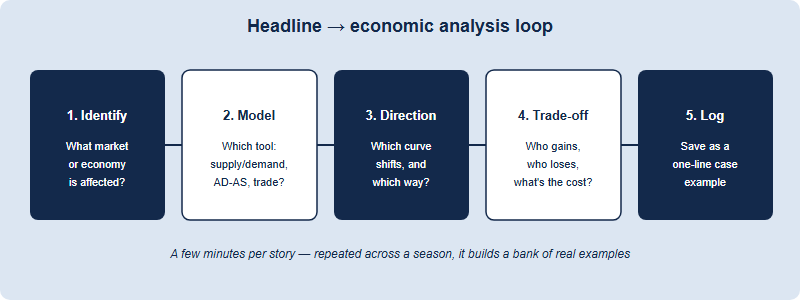
Worked example: a headline reports that a country’s central bank raised its policy interest rate. Step 1 — the affected arena is the whole macroeconomy and the money/credit market. Step 2 — the tools are monetary policy and the AD-AS framework. Step 3 — higher rates raise borrowing costs, dampening consumption and investment, so aggregate demand shifts left. Step 4 — the trade-off is lower inflation pressure against slower growth and possibly higher unemployment; borrowers and exporters feel it differently from savers. Step 5 — log it: “Rate hike → AD left → cools inflation, risks growth.” You now own a concrete, defensible case you can bring to any round that touches monetary policy.
A weekly reading diet that covers the NEC map
To make sure your examples span everything the competition draws on, structure your reading so each week touches micro, macro and the world economy rather than drifting toward whatever is in the headlines. The template below is a balanced default; adjust it to your own gaps and to the current syllabus emphasis, which you should confirm against the official framework.
| Focus | What to look for that week | Model to attach | Example case to bank |
|---|---|---|---|
| Micro: a specific market | A price move, shortage, new tax or subsidy in one industry | Supply & demand, elasticity, tax incidence | “Energy price cap → shortage / rationing logic” |
| Macro: the big picture | Inflation data, a central-bank move, a jobs report, a budget | AD-AS, fiscal / monetary policy, the multiplier | “Stimulus package → AD right → growth vs deficit” |
| World economy: cross-border | A tariff, trade deal, currency move, or trade imbalance | Comparative advantage, tariffs, exchange rates, BoP | “New tariff → protects producers, raises consumer prices” |
| Market failure / policy | Pollution rules, a monopoly probe, a public-good debate | Externalities, market structures, government role | “Carbon tax → internalising a negative externality” |
Where you read matters less than reading critically, but not all sources build the same skill. The most useful material explains the mechanism behind an outcome; the least useful just asserts a conclusion. Rank your reading by how much reasoning it exposes, and weight your time toward the top of that ladder.
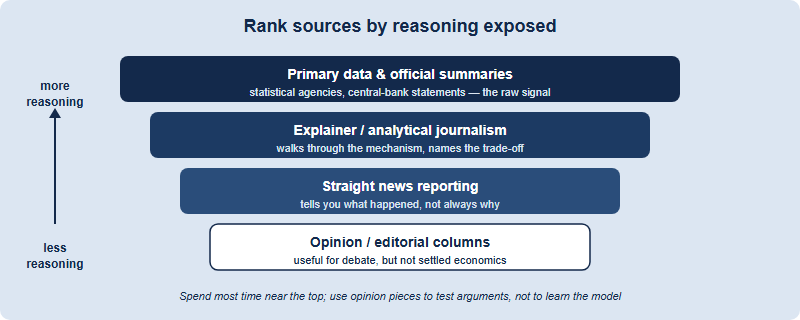
Two traps deserve special mention. Do not confuse a strong opinion column with settled economics — note explicitly where economists genuinely disagree, because being able to present both sides of a live debate is itself a mark of sophistication in an open-ended round. And do not import a headline’s political framing into an answer: NEC rewards the economic argument — who gains, who loses, what the efficiency trade-off is — not the editorial one. When a story is emotionally charged, that is precisely when disciplined, model-first reasoning stands out most.
Turning your example bank into round-ready performance
A bank of cases is only useful if you can retrieve and deploy it. Convert reading into competition performance with three moves. First, keep the bank searchable by model, not by date — group cases under “monetary policy”, “tariffs”, “externalities” so that when a round touches a concept, you instantly recall a matching real example. Second, practise the 60-second explain: pick a case and talk through the loop aloud, because the presentation and discussion components (run in the China round per the organiser) reward students who can narrate reasoning clearly under time. Third, run team case swaps — each teammate brings two fresh cases a week and teaches them, which multiplies everyone’s bank and surfaces disagreements you can pressure-test before competition day. If you want to sequence this alongside your formal prep, anchor it to your season plan starting from the CNEC home page.
As you build the habit, watch for the reasoning errors that most often weaken applied answers. Confusing correlation with causation is the classic trap — two things moving together does not prove one caused the other, and strong answers acknowledge alternative explanations. Ignoring second-round effects is another: a policy that helps one group directly may hurt it indirectly (a subsidy funded by higher taxes elsewhere), and examiners reward students who trace the chain past the obvious first step. Forgetting the counterfactual — what would have happened anyway — and treating the short run and long run as identical round out the list. Naming these tensions in an open-ended response signals genuine economic maturity, which is exactly what the higher rounds are designed to reward.
One honest caution: real-world literacy is a complement to, not a substitute for, solid theory and question practice. The foundation rounds still reward precise definitions and fast calculation. Build the example habit on top of your core preparation, not instead of it, and you arrive at the applied rounds with the one thing textbook-only competitors lack — the ability to make the theory concrete.
Frequently asked questions
How much time should current-affairs reading take?
Aim for a few short, analysed articles per week rather than long passive scrolling — consistency across a season beats occasional binges.
Do the applied rounds require memorising real statistics?
Precise figures are less important than being able to explain the mechanism with a concrete case; confirm each round’s exact expectations on the official site.
Which NEC rounds is this literacy most useful for?
The open-ended, applied and presentation-style components; the exact round list is set by the organiser, so verify the current structure on official channels.
Can I use news examples in the multiple-choice rounds too?
Indirectly — real cases deepen intuition that speeds up MCQ reasoning, even though those rounds test definitions and calculation directly.
Published by the NEC (CNEC) editorial desk, operated by Hanlin Education for China-based international-school students. Official rules are set by the competition and change yearly — confirm the current round structure, format and dates on councilforeconed.org and the official CNEC channels. Any error will be corrected within 7 working days.