
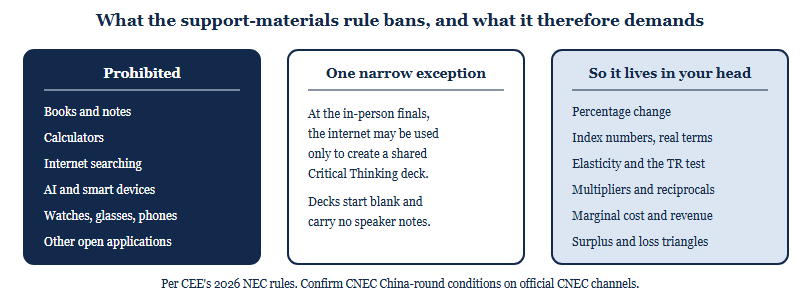
Calculators are barred at every stage of NEC. CEE’s 2026 rules state that “the use of books, notes, calculators or other support materials including but not limited to searching the internet is not allowed during the competition.” That single rule shapes the entire paper: the numbers are chosen to be friendly, and marks go to students who recognise the structure quickly, not to those who compute carefully but slowly.
The rule that shapes how the questions are written
The prohibition appears twice in CEE’s rules, once for the online semi-final round and again for the in-person finals, where it is extended explicitly to “AI-enabled, smart, or connected devices” including smartwatches, smart glasses and voice assistants, and to any other applications left open on a student’s computer. The only permitted internet use anywhere in the finals is to create a shared presentation deck for the Critical Thinking round, which must start blank and carry no speaker notes.
Three consequences follow, and all three should change how you revise.
- The numbers are friendly by design. A question writer who cannot assume a calculator must build items around halves, quarters, tenths and small whole numbers. If your working produces an ugly decimal, you have almost certainly taken a wrong route rather than found a hard question.
- Your time budget is brutal. CEE’s semi-final format gives students 45 minutes for 45 questions, four-option multiple choice. That is roughly sixty seconds per item including reading the stem and the options. Any calculation step that takes more than twenty seconds is eating a neighbouring question.
- Many “calculation” questions are recognition questions. A large share of numerical items can be resolved by knowing which direction a relationship runs, without computing a value at all. Learning those shortcuts is worth more than raw arithmetic speed.
Where these questions sit in the overall structure is worth knowing before you build a drill plan; our breakdown of the seven NEC rounds and how each one works distinguishes the timed individual gate from the team stages that reward extended reasoning. One caveat throughout: the rules quoted here are CEE’s published rules for the United States pathway. Timings and paper structure for the CNEC China rounds are set by the China organising committee, so confirm current details on official CNEC channels.
Percentages, index numbers and real versus nominal
This is the highest-frequency arithmetic family on any economics paper, and it produces more avoidable losses than anything harder. The operations are trivial; the traps are linguistic.
| Operation | Formula | The twenty-second version | The usual mistake |
|---|---|---|---|
| Percentage change | (new − old) ÷ old × 100 | Divide the gap by where you started | Dividing by the new value instead |
| Percentage points | Difference between two rates | Subtract, then say “pp” | Calling 5% to 6% a one per cent rise; it is 1pp, or a 20% increase |
| Inflation from a price index | (Index₂ − Index₁) ÷ Index₁ × 100 | Percentage change, applied to the index | Reading the index level as if it were the inflation rate |
| Deflating to real terms | Nominal ÷ (index ÷ 100) | Index of 125 means divide by 1.25 | Multiplying by the index instead of dividing |
| Real interest rate | Nominal − inflation | Straight subtraction as an approximation | Forgetting that negative real rates are perfectly possible |
| Doubling time | 70 ÷ growth rate | 3.5% growth doubles in about 20 years | Using the level of GDP rather than its growth rate |
Two more items belong in this family. The GDP deflator is nominal GDP divided by real GDP, times 100, which means the same deflating logic runs in reverse when a question hands you two of the three quantities. And the expenditure identity — consumption plus investment plus government spending plus net exports — is a computation as often as it is a definition: questions supply five figures and ask for the sixth, or supply the components and ask what happens when one moves.
Elasticity without a calculator
Elasticity questions look computational and usually are not. Price elasticity of demand is the percentage change in quantity demanded divided by the percentage change in price; the arc or midpoint version divides each change by the average of the two values rather than the starting value, which is why the two methods give slightly different numbers from the same data.
But the fastest route through most elasticity items is the total revenue test, which requires no arithmetic whatsoever:
- Elastic demand (coefficient greater than one in absolute terms): price and total revenue move in opposite directions. Cut the price, revenue rises.
- Inelastic demand (less than one): price and total revenue move together. Raise the price, revenue rises.
- Unit elastic (exactly one): total revenue is unchanged by a price move.
Learn the other three elasticities as sign questions rather than magnitude questions. Income elasticity is positive for normal goods, negative for inferior goods and above one for luxuries. Cross-price elasticity is positive for substitutes and negative for complements. Price elasticity of supply rises with time, because producers can adjust capacity in the long run. Determinants of demand elasticity — availability of substitutes, share of income spent, necessity versus luxury, time horizon, how narrowly the market is defined — are worth memorising as a list, because questions frequently ask which factor makes a described good more elastic.
The most valuable application is incidence. When a per-unit tax is imposed, the more inelastic side of the market bears the larger share of the burden, because it is the side less able to walk away. That single sentence answers a whole category of questions that students otherwise try to compute.
Multipliers and marginal tables: the two calculation families that recur
The macro side reduces to a handful of reciprocals. The spending multiplier is one divided by one minus the marginal propensity to consume, which is the same as one divided by the marginal propensity to save. The tax multiplier is the negative of MPC divided by MPS, and is always smaller in absolute size than the spending multiplier because part of a tax cut is saved rather than spent. The balanced-budget multiplier is one: an equal rise in spending and taxes raises output by the amount of the change.
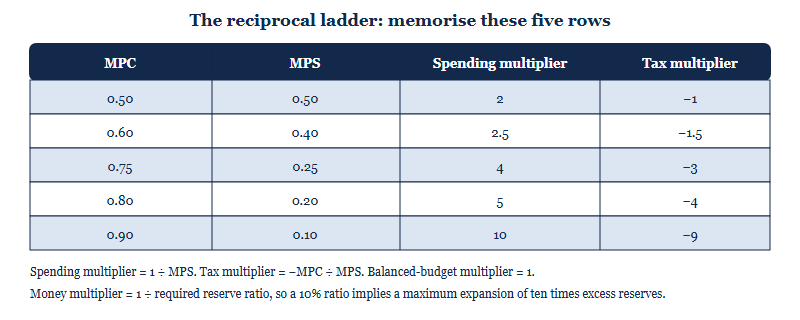
The banking side works the same way: the simple money multiplier is one divided by the required reserve ratio, so a ten per cent requirement implies maximum deposit expansion of ten times excess reserves. Questions that hand you a deposit, a reserve ratio and ask for the maximum change in the money supply are two-step items, not hard ones. The quantity equation — money times velocity equals price level times real output — is best carried in growth-rate form, where money growth plus velocity growth roughly equals inflation plus real growth.
On the micro side, the recurring family is the marginal table. Marginal cost is the change in total cost divided by the change in quantity, marginal revenue the change in total revenue. The single most useful habit here is to read the change between rows rather than recomputing totals: examiners lay these tables out so that the differences are clean even when the totals are not. From there:
- Profit is maximised, or loss minimised, where marginal revenue equals marginal cost.
- Per-unit profit is price minus average total cost; total profit is that gap multiplied by quantity.
- A firm shuts down in the short run when price falls below average variable cost, and breaks even at the minimum of average total cost.
- Consumer surplus, producer surplus and deadweight loss are triangles: one half base times height, with clean numbers by construction.
- Utility maximisation sets marginal utility per unit of currency equal across goods.
How far these are pushed varies by bracket, and teams in the advanced division should expect the quantitative expectations to sit higher — our guide to the Adam Smith division sets out that difference.
A three-week numeracy drill, twenty minutes a day
Numeracy responds to short daily repetition far better than to weekend marathons. Twenty minutes, five days a week, for three weeks is enough to move a roster from “can do it slowly” to “does it without noticing”. All of it needs material to drill on: we keep our own collected pack of timed numeracy drills, marginal-table sets and full mock papers — with worked solutions for many of the items — alongside the rest of our preparation resources, and China-based teams can ask us for a copy.
- Week 1 — percentages and reciprocals. Flash drills only. Thirty items in five minutes: percentage changes, percentage points versus per cent, index-to-inflation, deflating a nominal figure. Then the multiplier ladder until all five rows are instant. Target zero errors before you target speed.
- Week 2 — elasticity and direction. Twenty questions in eight minutes, answered wherever possible by the total revenue test rather than by computation. Add tax incidence: for each scenario, say which side is more inelastic and therefore bears more of the burden.
- Week 3 — marginal tables at pace. Mixed sets combining marginal cost and revenue tables, per-unit profit, surplus triangles and money-multiplier items, at roughly one question per minute. Finish the week with a full mock under competition conditions: pen and paper only, no calculator, no notes, no phone on the desk.
Then run an error log, and classify every miss into one of four buckets: wrong formula, wrong direction, arithmetic slip, or misread units. This is the part most teams skip, and it is where the diagnosis lives. In the mock cycles we run with China-based cohorts, the losses cluster heavily in the second and fourth buckets — direction errors and unit misreads — rather than in genuine gaps in formula knowledge. Students who conclude “I need to learn more economics” after a weak numerical section are usually misdiagnosing a reading problem as a knowledge problem. Fix the biggest bucket first; it is rarely the one you expect.
It is worth being clear about what this kind of training is for. NEC is a timed test of recall and applied reasoning, which is a different discipline from the extended written argument rewarded by economics essay competitions — a contrast we set out in NEC versus the economics essay prizes. Drills of this kind would be nearly useless preparation for the latter, and they are close to decisive for the former.
Frequently asked questions
Are calculators ever allowed in NEC?
CEE’s 2026 rules bar books, notes, calculators and internet use at both the online semi-finals and the in-person finals. Confirm CNEC round conditions officially.
Can I use scratch paper during the test?
CEE’s rules name books, notes, calculators and internet use as prohibited, but do not address scratch paper. Ask your proctor or coordinator before the sitting.
Do I need to memorise the midpoint elasticity formula?
Know it, but reach for the total revenue test first: it resolves many elasticity questions with no arithmetic at all.
How fast should each calculation be?
CEE’s semi-final format is 45 questions in 45 minutes, so budget under twenty seconds for any single calculation step.
Published by the NEC (CNEC) editorial desk, operated by Hanlin Education for China-based international-school students. Official rules are set by the competition and change yearly — confirm current details on councilforeconed.org. Errors reported to us are corrected within 7 working days.