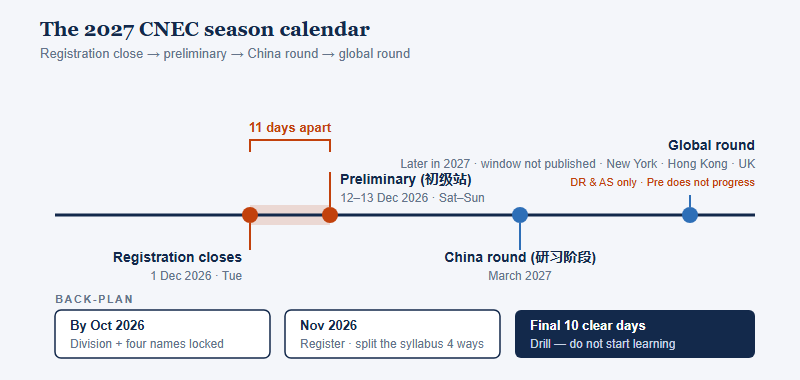
The 2027 CNEC season has four stages, and only three of them carry dates. Per the operator’s 2027-season note, registration for the preliminary closes on 1 December 2026, the preliminary (初级站) is sat on 12–13 December 2026, and the China round follows in March 2027; the global round comes later in the year, hosted across New York, Hong Kong and the UK, with no window published — confirm it on the official CNEC channels. Eleven days separate the registration close from the first paper day, leaving ten clear days in between — so the decisions that shape your season are made in October and November, not December.
The 2027 CNEC calendar at a glance
CNEC is the China route into the NEC (National Economics Challenge), which is run by the US Council for Economic Education. It is a progression, not a single sitting: preliminary → China round → global round — and not every division travels the whole way, because the Pre division does not progress to the global round. The stages are months apart, but the front of the season is compressed into under two weeks, and that is where planning goes wrong.
| Stage | When (2027 season) | What is already locked by then | Who can enter it |
|---|---|---|---|
| Registration closes | 1 December 2026 (a Tuesday) | Division choice and, for DR/AS, your four names | Grades 7–12, under 20 |
| Preliminary (初级站) | 12–13 December 2026 (Saturday–Sunday) | Everything — nothing about entry can change now | Sat individually or as a team |
| China round (研习阶段) | March 2027 | Your team, which progression requires | Team-based |
| Global round | Later in the year — no window published | — | Team-based, DR and AS only — the Pre division does not progress to the global round; hosted across New York, Hong Kong and the UK |
Treat the March round and the later-in-the-year global round as the season shape rather than as bookable dates: the December dates above come from the operator’s 2027-season note, and the China programme sets the exact days, the venue allocation across the three global hosts, and the sitting slots each year. No month or window has been published alongside the three global hosts, so do not plan around one until it is. Confirm the current calendar on the official CNEC channels and the entry platform (webloom.cn), and see our CNEC competition schedule page for the live version.
The trap: eleven days apart, mid-term, with the division already locked
Read the calendar row by row and it looks generous. Registration through to the start of December, the paper in mid-December, then three months to March. Nobody feels rushed in September.
The problem is the shape of those first two dates. Registration closes on 1 December 2026; the preliminary is sat on 12–13 December 2026 (both per the operator’s 2027-season note — confirm on the official CNEC channels and webloom.cn). That is eleven days from the close to the first paper day, and only ten clear days in between: 2 to 11 December. And what you register with is not just a name on a list — it is a division, and with it a team size that cannot be renegotiated afterwards.
Three consequences follow, and they are the whole reason this article exists:
- The division decision is a November decision, not a December one. By the time you are eleven days out, the hardest choice of the season is already behind you, whether or not you made it deliberately.
- Those ten clear days are not preparation time in any meaningful sense. Nobody learns price elasticity, monetary policy transmission and the balance of payments in ten days. That stretch is for drilling material you already hold.
- Mid-December is the worst fortnight in the school year to discover a gap. Across international schools in China, the back half of December typically collides with end-of-term assessments, mocks and reports. Whatever preparation time you imagine you have in that window, discount it heavily.
Put plainly: the season is decided in October and November. December just settles it.
October — settle the division and the four names
Two things have to be finished before the calendar starts compressing, and both are decisions rather than study.
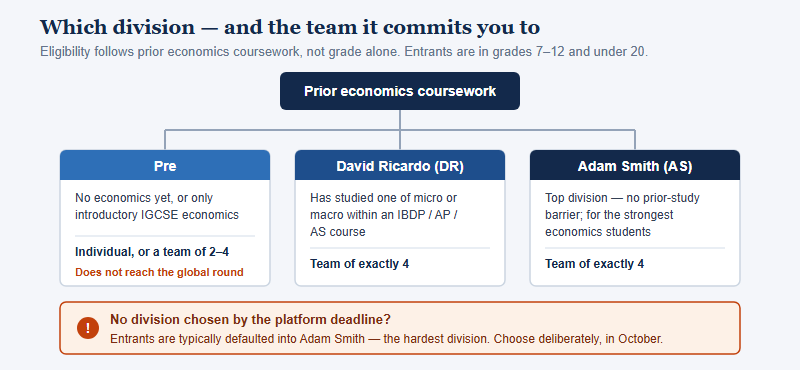
First, the division. CNEC runs three: Pre, David Ricardo (DR) and Adam Smith (AS). Eligibility follows prior economics coursework rather than grade alone, so an ambitious Year 10 student and a Year 12 student can legitimately end up in different places from where their year group would suggest. The team requirement differs too, and that is what makes the choice load-bearing: DR and AS require a team of exactly four, while Pre can be entered individually or as a team of two to four.
One limit belongs inside that choice rather than as a footnote to it: the Pre division does not progress to the global round — per the China programme, 全球站 does not involve Pre. Pre is a real entry point and a sensible one for a student without prior economics, but if a global round is part of the plan you are describing, Pre is not the route to it. Decide which of those two things you are actually optimising for before you register.
There is also a default that catches families every season. If you reach the platform’s deadline without having chosen, entrants are typically defaulted into Adam Smith — the hardest division. Nobody intends to enter the top division by inaction, but it happens, and it happens to exactly the students who were still deciding in late November.
Second, the four names. Because DR and AS are team-only, teammate-finding is preparation, not admin. October is when this is comfortable and late November is when it is not. Two structural points make October the right month rather than a nice-to-have:
- Cross-school teams are permitted, with the team declaring a “home school” on the platform. If your own school does not have four committed students, you are not stuck — but assembling a cross-school four takes weeks of conversations, not days.
- The preliminary can be sat individually, but progression cannot. A student may sit the December paper alone; the China round and the global round are team-based — and the global round is a DR and AS stage only, since the Pre division does not progress to it. So “we will sort the team out after we see the December result” is a plan that works right up until it works, and then costs you March.
If you want the full rules — who qualifies for which division, how the home-school declaration affects team honours, and how cross-school entries are handled on the platform — that is set out in our guide to the 2027 CNEC divisions and team rules.
November — register, then split the syllabus four ways
November has one hard deadline and one soft discipline.
The hard deadline is 1 December 2026, per the operator’s 2027-season note — check it against the official CNEC channels and webloom.cn before you build a plan on it. Register on the platform with time to spare, because the failure mode here is not forgetting — it is discovering on 29 November that one of your four has a scheduling conflict, or that a division definition reads differently from how you remembered it. Give yourself a week of slack against a deadline you cannot move.
The soft discipline is the one that separates teams that peak in December from teams that panic in December: split the syllabus across four people rather than having four people revise the same thing. DR and AS both examine microeconomics, macroeconomics, and international economics and current affairs. Four students revising all three areas identically produces a team with one shared blind spot. A four-way split with deliberate overlap produces a team where somebody always has the answer.
| Approach | What each member does in November | Where it breaks |
|---|---|---|
| Everyone revises everything | Four parallel general reviews | Shared blind spots survive to exam day; nobody is deep enough to carry a hard question |
| Four-way split, no overlap | One area each, strictly | One absent or weak member removes an entire content area from the team |
| Split with paired overlap (recommended) | Each member owns one area and second-covers a teammate’s | Requires the team to have existed since October — which is the point |
Note what that last row implies. Paired ownership only works if the four people know each other’s strengths, and that knowledge takes a month of working together. A team formed on 28 November physically cannot run this, which is why it defaults to the first row and why the first row is so common.
For structured practice sets and past-round material organised by division, ask this desk and we will send the current set — our preparation resources page lists what is available and how the material is organised for a four-way split.
The final ten days — drill, do not learn
Between the close on 1 December and the paper on 12 December — ten clear days, 2 to 11 December — there is time for exactly one thing: converting knowledge you already have into speed and accuracy under timed conditions. That means full timed sets rather than topic reading, error logs rather than new notes, and mental arithmetic practice rather than fresh theory.
The most useful test of whether your season was planned well is simple: if those ten days feel like consolidation, October and November were done properly. If they feel like learning, they were not. There is no version of this window in which cramming three content areas across four people works, and pretending otherwise is how strong students end up with results that do not reflect them.
Two practical notes for the window itself. The paper falls on a Saturday and Sunday (12–13 December 2026), which is worth knowing when you plan family logistics and the last full practice sitting. And the platform sets the sitting arrangements and any mock window each year, so confirm those details on the official CNEC channels rather than assuming last season’s pattern.
The most common way a strong student underperforms
It is worth being blunt about this, because it is the single pattern we see repeat.
A strong economics student underperforms at CNEC far more often because of a team formed late than because of a knowledge gap. The mechanism is not mysterious. A team assembled in the final days before the paper has no shared preparation, no division of the syllabus, no established communication habits, and frequently a member who joined to fill the fourth seat rather than because they wanted to be there. All four students may individually be capable. The team is still starting from zero on the one dimension the competition actually rewards.
The corollary is encouraging: this is the cheapest problem in the whole season to fix, because fixing it costs conversations in October rather than study hours in December. Of everything in this calendar, the highest-return action is simply having four committed names before the autumn half-term ends.
What the season looks like after December
Teams that come through the preliminary move to the China round in March 2027, which is team-based — the point at which entering alone stops being an option. From there the global round follows later in the year, hosted across New York, Hong Kong and the UK — and it is a DR and AS stage: the Pre division does not progress to the global round.
Two planning implications are worth flagging in December, not in April. First, the March round sits inside another busy academic window, so a team that intends to advance should keep meeting through January and February rather than disbanding after the preliminary. Second, the global round runs across three host locations and no window for it has been published, so travel decisions — passports, visas, school absence, family calendars — need lead time rather than a pencilled-in month. Venue allocation and exact dates are set by the organiser and the China programme; confirm them on the official CNEC channels before booking anything.
What we see in our own cohorts
CNEC has run in China since 2016 and, per the China programme, is present in 20+ provinces and 300+ schools, so the numbers below are a slice of a large field rather than a representative sample, and they are not a promise of anything.
In the 2026 season, across the students we worked with (de-identified, per Hanlin, and results vary): the Adam Smith division took first globally in Critical Thinking, the David Ricardo division took second in Quiz Bowl, and 14 teams advanced to the global round.
What is worth taking from that is not the placings but the shape behind them: teams that reached the global round were, without exception, teams that existed months before the December paper. None of them were assembled in the days between the registration close and the paper.
A one-page version of the back-plan
| By when | What must be done | Why it cannot wait |
|---|---|---|
| End of October 2026 | Division chosen; four committed names (or 2–4 for Pre, which does not progress to the global round) | Division is locked at registration; cross-school teams take weeks to assemble |
| Mid-November 2026 | Syllabus split four ways with paired overlap; weekly team sessions running | Paired ownership needs a month of working together to be real |
| By 24 November 2026 | Registered on the platform, division confirmed, team declared | A week of slack against the 1 December close, which cannot move |
| 2–11 December 2026 | Timed full sets, error logs, mental arithmetic | Ten clear days is a drilling window, not a learning window |
| January–February 2027 | Keep the team meeting | The March China round is team-based and arrives fast |
For the current live dates and the entry route, see our CNEC programme page and confirm on webloom.cn before acting on any date in this article.
Frequently asked questions
When does registration for the 2027 CNEC preliminary close, and when is the paper?
Per the operator’s 2027-season note, registration for the preliminary closes on 1 December 2026 and the preliminary (初级站) is sat on 12–13 December 2026, a Saturday and Sunday. That is eleven days from the close to the first paper day, leaving ten clear days (2–11 December) in between. Because dates and sitting arrangements are set each year, confirm the current calendar on the official CNEC channels and webloom.cn before planning around them.
Can I change division after registering for CNEC?
Division is chosen at registration on the platform, and it is what commits you to a team size, so treat the choice as final and settle it in October. Entrants who do not choose a division by the platform’s deadline are typically defaulted into Adam Smith, the hardest division. If you believe you need to change after registering, check the current-year platform rules rather than assuming it is possible.
Do I need a full team of four before 1 December 2026?
For David Ricardo and Adam Smith, yes — both require a team of exactly four. Pre can be entered individually or as a team of two to four. A student may sit the preliminary individually, but progression to the March 2027 China round is team-based — and the global round, held later in the year, does not involve the Pre division at all. Build the team before December rather than after results, and pick the division with the whole season in view.
When is the rest of the 2027 CNEC season?
The China round (研习阶段) is in March 2027, per the operator’s 2027-season note, and the global round follows later in the year, hosted across New York, Hong Kong and the UK — the Pre division does not progress to it. No month or window has been published alongside the three hosts, and exact dates and venue allocation are set by the organiser and the China programme — confirm on the official CNEC channels and webloom.cn before making travel plans.
Published by the CNEC editorial desk, operated by Hanlin Education as an authorised China test centre for the NEC. The NEC is run by its organiser, the US Council for Economic Education; official rules, dates and arrangements are set by the organiser and the China programme and can change — always confirm on the official CNEC channels and webloom.cn. Student results cited are de-identified Hanlin data and vary between students and seasons. Confirmed errors reported to us are corrected within 7 working days.