Across one recent CNEC season, the strongest outcomes in the cohort we coach did not come from the multiple-choice rounds — they came from Critical Thinking and Quiz Bowl. That single pattern is the most useful thing a season of results can tell you, because it says that content revision gets a team into the competition, while reasoning and recall speed decide where it finishes.
The results, stated plainly
Here is what the operator recorded for the cohort we coach, de-identified and reported per Hanlin. Results vary between teams, schools and seasons, and none of this predicts any individual team's outcome.
- In the Adam Smith division, a team we coach placed first globally in Critical Thinking.
- Also in the Adam Smith division, representing China, that team won the Quiz Bowl against the United States champion team — described by the operator as the strongest result recorded in five years.
- In the David Ricardo division, the China Quiz Bowl placing was second.
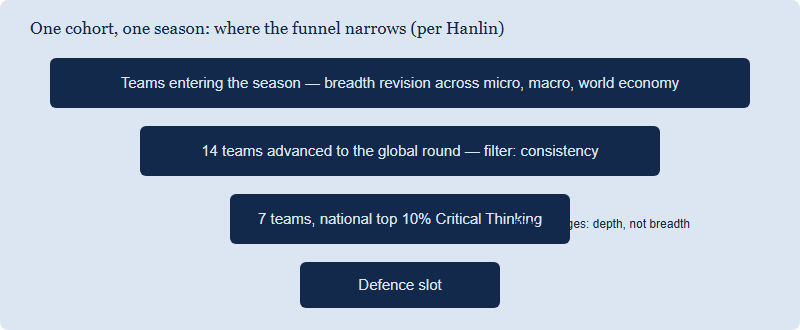
- 14 teams from the cohort advanced to the global round.
- 7 teams reached the national top 10% in Critical Thinking, earning the young-economist defence slot.
Two clarifications before drawing lessons, because both matter for reading these numbers honestly. First, the two Quiz Bowl results describe different divisions — the first-place Quiz Bowl outcome sits in Adam Smith, the second-place outcome in David Ricardo. They are not competing claims about the same event. Second, the organising committee positions CNEC as a professional social-practice activity rather than something linked to domestic school admission, and nothing here should be read as an admissions signal.
Both peaks landed in the rounds that are not recall tests
NEC assesses, in the Council for Economic Education's own words, “key micro and macroeconomic principles, as well as their knowledge of the world economy”. Most teams translate that into a revision plan: work through microeconomics, work through macroeconomics, add international economics, sit practice papers. That plan is necessary. What a season of results shows is that it is not what separates the top of the field.
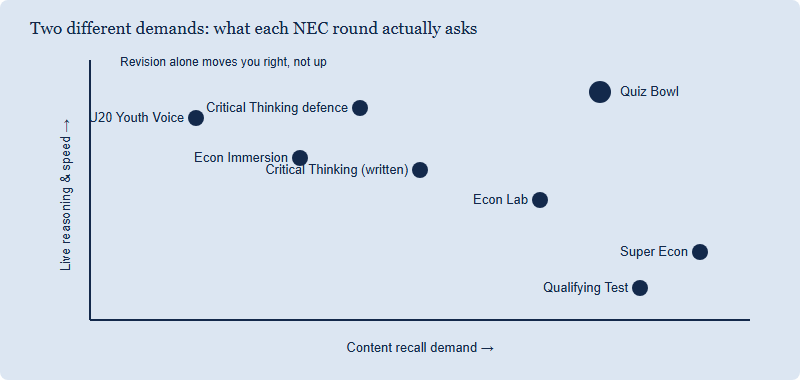
Both headline outcomes above came from rounds where the answer is not sitting in a textbook waiting to be recalled. Critical Thinking asks a team to build a defensible line of reasoning on an open problem. Quiz Bowl asks a team to convert knowledge it already holds into a correct answer faster than another team can. Neither is a content test in the ordinary sense — one is a reasoning test, the other a retrieval-speed and coordination test. If you want the full picture of how the rounds divide up, we have mapped them in the NEC rounds, explained.
The practical implication is uncomfortable for the way most teams revise. A team can raise its written accuracy substantially and move very little in the rounds that decided these results, because those rounds test a different capability. Revision builds the stock of knowledge; Critical Thinking and Quiz Bowl test what you can do with it under constraint.
Two divisions, two different readings of the same round
The Adam Smith and David Ricardo Quiz Bowl outcomes look similar on paper and mean different things in practice, because the divisions are not built for the same student.
The Council for Economic Education describes the David Ricardo Division as being “for students participating in the NEC for the first time and who have taken no more than one economics course”, and the Adam Smith Division as being “for advanced placement, baccalaureate, honors students, and returning competitors”. Note the phrase “returning competitors” — one of the defining features of the advanced track is that many of the teams in it have done this before. We cover what that means for entry choice in our guide to the Adam Smith division. Division criteria as they apply to the China national round are set by the organiser and can differ from the US-side description, so confirm which definition governs your entry before you commit.
Read that way, a second place in David Ricardo Quiz Bowl is a result achieved with a shorter content runway and, typically, less competition experience in the room. A first place in Adam Smith Quiz Bowl is a result achieved against teams that have been through the format before. Neither is “better”; they answer different questions about a team. If you are choosing a division this season, the useful question is not which one looks more impressive — it is which one puts you in a room where the marginal hour of preparation still moves your placing.
The funnel narrows on a skill most teams train last
The two cohort-level numbers are more instructive than the podium results, because they describe a shape rather than a peak.
Fourteen teams advanced to the global round. Seven reached the national top 10% in Critical Thinking and earned the young-economist defence slot. Advancement and Critical Thinking distinction are not the same filter, and they do not select for the same thing. Advancement rewards consistency across breadth — a team that is solid across microeconomics, macroeconomics and world economy, with no collapsing section. The Critical Thinking distinction rewards depth on a single problem — one argument, carried far enough to survive scrutiny.
That distinction should change how a team allocates its weeks. Breadth work and depth work are not substitutes, and doing more of the first does not gradually produce the second. A team that only ever sits mixed practice papers is training exclusively for the first filter. Reaching the second filter requires deliberately spending time on very few problems, taken much further than a practice paper would ever ask.
Turn the season into your own diagnostic
The point of reading someone else's results is not admiration — it is calibration. Each observed outcome implies a specific capability, and each capability has a training method that actually builds it.
| What was recorded (per Hanlin) | What that outcome rewards | What to build this term |
|---|---|---|
| Critical Thinking, first globally (Adam Smith) | A reasoning chain with stated assumptions that survives challenge | One open problem per fortnight, written up in full, then defended aloud to a teammate playing sceptic |
| Quiz Bowl won against the US champion team (Adam Smith) | Instant retrieval plus a team protocol for who answers what | Timed cold-recall drills on definitions; agree in advance who owns micro, macro and world-economy prompts |
| Quiz Bowl second (David Ricardo) | The same retrieval skill on a shorter content runway | Narrow the recall set deliberately; master a deliberately narrow core term list cold before widening |
| 14 teams advanced to the global round | Consistency across all three subject areas, with no weak section | Full-length mixed papers plus an error log sorted by topic, not by paper |
| 7 teams in the national top 10% for Critical Thinking | Depth on one problem rather than coverage of many | Take one problem far past the point a practice paper stops; stress-test the assumptions |
Run your own team through the left-hand column honestly. Most teams find they have been training row four and hoping rows one to three come free. They do not. If your written accuracy is already solid and your placing has stalled, the constraint is almost certainly retrieval speed or reasoning depth, and neither improves by sitting another mixed paper.
One further note on who is doing the assessing. The lead economics coach on our side has judged at the NEC China final across multiple seasons. That vantage point is worth flagging for a specific reason: the difference between a competent answer and a distinguished one is usually visible within the first minute of reasoning, not at the end of the working. Teams that lead with a clear claim and a stated assumption read differently from teams that arrive at a claim after four paragraphs of throat-clearing.
What a season of results does not tell you
Being precise about the limits of this evidence matters more than the headline numbers.
These are the outcomes of one coached cohort in one season, reported by the operator and de-identified. They are not a league table, not a sample large enough to generalise from, and not a forecast. Results vary substantially between teams, schools and seasons, and any team's outcome depends on factors no coaching arrangement controls. Nothing in these results connects to domestic school admission, and the organising committee is explicit that CNEC is positioned as a professional social-practice activity rather than an admissions credential.
They also tell you nothing about the rules. Every date, fee, division criterion, team-size requirement and advancement threshold is set by the competition, published through the official channels, and revised from season to season. Confirm all of it on the official CNEC channels and on councilforeconed.org before you plan around it.
What the results do support is a modest, useful claim: in this competition, breadth gets you through and depth decides the top. If you are weighing NEC against the economics essay competitions, that trade-off is one of the real differences between the two formats, which we set out in NEC versus the economics essay prizes.
Do the Quiz Bowl and Critical Thinking results describe the same team?
No. The first-place Quiz Bowl and Critical Thinking results sit in the Adam Smith division; the second-place Quiz Bowl result sits in David Ricardo.
What is the young-economist defence slot?
Per the operator, teams reaching the national top 10% in Critical Thinking earned it. Confirm eligibility and format on the official CNEC channels.
Does advancing to the global round mean a team was strong in Critical Thinking?
Not necessarily. Advancement rewards consistency across all three subject areas; the Critical Thinking distinction rewards depth on one problem.
Can I use these results to predict my own team's placing?
No. This is one cohort in one season, reported per Hanlin. Results vary and nothing here forecasts an individual outcome.
Published by the NEC (CNEC) editorial desk, operated by Hanlin Education for China-based international-school students. Official rules are set by the competition and change yearly — confirm current details on councilforeconed.org. Errors are corrected within 7 working days.