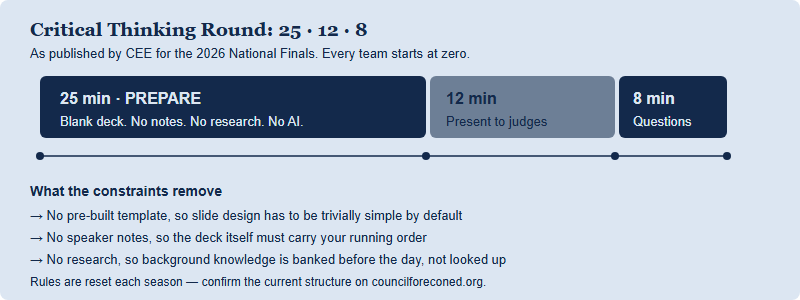
In the rules the Council for Economic Education (CEE) published for the 2026 National Economics Challenge finals, the Critical Thinking Round gave teams 25 minutes to prepare, 12 minutes to present and 8 minutes to answer judges' questions — starting from a blank slide deck, with no speaker notes, no research and no internet beyond the shared file itself. That is a production problem as much as an economics problem, and it needs its own protocol.
The clock, exactly as published
It is worth being precise about the structure, because most summaries of this round describe the reasoning and skip the constraints. According to CEE's published 2026 rules, the top sixteen teams at the National Finals — eight from Adam Smith and eight from David Ricardo — took part in a Critical Thinking Round, and the score from that round determined the top four teams from each division that advanced to the finals Quiz Bowl. Every team began the round on a score of zero, regardless of how they had performed to get there.
That last detail deserves a moment. Whatever your team did on the written rounds does not carry forward into this one. A team that squeaked into the finals and a team that topped its division arrive at the Critical Thinking Round on level terms. For students who have spent months optimising a multiple-choice score, that is a strategic fact, not a piece of trivia: the round most likely to decide your placement is the one least like the round you probably trained hardest for. Our round-by-round guide to the seven NEC events sets out how the pieces relate.
What "blank deck, no speaker notes" actually removes
CEE's published rules for that round were unusually specific about the working environment. The internet could be used only to create a shared presentation — not for research, and explicitly not for AI. No other programs or applications could be open — the document specifically prohibited messaging apps, naming iMessage, WhatsApp and WeChat, along with any social media platform. All presentations had to begin from a blank PowerPoint or Google Slides deck. Slides could not contain notes or speaker's notes. Additional devices — phones, tablets, other hardware — were prohibited, and violations, including cheating, carried immediate disqualification.
Read as a set, those constraints tell you what kind of preparation transfers and what kind does not.
- Template craft is worthless. You cannot import a house style, so anything that takes more than a few seconds to format is time stolen from analysis. Decide in advance that your deck will be text on plain slides, and never negotiate that on the day.
- The deck is your script. With speaker notes banned, whatever keeps a nervous speaker on track has to be visible on the slide — which in practice means short, declarative headline sentences rather than topic labels. A slide headed "Impact" helps nobody; a slide headed "Higher input costs squeeze margins before they reach consumers" is both a claim and a cue.
- Background knowledge is a pre-loaded asset. You cannot look anything up, so every statistic, date or case you might want has to already be in someone's head. This is the strongest argument for the habit of following economic news through the season rather than cramming theory alone.
- Device discipline is a real risk, not a formality. Close everything before you start. A notification from a messaging app on a screen that judges or proctors can see is not worth the argument.
A minute-by-minute build protocol
Twenty-five minutes feels generous until you have spent nine of them arguing about what the question is really asking. The protocol below exists to make the expensive decisions early and cheaply, and to guarantee that the last three minutes are always spent the same way.
| Minutes | Phase | Who leads | Output before you move on |
|---|---|---|---|
| 0–3 | Read and frame | Whole team, silent first | One sentence naming what is actually being asked, agreed out loud |
| 3–7 | Choose framework and thesis | Lead | The economic model you will use, and a single-sentence position |
| 7–17 | Parallel build | Two analysts + one builder | Mechanism, evidence and trade-offs drafted straight into slides |
| 17–21 | Sequence and cut | Lead | Running order fixed; anything that does not serve the thesis deleted |
| 21–23 | Assign and time | Whole team | Who speaks to which slide, with a rough second count |
| 23–25 | Transitions and stress test | Whole team | Handovers rehearsed once; two likely judge questions named |
Three notes on why the shape is this way. The first three minutes are silent on purpose. Teams that start talking immediately converge on whoever spoke first, and the framing question — is this a supply-side problem, a demand-side problem, or a distributional one? — is the single decision with the largest downstream effect. Read alone, then compare.
The build phase runs in parallel, not in sequence. Four people taking turns to contribute to one shared document wastes the round's scarcest resource. One person types into the deck continuously while two work on substance and hand it over in fragments. A deck that is being written from minute seven is a deck that exists at minute seventeen.
Cutting is a phase, not an afterthought. Almost every team over-produces. Twelve minutes across four speakers is roughly three minutes each; a deck that cannot be delivered in that time will be truncated by the clock, which means the judges never hear your conclusion. Deleting a slide you liked is cheaper than being stopped mid-argument.
Build to the judging criteria, not to the aesthetics
CEE's published rules set out what judges scored: completeness of response, economic analysis and insight, background knowledge, and presentation, together with responses to the judges' questions. Those criteria are not earned at the same moment, and mapping them onto the clock changes how you allocate effort.
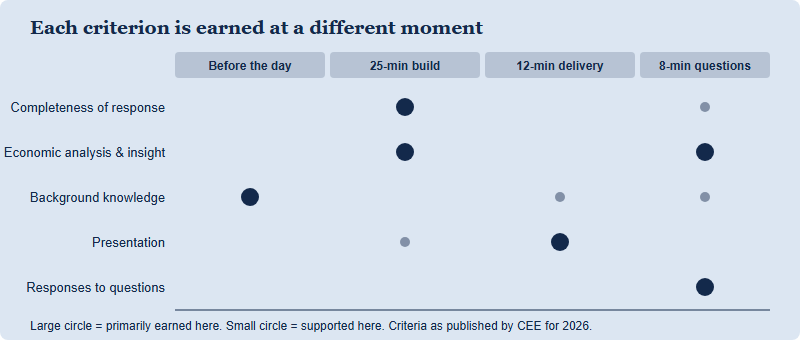
Two implications follow. First, completeness is usually lost in the build, not in the delivery. Teams that answer only the half of the problem they find interesting are scoring against themselves before they speak. A cheap safeguard: at minute seventeen, one person reads the prompt aloud again and checks it clause by clause against the running order.
Second, presentation is a build decision disguised as a delivery skill. Judges experience your structure, and structure is fixed during the sequencing phase. A well-ordered argument delivered plainly reads as competent; a brilliant argument delivered out of order reads as confusion.
Twelve minutes and eight minutes are different performances
The 12-minute presentation is rehearsed material. The 8-minute question period is not, and the shift catches teams out. In the presentation your job is coverage and clarity; in the questions your job is to defend a specific claim, concede where a judge is right, and hold the line where they are testing you. Teams that have practised only the delivery half arrive at minute thirteen having used up everything they prepared.
The cheapest insurance is built into the protocol above: in the final two minutes of preparation, name the two questions you would ask if you were the judge. Usually they are obvious — the assumption you glossed over and the trade-off you did not quantify. Deciding in advance who answers each one converts your most exposed moment into a semi-rehearsed one. This live, spoken defence of an argument is also the clearest structural difference between NEC and written economics competitions, which we set out in our comparison of the test-and-team format against the essay prizes.
A first-party pattern from three seasons
Drawn from the teaching record of one of our economics coaches and de-identified: across three seasons, that single coaching cohort saw its recognition cluster in this round more than anywhere else. In the 2026 season, two teams from that cohort were recognised as best in critical thinking; in 2024, two teams from the same cohort were named top teams in critical thinking; and in 2025 a team placed seventh in critical thinking at the global round. Over the same period the cohort's advancement rate from the national round to the global round ran at six of eight teams in 2026, four of eight in 2025 and seven of eleven in 2024.
The pattern worth extracting is not the medal count. It is that recognition in the critical thinking event on its own route recurred across cohorts with different students each year — which is what you would expect if the round rewards a trained process rather than an unusually gifted individual. That is encouraging for any team willing to rehearse the 25 minutes as a drill rather than treating it as something you improvise on the day. This is one coach's cohort record, not a company-wide or official total, and results vary between students, teams and seasons.
A closing note on scope. Everything above is drawn from what CEE published for the 2026 United States finals. The China national round administered through CNEC runs its own division and event structure, and formats are reset each season. If your team is deciding which entry tier to target, our guide to the Adam Smith division covers what changes at the advanced level — and whatever your round, confirm the current preparation window, presentation length and permitted materials on the official channels before you rehearse to a clock that may have moved.
How long do teams get to prepare in the Critical Thinking Round?
CEE's published 2026 finals rules allow 25 minutes to prepare, 12 minutes to present and 8 minutes for judges' questions. Confirm the current season.
Can you bring a prepared slide template?
No. The published rules required teams to begin from a blank PowerPoint or Google Slides deck, with no notes or speaker's notes on slides.
Is internet research allowed during the round?
No. The internet could be used only to create the shared presentation; research, including AI use, was prohibited during competition.
Does your earlier score carry into this round?
No. Under the published rules every team began the Critical Thinking Round on zero, and that score set who advanced to the Quiz Bowl.
Published by the NEC (CNEC) editorial desk, operated by Hanlin Education for China-based international-school students. Official rules are set by the competition and change yearly — confirm current details on councilforeconed.org. Errors are corrected within 7 working days.