When CNEC asks you to explain how monetary policy affects the economy, examiners want more than a list of channels. They want you to trace the causal chain: from the central bank’s action, through financial markets, to spending decisions, with attention to what changes and what stays uncertain. This article builds that skill with a worked hypothetical teaching illustration, a contrasting case where the standard transmission breaks down, and a diagnostic you can apply to any policy scenario.
What the Federal Reserve Actually Says About Transmission
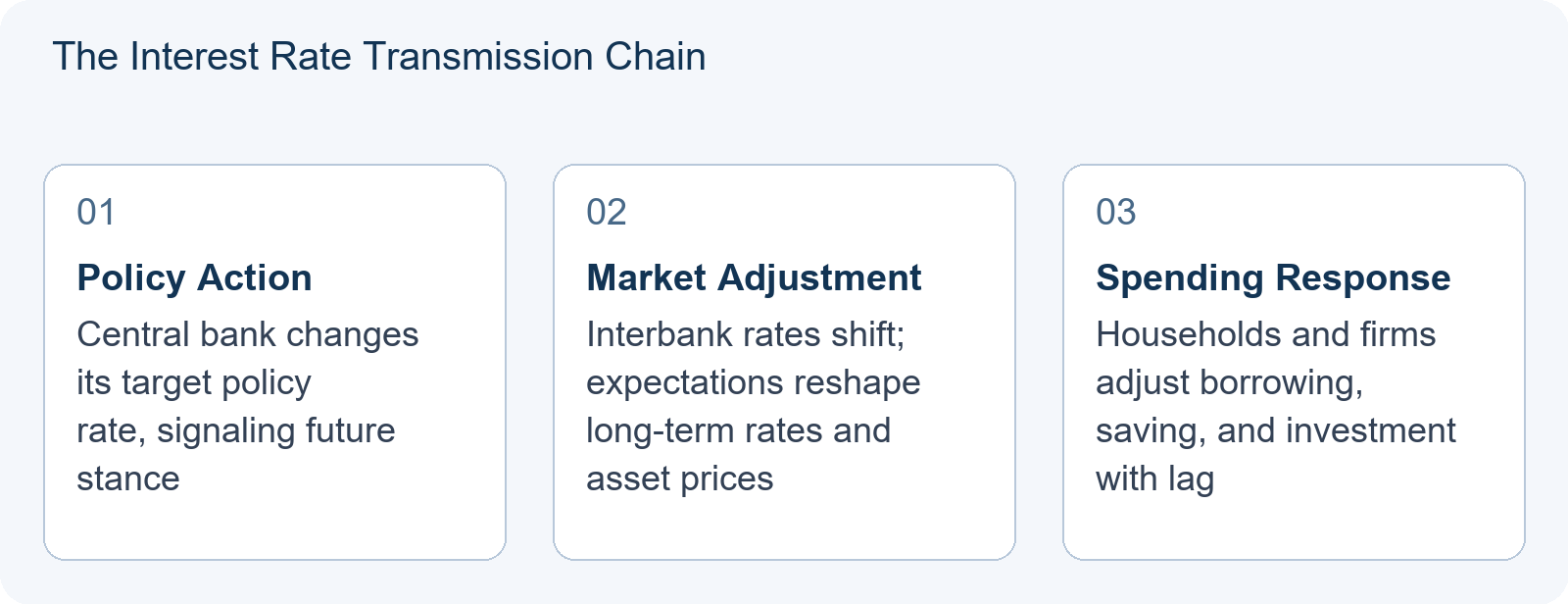
According to the Federal Reserve’s own explanation of monetary policy, policy influences market rates, expectations, credit conditions, asset prices, and exchange rates, which in turn affect spending over time. Long-term rates depend on expected future conditions. There is no fixed, guaranteed quantitative response. This is essential for NEC Monetary Policy preparation: you must describe transmission as conditional and lagged, not mechanical.
The policy rate set by a central bank is not the same as the rate a borrower pays. The lending rate for any specific loan includes credit risk, administrative costs, and bank markup. A change in the central bank’s target ripples through interbank markets and eventually to consumer and business loans, but the pass-through is neither automatic nor complete. Expectations about future policy, exchange rate movements, and asset price reactions all condition the final effect on spending and inflation.
Teaching Illustration: Tracing a Rate Cut Step by Step
Consider a hypothetical household with an outstanding variable-rate loan of $10,000, no fees, simple annual interest, and the same balance throughout the year. The initial annual rate is 5 percent. The central bank cuts its policy rate, and after transmission the household’s lending rate falls to 4 percent.
Step 1: Calculate original annual interest.
$10,000 × 0.05 = $500
Step 2: Calculate new annual interest after the rate change.
$10,000 × 0.04 = $400
Step 3: Compute the household’s saving.
$500 − $400 = $100
The rate fell by 1 percentage point, not by 1 percent. A drop from 5 percent to 4 percent is a 20 percent reduction in the interest rate itself, but the change in percentage points is what borrowers typically observe. The household’s response is uncertain: they might spend the $100, save it, or pay down principal faster. Savers who depend on interest income face the opposite effect and may reduce spending. This ambiguity is what makes monetary policy transmission a topic of analysis, not just arithmetic.
The Conditional Channels: When Policy Works and When It Does Not
The hypothetical illustration above assumes the lending rate moves with the policy rate. In reality, several channels operate, and their strength varies:
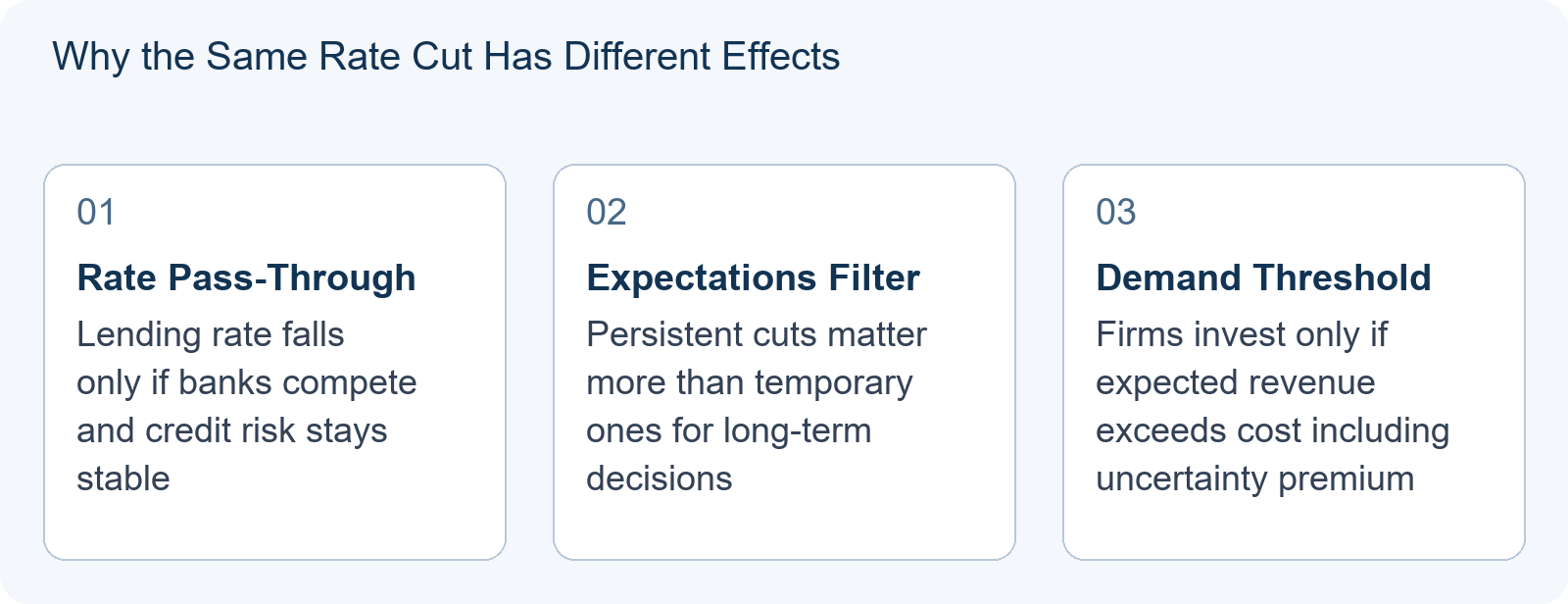
Interest rate channel: Lower policy rates reduce short-term market rates, which can feed into lower loan rates for creditworthy borrowers. The pass-through depends on bank competition, default risk premiums, and the term structure.
Expectations channel: If households and firms expect the rate cut to be reversed quickly, long-term rates may not move much. Long-term rates depend on expected future conditions, not just today’s announcement.
Asset price channel: Lower rates can raise equity and bond prices, creating wealth effects that boost consumption. This is conditional on investor sentiment and global capital flows.
Exchange rate channel: A rate cut can depreciate the currency, making exports cheaper and imports dearer. This depends on what other central banks are doing and on currency traders’ expectations.
Credit conditions channel: Even with low policy rates, banks may tighten lending standards during uncertainty. The central bank rate and the lending rate diverge when credit risk rises.
Contrasting Case: Why a Firm Might Not Invest Despite Cheaper Loans
Suppose a manufacturing firm can borrow at a variable rate tied to the central bank’s policy rate. The rate falls from 5 percent to 4 percent, reducing the firm’s annual interest cost on a planned $100,000 investment loan from $5,000 to $4,000. The saving is $1,000 per year.
Yet the firm defers the investment. Why? Demand uncertainty. If consumers are pessimistic about future income, expected sales revenue may fall by more than the $1,000 interest saving. The net present value of the project turns negative not because of financing costs, but because of revenue risk. This is the evidence check: lower borrowing rates alone are not sufficient to induce this investment. The same rate cut that helps a household with stable employment may fail to move a firm facing volatile orders.
This contrast reveals a common exam error. Students often write “lower interest rates increase investment” as a mechanical rule. The accurate statement is: lower interest rates, ceteris paribus, reduce the cost of borrowing and can stimulate investment, but the actual response depends on demand expectations, credit availability, and other investment determinants. NEC Monetary Policy questions reward this nuance.
Diagnostic Application: Annotated Reasoning
Scenario: A central bank cuts its policy rate by 0.5 percentage points. Analyst A predicts rapid GDP growth. Analyst B predicts no change. Evaluate both positions using the channels above.
Annotated reasoning for Analyst A: If the rate cut is expected to persist, long-term rates fall, asset prices rise, and the exchange rate depreciates. Households with variable-rate debt see higher disposable income. Firms with strong demand expectations expand. Transmission operates through multiple reinforcing channels.
Annotated reasoning for Analyst B: If banks tighten lending standards due to recession fears, the lending rate may not fall by the full 0.5 percentage points. Firms facing demand uncertainty do not borrow despite cheaper rates. Households worried about job security save any interest savings. The exchange rate may not move if other central banks cut simultaneously. Transmission is blocked.
Conclusion: Both positions are logically possible. The difference lies in assumptions about expectations, credit conditions, and the external environment. A complete answer must specify which channels are active and why.
What This Means for Your Next Learning Task
The diagnostic result tells you whether you need to strengthen channel identification or conditional reasoning. If you defaulted to “rates down, spending up,” practice stating ceteris paribus explicitly and then listing the conditions that must hold. Useful feedback would identify which channel you omitted and whether your conclusion was overstated.
For further reading, see How NEC Tests Loanable Funds and Bond Prices: Real Rates, Nominal Rates and the Graph Students Mix Up, which examines the difference between nominal and real rates that this article’s hypothetical illustration assumes away. For the broader macroeconomic framework, consult The Macroeconomics You Need for NEC: GDP, Inflation and Policy, Decoded. For the international dimension of rate changes, see How NEC Tests International Economics: Trade, Exchange Rates and the Balance of Payments.
Applying the Diagnostic: The Zero-Bound Trap
The previous sections traced how a rate cut from 5 percent to 4 percent affects borrowers and firms. But what happens when the central bank cuts rates from 1 percent to 0.5 percent? Or when it attempts to cut below zero? This is where standard transmission logic often fails, creating a distinct analytical challenge for NEC Monetary Policy questions. Examiners frequently test whether you can identify the Zero Lower Bound (ZLB) or effective lower bound as a constraint on policy efficacy.
Teaching illustration: Consider a hypothetical household with $10,000 in savings earning an annual interest rate of 1 percent. Their annual interest income is $100 ($10,000 × 0.01). If the central bank cuts the policy rate by 0.5 percentage points, the lending rate falls, but the deposit rate also falls to 0.5 percent. The household’s new interest income is $50 ($10,000 × 0.005). They have lost $50 in income. Unlike the borrower who gains disposable income, this saver faces a reduction in interest income. If they are liquidity-constrained or rely on interest income for retirement, they may reduce consumption further to maintain their savings buffer, counteracting the intended stimulus.
This creates a paradox: the same policy action that stimulates spending for debtors depresses spending for creditors. In a net-debtor economy, the aggregate effect might still be positive. However, if households are predominantly net-savers, or if banks refuse to pass through negative rates to depositors (keeping them at 0 percent), the transmission mechanism weakens significantly. Banks may absorb the cost themselves, compressing their net interest margins without lowering consumer loan rates proportionally. This is the bank profitability channel, which acts as a brake on transmission.
Diagnostic Question: Evaluating Policy Limits
Scenario: A central bank has already reduced its policy rate to 0.25 percent. It announces a further cut to 0.10 percent. Analyst C claims this will boost investment because borrowing costs are now “effectively free.” Evaluate this claim using the concepts above.
Correct Analysis: Analyst C’s claim is flawed for three reasons. First, the absolute reduction in interest cost is minimal (0.15 percentage points). For a firm borrowing $1 million, the annual saving is only $1,500. Second, if the firm’s demand uncertainty remains high (as discussed in the contrasting case), this small saving is unlikely to change the Net Present Value calculation enough to trigger investment. Third, if banks are unwilling to lend due to compressed margins or credit risk fears, the lower policy rate does not translate into available credit. The ZLB implies that conventional interest-rate tools lose potency; further cuts yield diminishing returns compared to initial reductions from higher levels.
Next Practice Task: Mapping Diminishing Returns
To solidify this understanding, perform the following exercise. Create a table comparing two scenarios: (A) A rate cut from 5% to 4%, and (B) A rate cut from 1% to 0.5%. Calculate the percentage point change and the relative percentage change in interest costs for a $10,000 loan in both cases.
In Scenario A, the rate falls by 20% and the annual interest cost falls by 20% as well (from $500 to $400), giving an absolute saving of $100. In Scenario B, the rate falls by 50% and the annual interest cost also falls by 50% (from $100 to $50), but the absolute dollar saving is only $50. More importantly, analyze the expectations. If rates are near zero, markets may interpret further cuts as a sign of severe economic weakness rather than aggressive stimulus. This can increase risk premiums, causing long-term rates to rise despite short-term cuts—an illustrative expectations channel whose direction depends on how markets interpret the announcement. Write a 150-word paragraph explaining why a central bank might choose quantitative easing over further rate cuts when facing the ZLB, referencing the asset price channel and expectations channel.
This task forces you to move beyond mechanical arithmetic to strategic interpretation, a key skill for high-scoring NEC responses. Remember, monetary policy is not just about the level of rates, but about the credibility of the central bank’s commitment to future inflation targets when current rates cannot go lower.
Frequently Asked Questions
Why does the article use a hypothetical $10,000 loan instead of an official NEC past problem?
The Federal Reserve source and standard pedagogical theory provide sufficient grounding for a teaching illustration. The hypothetical is explicitly labelled as such, not as an official contest problem. It allows checked arithmetic without claiming NEC has used this exact scenario.
How should I explain ‘1 percentage point’ versus ‘1 percent’ in an exam answer?
A change from 5 percent to 4 percent is a 1 percentage point decrease. It is also a 20 percent decrease in the rate itself (1/5 = 0.20). In monetary policy contexts, state the percentage point change for clarity, then note that the proportional impact depends on the starting level.
If lower rates do not always stimulate investment, what should I write for a full-mark response?
State that lower rates reduce the cost of borrowing, ceteris paribus, which can stimulate investment. Then specify that the actual response depends on demand expectations, credit availability, the expected persistence of the rate change, and other investment determinants. Use the contrasting firm case to show you understand the conditionality.