For many students preparing for the China National Economics Challenge (CNEC), the preliminary round is not just a test of economic theory; it is a test of self-awareness. After completing a practice mock, you might receive a score, but that number alone tells you very little about what to do next. Did you lose points because you misunderstood marginal utility? Or did you run out of time on the final questions? The difference dictates entirely different study strategies.
This article focuses on NEC mock test report interpretation. Specifically, we will look at how to read the diagnostic fields generated by operator-led mock assessments, such as the Hanlin mock described in the October 16, 2026 note. The source note dated October 16, 2026 describes a free CNEC mock that covers microeconomics, macroeconomics, and world economics, including objective questions and a team Critical Thinking (CT) simulation. The report then marks weak knowledge points, locates loss reasons, and judges a suitable division. By learning to decode these tags, you can move beyond vague feelings of being bad at macro to executing precise revision actions before the preliminary window.
If you are still deciding whether a mock belongs in your preparation, the Prep Test to Mock CNEC: The Five-Stage Ladder, and How to Tell Which Rung You Are On explains the stage question. This article begins after that question is answered: you already have a mock report, and you need to turn it into a plan.
Beyond the Score: Why Diagnostic Tags Matter More Than Raw Numbers
A raw score is a lagging indicator. It tells you where you ended up, but not why. In contrast, diagnostic tags are leading indicators. They point to the root cause of your performance gaps. For instance, if your mock report flags time management as a primary loss reason, spending another week reading textbook chapters on GDP calculation will not help. You need to practise pacing. Conversely, if the report flags weak knowledge points in international trade, no amount of speed drilling will fix the underlying conceptual gap.
The value of a mock assessment lies in its ability to simulate the real exam environment while providing granular feedback. According to Hanlin’s October 16, 2026 note, the free mock is timed and closed-book, and it simulates the real online exam environment. The system automatically generates a personal or team score report. That report is not an official NEC score report; it is an operator diagnostic tool. Treat it as preparation intelligence, not as a final judgment.
Reading Weak Knowledge Points: Separating Conceptual Gaps From Calculation Slips
When a report lists weak knowledge points, it often aggregates errors by topic. However, you must distinguish between two types of weaknesses: conceptual misunderstandings and procedural slips. A conceptual misunderstanding means you do not grasp the underlying economic logic. For example, you might confuse a movement along a demand curve with a shift of the curve itself. A procedural slip means you understood the logic but made an error in execution, such as misreading a graph axis or making a simple arithmetic mistake.
Teaching illustration, not an actual contest problem: Suppose a student answers a price elasticity question incorrectly. If the student chose the wrong option because they thought price elasticity of demand is always reported as a positive number, that is a conceptual gap. If the student knew the midpoint method but accidentally used the initial value as the base, that is a procedural slip. The remediation differs. The first requires re-learning the definition and convention. The second requires drilling the calculation steps and checking the base before comparing percentage changes.
To interpret this correctly, review the AI explanations provided in the mock report. The source note says the AI analysis breaks down each question’s testing points and answer logic, outlines the core economic framework, and gives a personalised preparation plan. Use those explanations to categorise each error. As a rough rule of thumb, if more than 30% of your errors in a topic are conceptual, prioritise foundational review. If they are mostly procedural, focus on accuracy drills and graph-reading discipline. Do not simply count wrong answers; label why each one was wrong.
Reading Loss Reasons: Time Pressure, Misread Questions, or Genuine Deficit
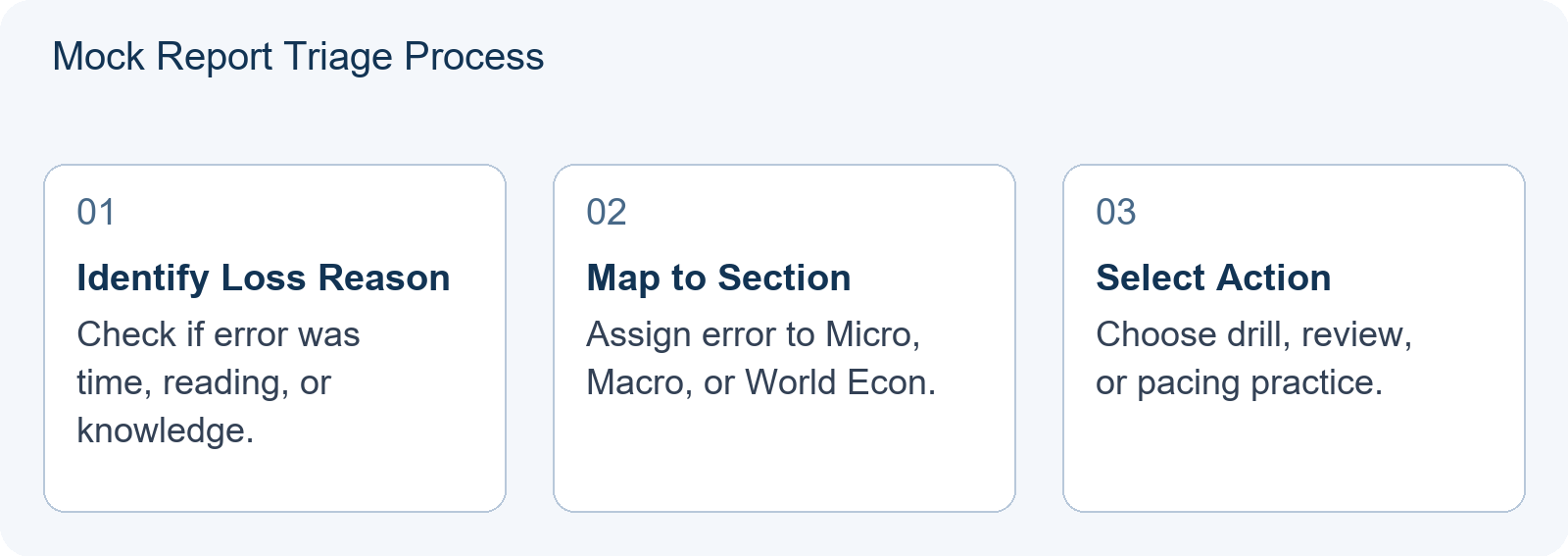
The loss reason field is perhaps the most actionable part of the report. When you interpret the loss-reason notes, group them into common causes such as time pressure, misreading questions, and genuine knowledge deficits. Each requires a distinct response strategy.
- Time pressure: If you left questions blank or rushed through the final section, your issue is pacing. To address this, practise with a timer, aiming to complete an early block of questions at a controlled pace and then review the questions you marked for return. The 45 Questions in 45 Minutes: The Pacing and Guessing Strategy NEC Scoring Actually Rewards can help you decide which questions to skip early.
- Misread questions: This often manifests as choosing an answer that is true but does not answer the specific prompt. For example, you might select a statement about short-run costs when the question asked about long-run average cost curves. The fix is not more content study, but better reading comprehension. Practise underlining key constraints in every question stem.
- Genuine knowledge deficit: If you consistently miss questions in a specific area, such as monetary policy transmission mechanisms, you have a content gap. Rebuild that framework with a targeted review, then test yourself with a small set of mixed questions. Do not hide a content gap behind general speed practice.
One error can have more than one loss reason. A student might misread a question because of time pressure, then choose a familiar but wrong rule because of a conceptual gap. The report tag is a starting point, not a full diagnosis. Read the AI explanation for the item and ask which cause came first. If time pressure caused the misread, fix pacing. If the concept was never secure, fix the concept.
Using the Suitable-Division Indication as a Planning Signal
One distinctive feature of a comprehensive mock assessment is the suitable-division indication. Based on your performance, the system may suggest whether you are better prepared for the Pre Division, David Ricardo (DR) Division, or Adam Smith (AS) Division. It is vital to understand that this is a planning signal, not a formal placement decision. Check official division rules before you register.
The source note lists the Pre Division as a 2-4 member team mainly for grades 7-9. DR and AS are 4-member teams; DR is generally for grades 9-11, and AS is generally for grades 10-12. The same note also says NEC encourages cross-grade collaboration. Readiness is not solely about grade level; it is about depth of knowledge and team composition. If a Grade 10 student receives a strong recommendation for DR but their report shows unresolved gaps in more advanced material, they should treat that as a warning about content coverage, not as a permanent label. Conversely, a younger student who demonstrates mastery of complex models may be ready for a higher tier, provided the team and official eligibility rules allow it.
Use the indication to calibrate your next mock. If the report suggests you are borderline between DR and AS, consider taking a second mock focused on more advanced material. This helps avoid the common pitfall of entering a division where the material is too advanced, leading to frustration and lower scores. Division choice is a strategic decision, not a reward for one good diagnostic.
Mapping Report Findings to Micro, Macro and World-Economy Practice Blocks
The mock described in the source note covers three main blocks: microeconomics, macroeconomics, and world economics. Your report likely breaks down performance by these blocks. Do not treat them equally. Analyse the relative weight of errors in each section.
| Section | Common weaknesses | Targeted action |
|---|---|---|
| Microeconomics | Elasticity calculations, market structures, consumer choice | Drill graph shifts vs movements; practise opportunity cost and comparative advantage problems with clear numerical bases. |
| Macroeconomics | AD/AS model shifts, fiscal and monetary policy lags, inflation measures | Review policy transmission chains; clarify real vs nominal variables and the order of cause and effect. |
| World economics | Exchange rates, balance of payments, trade barriers | Integrate current events; practise interpreting trade and exchange-rate data tables without guessing. |
For example, if your report shows a 20% error rate in micro but only 5% in macro, you might weight micro much more heavily, allocating roughly 70% of your remaining study time to it. Be careful not to neglect world economics simply because it may feel less familiar. It often feels less predictable to students because it can rely on contemporary data and applied reasoning. The goal is balanced competence, not a single heroic rescue of one section.
Turning the AI Explanation into a Two-Week Revision Loop
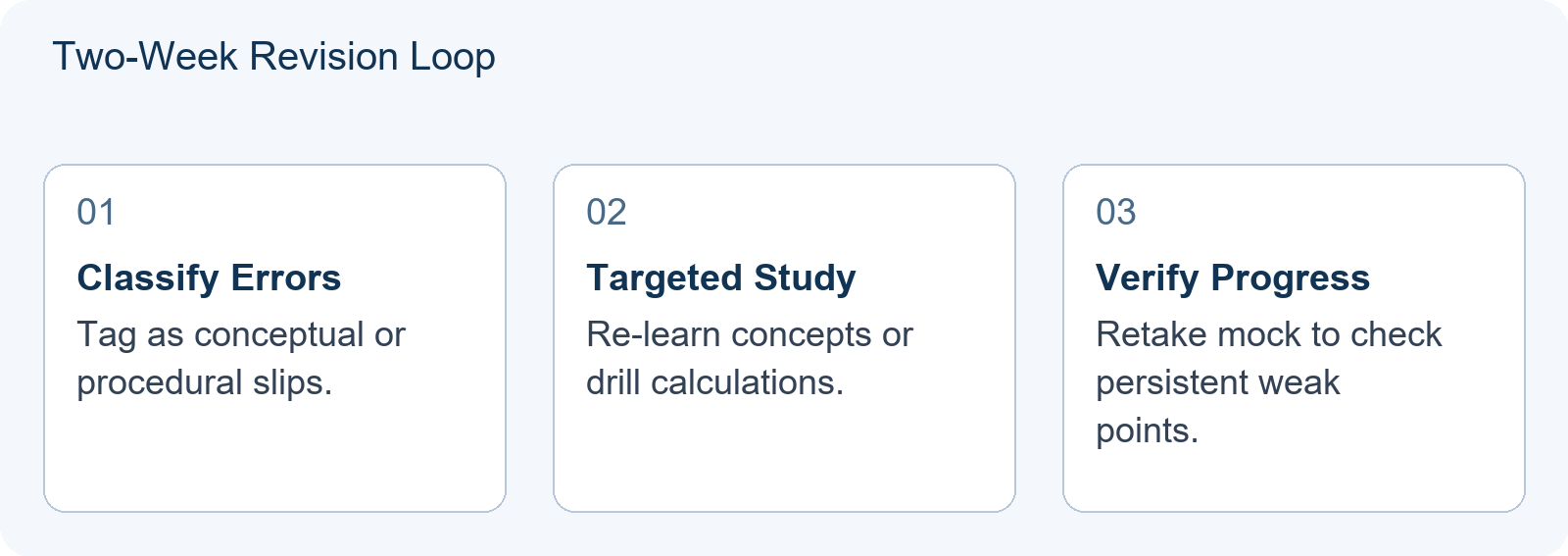
The Hanlin mock report described in the source note includes AI-driven explanations that break down the logic behind each correct answer. Instead of passively reading these, use them to create a two-week revision loop. The The NEC Error Log: How to Review a Practice Test So the Same Mistake Cannot Cost You Twice method is useful here because it forces you to record the cause, not just the answer.
In the first three days, go through every incorrect question. Tag it as conceptual, procedural, or attentional. Write a one-sentence summary of why you got it wrong. In the next four days, do targeted re-study. For conceptual errors, revisit the relevant textbook chapter or lecture note. For procedural errors, redo five similar problems without looking at the solution. In the final week, take a new set of mixed questions, then retake a timed mock. Compare the new report with the old one. Have the same weak points disappeared, or have they simply changed names?
This loop helps you avoid simply memorising answers and instead rebuild the reasoning pathways associated with economic thinking. The AI explanation serves as a tutor, guiding you through the testing point and answer logic. Your job is to convert that explanation into a drill, a correction, or a new habit.
When to Retake a Mock: Checking Whether the Same Weak Points Persist
Retaking a mock is useful, but timing matters. Do not retake immediately after studying. Allow at least 48 hours for consolidation. When you do retake, compare the new report to the previous one. Look for persistence of specific tags.
If the same weak knowledge point appears twice, your initial intervention may need adjustment. You may need a different resource or a deeper foundational review. For example, if you still struggle with monetary policy transmission, a focused review of interest-rate chains may help. Conversely, if the weak points shift—say, you fixed micro issues but now show macro gaps—this indicates progress but reveals new priorities. Keep iterating until your error distribution stabilises across all three sections. The goal is not perfection; it is balanced competence.
Conclusion: From Data to Decision
Interpreting your NEC mock test report is a skill in itself. By moving beyond the score to analyse weak knowledge points, loss reasons, and division indications, you can craft a study plan that addresses your specific vulnerabilities. Whether you are preparing for the Pre, DR, or AS division, the diagnostic data from a well-designed mock assessment is a valuable asset in the weeks leading up to the preliminary round.
Remember, these insights come from operator-provided mock evaluations, designed to mirror the actual competition format. As of Hanlin’s October 16, 2026 note, registration is open and the preliminary is listed for mid-to-late December, with the note marking those calendar items as a reference to the 2025-26 season. Always verify official requirements and deadlines directly with the NEC organisers. Use the mock report as a map, then take the next concrete step: classify your errors, and study the highest-yield weakness first.
Frequently Asked Questions
Is the suitable division indication from a mock test binding?
No, it is a planning signal based on your performance. Check official NEC division rules before registering.
What if my mock report shows no clear weak points?
If errors are scattered, focus on general test-taking strategies such as pacing and graph reading. Consider taking a harder mock to reveal deeper gaps.
How often should I take a mock test?
Ideally once every two weeks during the preparation phase. This allows time to implement corrections and measure improvement in subsequent reports.