
In the rules the Council for Economic Education (CEE) published for the 2025 National Economics Challenge, the online semi-final round gave students 45 minutes to answer 45 questions, scored +10 for a correct answer, 0 for a wrong answer and 0 for no answer. That scoring line changes everything about how you should sit the test: a blank is never safer than a guess, and a minute per question is the only budget you get.
What the published rules actually specify
Most preparation advice for NEC is written from memory or from other people's summaries. It is worth going to the source. The NEC is run by the Council for Economic Education, founded in 1949, and CEE publishes a rules and eligibility document each season. In the 2025 edition, the Online National Semi-Finals were described as three consecutive rounds with no breaks in between, with students given a total of 45 minutes for 45 four-option multiple-choice questions, covering microeconomics, macroeconomics and international economics.
Two further details in that document matter more than most students realise. First, each team member answers individually, not collaboratively — the test is a solo performance that later gets aggregated. Second, no books, notes, calculators or internet access are permitted. Everything below is built on those constraints.
One important caveat before you plan around any number here: those specifications are what CEE published for the 2025 United States semi-final round. Formats, question counts and timings are set by the competition and change from season to season, and the China national round administered through CNEC has its own structure — four divisions for 2027 and its own round line-up rather than the two-division United States structure. Treat the figures below as the published national standard and the reasoning as transferable; confirm your own round's question count, clock and scoring on councilforeconed.org and the official CNEC channels before you build a study plan around them. Our round-by-round guide to the seven NEC events covers how the pieces fit together.
| Element | As published by CEE for the 2025 semi-final round | What it means for how you sit the test |
|---|---|---|
| Clock | 45 minutes total, three consecutive rounds, no breaks | 60 seconds per question on average — you cannot afford one long stall |
| Question format | Four-option multiple choice | A blind guess is worth one quarter of the marks on offer |
| Correct answer | +10 points | Every question carries identical weight — no question is worth extra time |
| Wrong answer | 0 points | No penalty for being wrong; a wrong answer costs exactly what a blank costs |
| No answer | 0 points | Strictly dominated — a blank can only ever tie a guess, never beat it |
| Content | Microeconomics, macroeconomics, international economics | Breadth beats depth; a gap in one area is not recoverable elsewhere |
| Support materials | No books, notes, calculators or internet | Arithmetic must be done in your head, so keep numbers small and rounded |
| Team score | Sum of the top three individual scores | Your individual result is the unit of account, not the team's discussion |
The single most consequential line: zero points for a wrong answer
Students trained on examinations that deduct marks for wrong answers carry a deep habit: when unsure, leave it. Under the scoring CEE published, that habit is pure loss. If a wrong answer and a blank are both worth zero, then answering costs you nothing and might earn ten.
The arithmetic is worth doing explicitly, because it converts a vague instinct into a decision rule. On a four-option question with no penalty, a completely blind guess has an expected value of one in four multiplied by ten points, or 2.5 points. Eliminate one option you know is wrong and you are choosing between three, worth roughly 3.3 points. Eliminate two and you are at 5 points — half the value of a question you genuinely know, earned from partial knowledge alone.
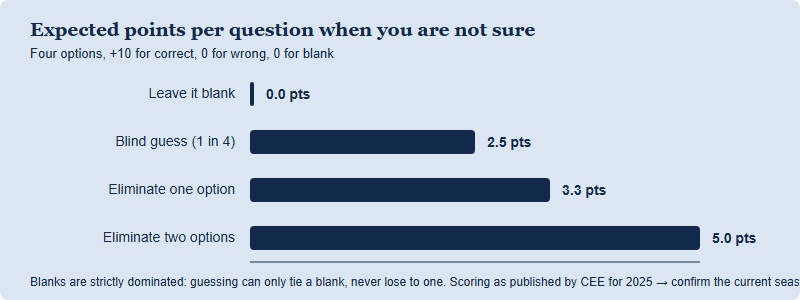
This has a practical corollary that costs nothing to adopt: elimination is a scoring technique, not just a comprehension technique. When you meet a question you cannot solve, do not simply move on — spend five seconds crossing off the options that are definitionally impossible (a supply-side answer to a demand-side question, a sign that points the wrong way, a magnitude that is absurd). Then commit. You have converted a zero into an expected 3.3 or 5.
Sixty seconds a question — and why speed is only the third tiebreaker
Forty-five questions in forty-five minutes is a deceptively tight budget, because the average conceals the distribution. Perhaps fifteen questions are recall you can complete in twenty seconds. Perhaps eight require a short chain of reasoning or a two-step calculation and will take ninety seconds or more. The clock only works if the fast questions genuinely subsidise the slow ones — and that only happens if you never let a hard question consume four minutes.
There is a tempting misreading of the rules here. CEE's published tiebreaker sequence for that round ran: first, the team score by round counting all four members; then the team with the highest individual scorer; and only then the team with the least combined time to complete the round. Some students hear "time is a tiebreaker" and start racing. That is the wrong inference. Speed is the third tiebreaker, behind two accuracy-based ones. Rushing to save ninety seconds while dropping two questions trades ten or twenty real points for a tiebreaker you will probably never reach. Finish inside the clock; do not try to win it.
A three-pass protocol for the clock
The most reliable way to spend a fixed clock across unevenly difficult questions is to refuse to answer them in order of appearance. Answer them in order of cost.
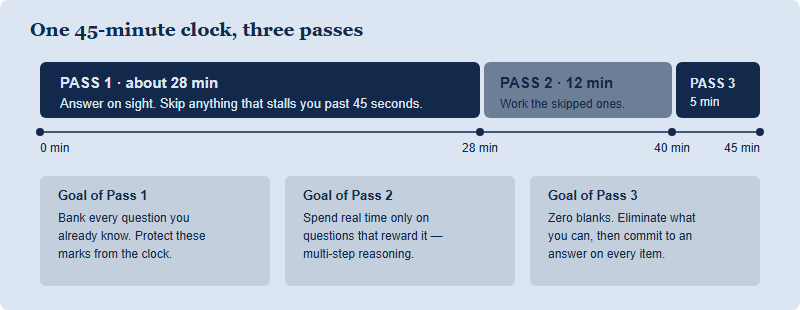
Pass one (roughly 28 minutes). Move through the paper answering everything you recognise on sight. Set a private stall limit — if a question has not started to yield within about forty-five seconds, mark it and move. The discipline here is emotional, not intellectual: strong students hate abandoning a question they feel they should be able to do. That feeling is precisely what wrecks the clock.
Pass two (roughly 12 minutes). Return to the marked questions in ascending order of difficulty, not in paper order. Multi-step items — a multiplier calculation, an elasticity sign, a comparative-advantage comparison — belong here, because they genuinely convert time into marks.
Pass three (final 5 minutes). The only objective is that no question is left blank. Sweep the paper, eliminate what you can in a few seconds per item, and commit. On a 45-question paper, arriving at this pass with eight unanswered questions and guessing all of them is worth roughly twenty points in expectation — the equivalent of two questions you actually knew, recovered from nothing.
Why your individual score is the unit that counts
CEE's published scoring aggregated the team result as the sum of the top three individual scores, while the first tiebreaker counted all four members. This creates a subtle motivational structure that many teams read wrongly. It does not mean the fourth member is decorative — that member is your insurance against an off day and appears directly in the first tiebreaker. What it does mean is that on test day there is no collaborative strategy to execute. There is no one to divide questions with, no one to sanity-check a sign error. Whatever preparation you did as a team has to already be inside your own head.
The practical implication is about what you train, not what you feel. Team practice is genuinely valuable for building shared vocabulary and exposing blind spots — but if every session is a group discussion, you have never once rehearsed the conditions of the actual round. At least half of your practice should be silent, timed and individual. If your team is weighing which division to enter, our guide to the Adam Smith division covers how the entry tiers differ in expectation.
Training the clock, not just the content
Content revision and clock training are different activities, and most students do only the first. Three habits close the gap.
- Practise at full length, not in fragments. Doing ten questions well tells you nothing about whether you can hold accuracy at question thirty-eight. Fatigue errors are real and only appear in full-length sittings.
- Log where the time went, not just what you got wrong. After each timed set, mark every question that took more than ninety seconds. That list, not your error list, is what your pacing needs to fix.
- Rehearse the ban. No calculator, no notes, no phone on the desk. If you have practised every set with a calculator to hand, the first no-calculator sitting will cost you time you had not budgeted.
A first-party note on what this looks like in practice, drawn from the teaching record of one of our economics coaches and de-identified: across recent seasons, that single coaching cohort recorded several perfect scores at the test stage — three in the 2025 season and three in 2024. Perfect scores are informative for a different reason than the obvious one. They confirm that a perfect multiple-choice round is genuinely reachable, which means the marginal student is not lost to impossible questions; they are lost to unfinished ones. This is one coach's cohort record rather than a company-wide or official total, and results vary between students, teams and seasons. Where NEC sits relative to written economics competitions is covered in our comparison of the test-and-team format against the essay prizes.
One last check worth building into your season plan. Before test day, get three specific answers in writing from your coordinator or the official channels: how many questions, over how many minutes, and what happens to a wrong answer. Every recommendation above depends on that third answer. If your round applies a penalty for incorrect responses — which the 2025 national semi-final round did not — then the guessing arithmetic inverts, and Pass 3 becomes a very different exercise.
Does NEC deduct marks for wrong answers?
In the rules CEE published for the 2025 semi-final round, no: a wrong answer scored 0, the same as a blank. Confirm your season on councilforeconed.org.
How long do you get per question?
The 2025 published semi-final structure allowed 45 minutes for 45 questions — roughly 60 seconds each on average, with faster items subsidising slower ones.
Can I use a calculator in the NEC test?
The published rules prohibited books, notes, calculators and internet access during competition. Practise all arithmetic unaided well before test day.
Is it worth rushing to finish early?
No. Completion time was only the third tiebreaker, behind two accuracy-based ones. Accuracy outranks speed until the very last margin.
Published by the NEC (CNEC) editorial desk, operated by Hanlin Education for China-based international-school students. Official rules are set by the competition and change yearly — confirm current details on councilforeconed.org. Errors are corrected within 7 working days.