
You clear the NEC Qualifying Test by attacking each multiple-choice question methodically and by covering the whole syllabus, not your favourite third of it. Read the stem before the options, name what is being asked, eliminate the wrong answers you can prove wrong, and choose from what survives. The Qualifying Test is the individual gate that filters the field before any team round begins, so breadth across microeconomics, macroeconomics and the world economy is what gets you through.
Most NEC guides — including several already on our own site — survey the seven rounds, list the divisions, and walk through registration. Useful once. This one stays on a single thing: how to actually answer the Qualifying Test questions. The National Economics Challenge is run by the Council for Economic Education (CEE, founded 1949) and draws roughly 10,000 students a year in the United States, across microeconomics, macroeconomics and the world economy. The China National Round (CNEC) has been operated by Hanlin (SKT) since 2016, across 20+ provinces and 300+ schools, and is the official path from China into the NEC global rounds. The economics standard below comes from the CEE; the exact question count, time limit and delivery format for your division can change season to season, so confirm those on the official CNEC channels before you build a plan around them. Pacing — how to spend your clock — is a separate skill we treat in its own guide; here the focus is question approach and coverage.
What the Qualifying Test is — and the gate it controls
The Qualifying Test is the written, individual assessment that decides who advances. Every member of a team sits it, and the strongest teams from this opening round are the ones that go on to compete on the national stage — which means the Qualifying Test is the highest-leverage point in the whole competition. It is also the most “studyable” round, because it rewards systematic coverage over improvisation. Treat it the way you would treat an AP or A-Level exam: a broad, fair test of whether you know the syllabus and can apply it under exam conditions.
A key consequence of the gate design: a team is only as strong as its lowest scorers here. One brilliant member cannot carry a team past the Qualifying Test if a teammate has a thin patch in, say, macroeconomic policy or exchange rates. That is why the strategy for this round is less about heroics and more about closing gaps — every member covering the full map well enough that no single topic sinks the team. Whether the assessment is delivered as pure multiple choice, or mixes multiple choice with other written items, is set by the organiser and can vary by year and division, so confirm the current format on the official CNEC channels; the question-attack habits below apply to any multiple-choice items you face.
| Division | Level | Who sits the Qualifying Test | What the gate rewards |
|---|---|---|---|
| Pre | Entry | Individual, or each member of a team of 2–4 | Solid coverage of core principles |
| David Ricardo | Intermediate | Each member of a team of 4 | Breadth + applied reasoning; no thin patches |
| Adam Smith | Advanced | Each member of a team of 4 | Depth across the full syllabus under pressure |
The question-attack routine: a four-step pass on every item
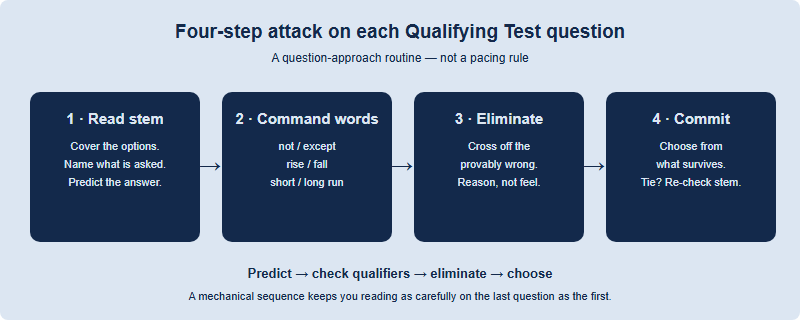
The single most reliable way to lift a multiple-choice score is to stop reading questions passively and run a fixed routine on each one. Diligent students lose marks not because they lack the economics but because they answer the question they expected instead of the question on the page — they miss a “which of the following is not,” anchor on the first plausible option, or talk themselves out of a correct answer. A repeatable four-step pass closes those leaks.
- 1 · Read the stem first, options later. Cover the answer choices and read the question itself. Decide what it is actually asking and, where you can, predict the answer before you look at the options. A predicted answer makes you far harder to mislead with a well-built distractor.
- 2 · Mark the command words. Underline the words that control the question: not, except, increase, decrease, short run, long run, ceteris paribus, most likely. A single missed “not” turns a correct understanding into a wrong bubble. Direction words (rise/fall) and time-frame words (short/long run) are the most common traps in economics items.
- 3 · Eliminate what you can prove wrong. Cross off every option you can rule out with a reason, not a feeling. Two options gone turns a one-in-four question into a near coin-flip on the right answer; three gone leaves the answer standing. Elimination is where partial knowledge becomes points.
- 4 · Commit from what survives. Choose among the remaining options and move on. If two still look right, re-check the stem for a qualifier you skimmed — usually the distinction lives in a time frame, a direction, or a “best / most likely” that separates a true statement from the most correct one.
This routine is deliberately mechanical, and that is the point. Under exam pressure a fixed sequence you trained when calm beats improvisation: it keeps you reading carefully on question forty as well as you did on question four. Note what it is not — it is not about how many seconds to spend or when to skip; that clock discipline is a separate skill, covered in our NEC preparation resources.
Reading the distractors: how wrong options are built
Well-written multiple-choice questions do not surround the answer with nonsense; they surround it with options that are almost right. Recognising how distractors are engineered turns elimination from guesswork into pattern-matching. In economics items the same handful of traps recur, and once you can name them, they stop working on you.
| Distractor type | How it tricks you | The defence |
|---|---|---|
| Reversed direction | States the right variables but the wrong way (price rises instead of falls) | Re-derive the direction from the model, don't trust the wording |
| Right idea, wrong time frame | True in the short run but the stem asks long run (or vice versa) | Match the answer to the time frame the stem specifies |
| Common misconception | The intuitive answer a student gives before learning the theory | Trust the model over the gut, especially when an option feels obvious |
| True but irrelevant | A correct economic statement that doesn't answer this question | Ask "does this respond to the stem?", not just "is this true?" |
| Ceteris paribus break | Smuggles in a second change the question said to hold constant | Hold all else equal unless the stem explicitly moves it |
The most useful mental move is to ask of each option, “is this true, and does it answer the question?” — two separate tests. A surprising share of distractors pass the first test and fail the second: they are perfectly correct economics that simply do not respond to the stem. Students who only check “is it true?” get pulled toward them. Adding the second check is one of the highest-return habits you can build, and it costs nothing but attention.
Breadth beats depth: covering the whole syllabus
Because the Qualifying Test samples across the entire syllabus, the marginal point is almost always cheaper to earn by shoring up a weak area than by deepening a strong one. The CEE standard spans microeconomics, macroeconomics and the world / international economy, and CNEC describes the China written assessment as weighting roughly 40% economic theory and 60% applied analysis — so knowing definitions is necessary but not sufficient; you have to be able to use them on a scenario. Confirm the current weighting and topic emphasis for your division on the official CNEC channels, as they can be adjusted season to season.
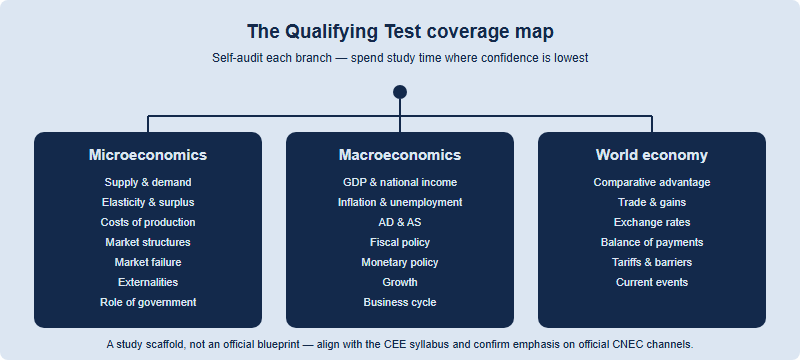
The practical method is a coverage checklist. Lay the syllabus out as a map across the three areas, rate yourself honestly on each branch, and spend your study time where your confidence is lowest — not where revision feels most comfortable. The branches below are the standard territory of introductory economics and a reasonable scaffold to self-audit against; treat it as a study map, not an official blueprint, and align it with whatever the CEE syllabus and CNEC materials specify.
- Microeconomics: supply and demand, elasticity, consumer and producer surplus, costs of production, market structures (perfect competition, monopoly, oligopoly), market failure and externalities, the role of government.
- Macroeconomics: GDP and national income accounting, inflation and unemployment, aggregate demand and supply, fiscal policy, monetary policy and the central bank, economic growth and the business cycle.
- World / international economy: comparative advantage and trade, exchange rates, the balance of payments, tariffs and trade barriers, and how current global events map onto these ideas.
A first-party note from running the China round
As the officially authorized China test centre (CNEC) for the NEC, what we see most often is not a knowledge ceiling — it is uneven coverage. Many Chinese international-school students arrive with genuinely strong economics from their AP, IB or A-Level coursework, then leave Qualifying Test marks on the table in the one or two corners of the syllabus their school course happened to skim. International economics and the applied, scenario-style items are the predictable soft spots, precisely because they sit at the edge of a typical school syllabus. The fix is rarely “study harder”; it is “study wider,” plus rehearsing the four-step question routine until reading carefully is automatic. We confirm every format detail against the CEE standard and the official CNEC materials each season rather than assuming last year’s numbers still hold — and we would encourage every team to do the same. For the current syllabus, schedule and rules to practise against, start from the CNEC home page.
FAQ
Is the NEC Qualifying Test multiple choice?
It is the written, individual qualifying round covering micro, macro and world economics. Whether it is purely multiple choice can vary by year — confirm the format on the official CNEC channels.
How should I attack each question?
Read the stem before the options and predict an answer, underline command words like "not" or "long run," eliminate what you can prove wrong, then commit from what survives.
What topics does the Qualifying Test cover?
The CEE syllabus spans microeconomics, macroeconomics and the world economy. CNEC describes the written assessment as roughly 40% theory and 60% applied analysis; confirm officially.
Should I focus on my strongest topic or my weakest?
Your weakest. The Qualifying Test samples the whole syllabus, so the cheapest marks come from closing gaps, not deepening an already strong area.
Published by the NEC / CNEC editorial desk, operated by Hanlin Education as the officially authorized China National Economics Challenge (CNEC) test center. The NEC is run by the Council for Economic Education, which sets the official rules — always confirm current dates, divisions, fees and awards on the official CNEC channels. Any error will be corrected within 7 working days.