The fastest way to build an NEC foundation is to treat the May-to-August window after your AP exams as a dedicated study runway, not downtime. With no school deadlines competing for attention, a structured summer lets you consolidate the economics you already half-know, build a reusable model bank, and rehearse the collaborative skills the NEC team rounds demand — so you reach the autumn season already ahead instead of starting cold.
This is an execution plan for one specific stretch of the calendar. It is not a “what is the NEC” overview, nor a full-season calendar, nor an admissions essay about why the competition matters — we cover those elsewhere. Here the single question is: what do you actually do, week by week, between the last AP exam and the start of the autumn term to build a real foundation? The National Economics Challenge is run by the Council for Economic Education (CEE, founded 1949), draws roughly 10,000 students a year in the United States, and tests microeconomics, macroeconomics and the world economy. The China National Round (CNEC) has been operated by Hanlin (SKT) since 2016 across 20+ provinces and 300+ schools, and is the official path from China into the NEC global rounds. Exact dates, divisions, fees and round formats are set by the organiser and shift season to season, so confirm the current cycle on the official CNEC channels before you anchor a plan to specific deadlines.
Why the post-AP window is the best runway you will get
For most international-school students, May to August is the only multi-week block of the year with no graded coursework, no internal assessments and no exam revision pulling in another direction. That makes it uniquely valuable for foundation-building, which is exactly the kind of work that gets squeezed out once term resumes and homework, mocks and applications compete for every hour.
There is also a content advantage that is specific to this moment. If you have just sat AP Microeconomics or AP Macroeconomics, the core models are as fresh as they will ever be — supply and demand, AD-AS, the money market, comparative advantage. The summer is when you convert that just-tested knowledge into competition-ready recall before it fades, rather than re-learning it in October. Students who skip this window do not usually lack ability; they lack the consolidation that turns a passed AP into an NEC edge.
- No competing deadlines. Foundation work finally gets uninterrupted time instead of the scraps left after coursework.
- Peak content freshness. Post-exam, your AP micro/macro models are at maximum recall — cement them now.
- Room to go wide. The summer is long enough to close the syllabus gaps a school course skimmed, especially the world economy.
- A head start on the team. A standing study group formed in July is a functioning unit by the autumn season, not a set of strangers.
A four-phase summer plan: May to August
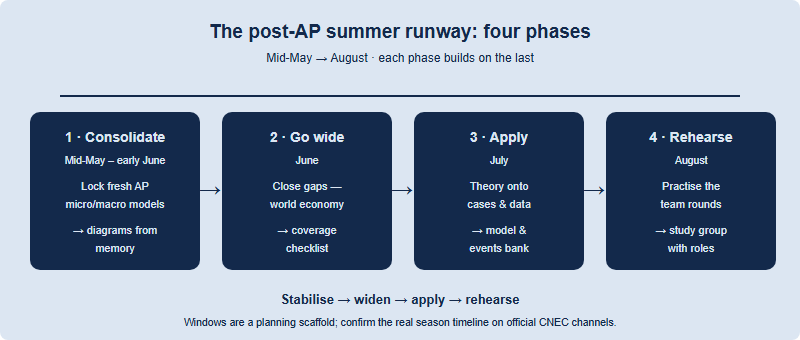
Treat the runway as four phases rather than one shapeless “study over the summer.” Each phase has a single job, and each builds on the last: stabilise, then go wide, then connect theory to scenarios, then rehearse as a team. The week ranges below are a planning scaffold you can shift to fit your own holiday dates — they are not tied to any official NEC deadline, which you should confirm separately on the CNEC channels.
| Phase | Rough window | Primary job | What you produce |
|---|---|---|---|
| 1 · Decompress & consolidate | Mid-May – early June | Lock in fresh AP micro/macro models | A clean set of core diagrams from memory |
| 2 · Go wide | June | Close syllabus gaps, especially world economy | A self-audited coverage checklist |
| 3 · Theory to scenario | July | Apply models to real cases & data | A personal model & current-events bank |
| 4 · Rehearse as a team | August | Practise the collaborative rounds | A working study group with assigned roles |
Phase 1 & 2: stabilise, then go wide
The first job is not to learn anything new — it is to make sure what you just tested actually sticks. In the two or three weeks after your AP exams, rebuild your core diagrams from a blank page: a supply-and-demand market with a tax wedge, the AD-AS model showing short-run versus long-run, the money market, and a comparative-advantage example. If you can draw each from memory and explain every shift out loud, the model is yours. This active recall is what separates “I revised this in April” from “I own this in September.”
Phase 2 is about breadth, because the NEC samples the entire syllabus and the cheapest marks come from your weakest area, not your strongest. The CEE standard spans microeconomics, macroeconomics and the world / international economy. For most AP and IB students the predictable soft spot is the world economy — exchange rates, the balance of payments, tariffs — precisely because school courses often treat it last and lightest. Build a one-page coverage checklist, rate your confidence honestly on each branch, and spend June on the red cells. Confirm the current topic emphasis and any weighting for your division on the official CNEC channels, as the organiser can adjust it season to season.
- Microeconomics: supply and demand, elasticity, surplus, costs of production, market structures, market failure and externalities, the role of government.
- Macroeconomics: GDP and national income, inflation and unemployment, AD-AS, fiscal policy, monetary policy and the central bank, growth and the business cycle.
- World economy: comparative advantage and trade, exchange rates, the balance of payments, tariffs and trade barriers — the area to audit first.
Phase 3: turn theory into a model bank
By July you should stop revising definitions and start using them, because the NEC rewards applied reasoning, not recitation. CNEC describes the China written assessment as weighting roughly 40% economic theory and 60% applied analysis — so knowing what an externality is matters far less than being able to map one onto a live scenario. Confirm the current split for your division officially; the principle holds regardless of the exact percentages.
The asset you build in this phase is a model bank: a running notebook that pairs each core model with two or three real situations it explains. When you read that a central bank has changed interest rates, you file it under the money market and AD-AS; when you read about a new tariff, you file it under trade and welfare effects. Over a few weeks this converts the morning news into a personal question bank, and it is the single most useful thing you can carry into the Critical Thinking and applied-analysis rounds. Practise writing a tight three-sentence economic explanation of each case — claim, mechanism, consequence — because that compression is the skill the harder rounds test.
| Real-world trigger | Model to reach for | What to practise explaining |
|---|---|---|
| Central bank changes interest rates | Money market & AD-AS | The transmission from rates to output and prices |
| A new import tariff is announced | Trade & welfare analysis | Winners, losers and the deadweight loss |
| A currency appreciates sharply | Exchange rates & balance of payments | Effects on exporters, importers and the trade balance |
| Government raises spending or taxes | Fiscal policy & the multiplier | The effect on aggregate demand and the trade-offs |
Phase 4: rehearse the rounds you cannot study alone
A foundation that is purely individual leaves the NEC’s defining feature untouched: it is largely a team competition. Beyond the individual Qualifying Test, the format includes collaborative rounds — the seven NEC rounds span the Qualifying Test, Super Econ, Quiz Bowl, Critical Thinking, Econ Lab, Econ Immersion and U20 Youth Voice — and several of these are won or lost on how a team works together under time pressure. The exact rounds that apply to your division are set by the organiser, so confirm them on the official CNEC channels; the point for August is that group skills need rehearsal, not just reading.
This is why the summer is the right time to form a study group rather than waiting for term. Use August to run mock Quiz Bowl rounds against the clock, assign provisional coverage roles so the team’s syllabus map has no holes, and practise the buzzer-style fast recall and the calm hand-off of “you take the macro, I’ll take the trade question.” For the Critical Thinking and presentation-style rounds, rehearse explaining a model to a non-economist and defending it against a follow-up. A group that has done this in August walks into the season as a unit; one that hasn’t spends the first month becoming one.
- Mock the timed rounds. Run buzzer-style Quiz Bowl practice so fast recall is a trained reflex, not a hope.
- Assign coverage roles. Map each teammate to syllabus branches so no topic is left thin across the team.
- Rehearse explaining out loud. Practise the three-sentence explanation and the defence of it for the analytical rounds.
- Confirm what applies. Check which rounds and rules govern your division on the official CNEC channels before drilling.
A first-party note from running the China round
As the officially authorized China test centre (CNEC) for the NEC, the pattern we see every autumn is that the teams who started consolidating over the summer are visibly steadier than those who began cold in October — not because they are more talented, but because they spent the post-AP window converting fresh AP economics into durable recall and team habits. The students who struggle most are usually strong individually but never rehearsed the collaborative rounds, or never closed their world-economy gap. None of this requires a tutor or a paid course; it requires using the runway. We re-check every format detail against the CEE standard and the official CNEC materials each season rather than assuming last year’s structure holds, and we would urge every team to plan against the confirmed current cycle. To find the season’s syllabus, schedule and rules to build your four phases around, start from the CNEC home page.
FAQ
When should I start preparing for the NEC over the summer?
Right after your AP exams. The mid-May to August window is the most uninterrupted study time you get, and your AP economics is at peak freshness.
What should I do first in the summer?
Consolidate before expanding: rebuild your core AP micro and macro diagrams from a blank page, then audit and close your weakest syllabus area, usually the world economy.
Can I prepare for the NEC alone over the summer?
Partly. Individual content yes, but the NEC is largely a team event, so use August to form a study group and rehearse the collaborative rounds.
Does the summer plan depend on the competition dates?
No — the four phases are a study runway you can shift to your own holiday. Confirm the actual NEC season dates separately on the official CNEC channels.
Published by the NEC / CNEC editorial desk, operated by Hanlin Education as the officially authorized China National Economics Challenge (CNEC) test center. The NEC is run by the Council for Economic Education, which sets the official rules — always confirm current dates, divisions, fees and awards on the official CNEC channels. Any error will be corrected within 7 working days.