
The NEC Pre division is the entry track of the National Economics Challenge (NEC): an on-ramp for students who are new to formal economics, tested on microeconomics and macroeconomics rather than the full international-economics load of the higher divisions. On the official CNEC pages it is open to students in grades 7–12 (under 20) and entered as a small team of 2–4. This guide explains what the Pre division actually asks of you, and who should enter it.
What the Pre division is — and what it deliberately is not
The NEC is run by the Council for Economic Education (CEE), a non-profit founded in 1949, and reaches close to 10,000 students a year in the United States. The CEE sets the official academic standard. In China, the National Round is operated as CNEC by Hanlin (SKT) — the officially authorized China test center since 2016, now spanning 20+ provinces and 300+ schools, and the only official route by which teams in China advance to the NEC Global Rounds.
Inside that competition there are three divisions, scaled by experience rather than by age alone: Pre (entry), David Ricardo (intermediate, a team of four) and Adam Smith (advanced, a team of four). This article is only about the first one. The defining trait of the Pre division is its scope: per the official CNEC description, it “tests microeconomics and macroeconomics — building interest and a base for higher-level study.” It is explicitly framed for students who are new to economics, or who have completed only an introductory course such as IGCSE economics.
That framing tells you what the Pre division is not. It is not the place to prove you have mastered international trade theory, exchange-rate regimes or open-economy macro — that breadth belongs to the higher divisions. It is not a ranking of prestige; it is a starting line. And it is not a consolation prize: many strong economists begin here precisely because securing a real result at entry level beats being out-scored in a division built for AP/IB veterans.
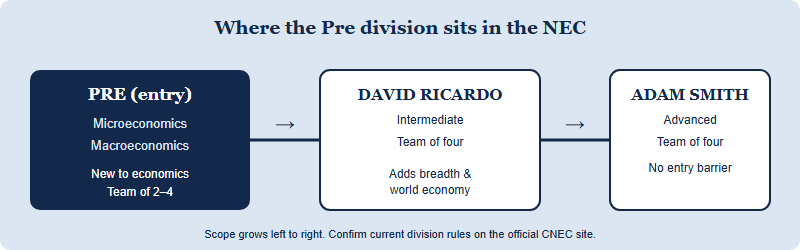
Eligibility and team format: who can actually enter
The official CNEC pages set the Pre division at grades 7–12, for students under 20 years old, entered as a team of 2–4. Some general NEC descriptions also note that the entry level can be attempted individually; whether an individual entry is accepted in the CNEC China round, or whether a team is required, is the kind of detail you should confirm on the official CNEC channels before you register — do not assume the US-wide rule and the China-round rule are identical.
A few practical points follow from the team format:
- Form your team early. Because the division allows 2–4 members, a school can field more than one Pre team; deciding who pairs with whom is easier in September than in November.
- Grade range is wide. A capable Grade 8 or 9 student is squarely inside the eligible band, which is unusual for a US high-school competition and part of why Pre is the natural first contest for younger international-school students.
- The under-20 ceiling is a hard fact to verify, not assume. If a team member’s age is near the limit, check it against the official rules rather than this page.
| Pre division — at a glance | Per the official CNEC pages |
|---|---|
| Level | Entry / on-ramp |
| Eligibility | Grades 7–12, students under 20 |
| Team size | Team of 2–4 (confirm individual-entry rules officially) |
| Subjects tested | Microeconomics + macroeconomics |
| Best for | Students new to economics, or who completed only an introductory course (e.g. IGCSE) |
| Dates / deadlines / fees / awards | Confirm on the official CNEC channels |
What the Pre rounds realistically expect of you
Across the NEC, the competition is built around seven rounds — the Qualifying Test, Super Econ, Quiz Bowl, Critical Thinking, Econ Lab, Econ Immersion and the U20 Youth Voice. Exactly which of these a Pre team encounters, and in what order, is set by the organiser and may differ from the higher divisions, so treat the round line-up for your season as something to confirm on the official CNEC schedule rather than infer from another division.
What you can plan around is the intellectual demand. Because the Pre division is scoped to micro and macro, the realistic expectation is fluency in the foundations rather than command of advanced or international material:
- Microeconomics: supply and demand, elasticity, how markets reach equilibrium, the basic costs of a firm, and simple market structures. The Pre level rewards a student who can apply these cleanly, not one who can recite edge cases.
- Macroeconomics: GDP and growth, inflation and unemployment, and the broad logic of fiscal and monetary policy — the vocabulary a newcomer needs to read an economy, without the open-economy depth the higher divisions add.
- Applied reasoning: NEC rounds reward students who can use a concept on an unfamiliar prompt, so a Pre team that has practised explaining “why” beats one that has only memorised definitions.
In short, the Pre division expects a solid grasp of introductory economics applied under time pressure as a team — an ambitious but reachable target for a motivated student inside a single season.
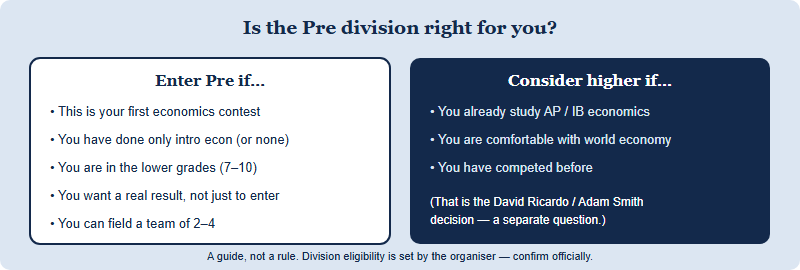
Who should enter the Pre division — a first-party view
As the team that runs CNEC, the pattern we see most often is students self-selecting up too fast. A Grade 9 student who has just discovered economics will sometimes register for an intermediate division to “look serious,” then spend the season out-paced by competitors who have already done two years of AP coursework. The Pre division exists precisely to prevent that mismatch. Three profiles are the clearest fit:
- The genuine newcomer. If economics is a new subject — or you have done only an introductory course like IGCSE economics — Pre is where the content matches what you actually know. You learn the contest format on foundations you can defend.
- The younger student building a multi-year arc. A motivated Grade 8–9 student can use Pre as season one of a deliberate progression, then move up to David Ricardo or Adam Smith in later years with contest experience already banked.
- The strong-on-paper, untested team. Even capable students who have never competed benefit from starting where the scope is micro-and-macro only, rather than gambling a first season on a division that adds the world economy.
If, on the other hand, your team already studies AP or IB economics comfortably and is at ease with international economics, the honest answer is that you are choosing between the higher divisions — a different decision this article does not cover. Read more about the structure of the season on the CNEC home page, and always confirm the current Pre-division eligibility, format and dates on the official CNEC channels before you commit a team.
Frequently asked questions
Is the Pre division easier than David Ricardo and Adam Smith?
It is the entry level, scoped to microeconomics and macroeconomics rather than adding international economics, so the content is narrower — but the competition is still real.
Who is eligible for the NEC Pre division?
Per the official CNEC pages, students in grades 7–12 who are under 20 years old, entered as a team of 2–4.
Can I enter the Pre division on my own?
The CNEC pages describe a team of 2–4; whether an individual entry is accepted in the China round should be confirmed on the official CNEC channels.
What does the Pre division test?
Microeconomics and macroeconomics — the foundations — without the world-economy depth weighted in the higher divisions.
Published by the NEC / CNEC editorial desk, operated by Hanlin Education as the officially authorized China National Economics Challenge (CNEC) test center. The NEC is run by the Council for Economic Education, which sets the official rules — always confirm the current dates, divisions, fees and awards on the official CNEC channels. Any error will be corrected within 7 working days.