
In the National Economics Challenge (NEC), balance-of-payments questions in the world-economy section test one core idea: every cross-border transaction is recorded in one of two big buckets — the current account (trade, income and transfers) and the capital and financial account (cross-border assets and lending) — and the two must balance. Master that accounting frame and you can read any “deficit” or “surplus” scenario fast, without inventing a single figure.
What the balance of payments actually records
The NEC, run by the Council for Economic Education (CEE, founded 1949), covers microeconomics, macroeconomics and the world/international economy, and reaches roughly 10,000 students a year in the United States. Its balance-of-payments questions reward a clean mental model rather than memorised numbers. The balance of payments (BoP) is simply a record of all economic transactions between residents of one country and the rest of the world over a period — exports and imports, wages and dividends crossing borders, and the buying and selling of foreign assets.
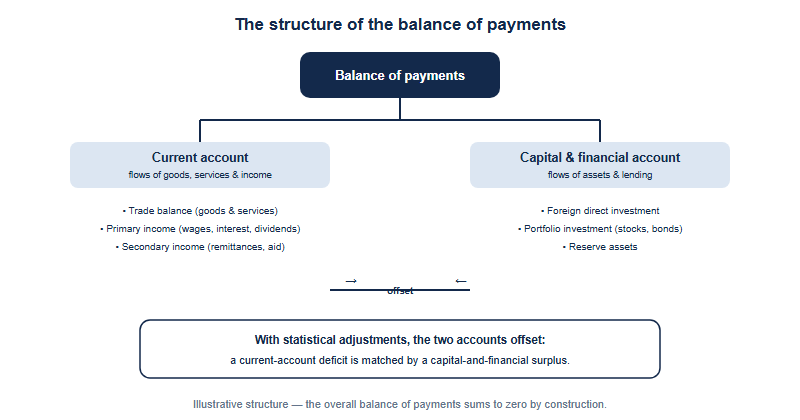
The single fact that unlocks most NEC questions is this: the BoP is built on double-entry accounting, so in principle it always balances to zero. Every transaction has two sides. If a Chinese family buys a foreign gadget, that import is a debit in one part of the accounts, but the foreign currency that leaves to pay for it shows up as a matching entry elsewhere. So when people say a country “runs a deficit,” they almost never mean the whole BoP — they mean a deficit in one part of it, offset by a surplus somewhere else. Getting this distinction right is half the battle on test day.
The current account: trade, income and transfers
The current account is the part students meet first, because it contains the trade balance. It has three components worth keeping straight. The trade balance records exports minus imports of goods and services — the largest piece for most economies. Primary income records cross-border earnings on factors of production: wages of workers abroad, plus interest and dividends a country earns on foreign assets (and pays out on foreign-owned assets at home). Secondary income records transfers where nothing is given in return — remittances sent home by migrant workers, foreign aid, and gifts.
A country runs a current-account surplus when the money flowing in from these three sources exceeds the money flowing out — typically because it exports more than it imports. It runs a current-account deficit when more flows out than in. The NEC frequently tests whether you can place a described transaction in the right component: a foreign tourist's spending is an export of services (current account), a factory built abroad is direct investment (financial account), and a dividend paid to a foreign shareholder is primary income (current account). Sorting transactions correctly is exactly the skill the round measures.
| Transaction | Account | Component |
|---|---|---|
| Country exports machinery abroad | Current | Trade balance (goods) |
| Foreign tourists spend while visiting | Current | Trade balance (services) |
| Dividends received on foreign shares | Current | Primary income |
| Migrant workers send money home | Current | Secondary income |
| A firm builds a factory overseas | Financial | Direct investment |
| Investors buy foreign government bonds | Financial | Portfolio investment |
The examples above are illustrative classifications, not figures to quote — the marker rewards putting each flow in the correct bucket. A useful test-day rule: if the transaction involves goods, services or income earned this period, it is current account; if it involves buying or selling an asset (a factory, a share, a bond, a bank deposit), it is the capital and financial account.
The capital and financial account: assets and the mirror image
The capital and financial account records cross-border changes in ownership of assets. The financial account — the larger part — captures foreign direct investment (lasting control, such as building or buying a company abroad), portfolio investment (buying foreign stocks and bonds without control), and changes in official reserve assets held by the central bank. The smaller capital account covers items such as debt forgiveness and transfers of certain non-produced, non-financial assets; in many syllabi and exam questions the two are grouped together, and you should treat any cited split as something to confirm on the official channels rather than assert.
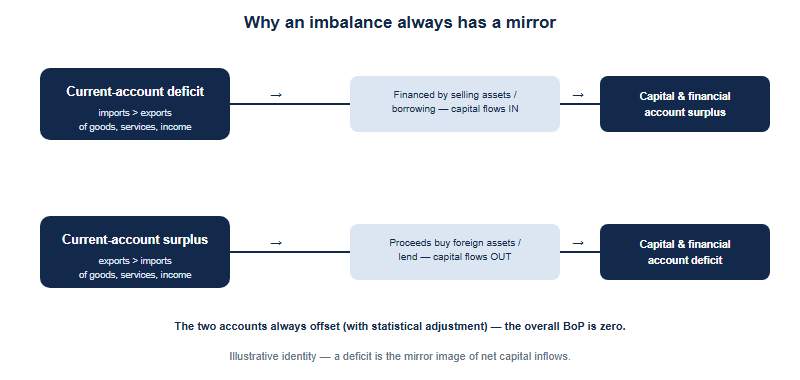
Here is the insight NEC scenario questions lean on most. Because the accounts offset, a country with a current-account deficit — importing more goods, services and income than it exports — must, by the accounting identity, be running a matching surplus on the capital and financial account. In plain terms, if it buys more from abroad than it sells, it is financing the gap by selling assets to foreigners or borrowing from them — foreign capital flows in. The reverse holds for a surplus country: it lends to, or buys assets from, the rest of the world. So a current-account deficit is not automatically “bad”; it is mirrored by capital inflows, and whether that is healthy depends on what the borrowing funds. This nuance — deficit as the flip side of capital inflow, not simply a failure — is the kind of judgement the NEC's analytical rounds reward.
The link to the currency — and the caveats markers reward
Balance-of-payments flows connect to the foreign-exchange market, and the NEC expects you to flag the link without over-claiming. The connection runs through currency demand and supply: when foreigners buy a country's exports or move capital in to buy its assets, they need its currency, which adds to demand for it; when residents import or send capital abroad, they supply their currency to obtain foreign money. So large, persistent imbalances are associated with pressure on the exchange rate — but the direction and size depend on the regime (floating versus managed) and on policy, which is why a careful answer states the link as a tendency, not a mechanical rule. (The detailed mechanics of how the FX market itself clears are a separate topic; here the point is only that BoP flows feed into currency demand and supply.)
Two caveats earn marks in the analytical rounds. First, the BoP balances by construction, so any reported imbalance lives in a sub-account; questions that say “the country's balance of payments is in deficit” are loosely worded shorthand for a current-account or financial-account position, and a sharp answer names which. Second, the statistical record is imperfect, so official accounts include a net errors and omissions line to reconcile the two sides — real data never matches to the penny even though the theory says it should. Knowing this stops you from being thrown when a scenario mentions a discrepancy. For where this world-economy strand sits in the wider syllabus, the three subject areas are laid out on the CNEC home page.
A four-step routine for any BoP question
NEC balance-of-payments questions rarely ask for a definition. They describe a transaction or a position and ask you to classify it, or to reason about what must be happening elsewhere. A repeatable routine turns any of them into a confident answer, whether the round is multiple-choice, a buzzer or a written response.
- Step 1 — Asset or flow? Decide whether the transaction is a current-period flow of goods, services or income (current account) or the buying/selling of an asset (capital and financial account).
- Step 2 — Name the component. Within the current account, is it trade, primary income or secondary income? Within the financial account, is it direct investment, portfolio investment or reserves?
- Step 3 — Find the mirror. If asked about an imbalance, remember the accounts offset: a current-account deficit implies a capital-and-financial surplus, and vice versa. State the offsetting flow explicitly.
- Step 4 — Add the caveat. Where the format allows, note the FX link as a tendency, and that the overall BoP balances by construction with a net errors and omissions adjustment.
Worked example: "A country imports far more goods than it exports, yet its overall balance of payments is zero. How is this possible?" Step 1, imports of goods are a current-account flow. Step 2, this widens the trade balance into a current-account deficit. Step 3, the mirror: it must be running a surplus on the capital and financial account — foreigners are buying its assets or lending to it, so capital flows in. Step 4, the overall BoP nets to zero by construction, with statistical adjustment. Four steps, no guesswork, no invented numbers.
A first-party note from the CNEC desk
As the officially authorized China test center for the NEC, the recurring pattern we see in practice rounds is that students lose balance-of-payments marks by treating “deficit” as a single, whole-economy verdict instead of a position in one sub-account. The teams that score well do two things: they classify the transaction (asset versus flow) before reasoning, and they always name the mirror entry — stating that a current-account deficit is financed by capital inflows, not just that it "exists." A third habit pays off in written rounds: end with the construction caveat (the BoP balances; the gap sits in a sub-account; errors and omissions reconcile the rest), which signals genuine understanding rather than a memorised label.
A standing reminder on facts: this article teaches the BoP accounting the world-economy section tests, which is stable economics. Anything competition-specific — the exact rounds in which these questions appear, the weighting, and the format for a given cycle — is set by the organiser and changes year to year, so confirm it on the official channels. The CEE sets the underlying academic standard for the NEC; the CNEC desk runs the China round. For the route onward, the CNEC is the official China National Round, operated by Hanlin (SKT) since 2016 across 20+ provinces and 300+ schools, and it is the only official path from China to the NEC global rounds. You can review the official details on the official CNEC site; any named question-setters or judges cited elsewhere are organiser claims to confirm officially, never to assert as fact.
Frequently asked questions
What are the two main parts of the balance of payments?
The current account (trade, primary income and secondary income) and the capital and financial account (cross-border assets and lending). They offset each other.
Can a country's whole balance of payments really be in deficit?
Not by construction — it balances to zero. A reported “deficit” means a sub-account, usually the current account, offset by a surplus elsewhere.
Is a current-account deficit always bad?
No. It is the mirror image of capital inflows financing it. Whether it is healthy depends on what the borrowing funds, not the label alone.
How do BoP questions link to exchange rates?
Cross-border flows add to or supply a currency, so imbalances tend to pressure the exchange rate, but the direction depends on the regime and policy — state it as a tendency.
Published by the NEC / CNEC editorial desk, operated by Hanlin Education as the officially authorized China National Economics Challenge (CNEC) test center. The NEC is run by the Council for Economic Education, which sets the official rules — always confirm current dates, divisions, fees and awards on the official CNEC channels. Any errors will be corrected within 7 working days.