
You can start the National Economics Challenge (NEC) with zero economics background — the school subject is not a prerequisite, only a head start. The fastest first 30 days is not “read a whole textbook.” It is to learn a small core of ideas in a deliberate order: how markets set prices, a handful of micro tools, the four big macro indicators, then a light pass over the world economy. This guide gives you that order, week by week, plus what to read and the mindset to keep.
Day 0: the mindset before the first chapter
The biggest mistake absolute beginners make is treating economics as a wall of vocabulary to memorise. It is closer to a way of thinking about choices under scarcity, built from a few reusable models you apply again and again. Two beliefs make the first month far easier. First, you are learning a small toolkit, not an encyclopaedia: most introductory NEC items at the entry level reward the same dozen concepts, applied to new scenarios. Second, economics is intuition first, graphs second — nearly every diagram you will draw is just a picture of a story you can tell in plain words (“when something gets scarcer, its price tends to rise”). If you can say the story, the graph follows.
It also helps to know what you are aiming at. The NEC is an assessment-style team competition run on the academic standards of the Council for Economic Education (CEE), founded in 1949, and it covers three subject areas: microeconomics, macroeconomics and the world (international) economy. For an absolute beginner that scope sounds large, but in your first 30 days you are not trying to master all three to competition depth — you are building enough of a foundation to read the questions, follow your teammates, and know what to study next. Treat the official format, divisions and dates as things to confirm on the official CNEC channels rather than memorise from a forum; your job in month one is the economics, not the logistics.
- Reframe: a toolkit of ~12 ideas, not a textbook to swallow whole.
- Sequence beats volume: learn micro foundations before macro, and macro before the world economy.
- Story first, graph second: if you can narrate it, you can draw it.
- Scope realistically: month one builds a foundation, not a finished competitor.
The concepts to learn first — in the right order
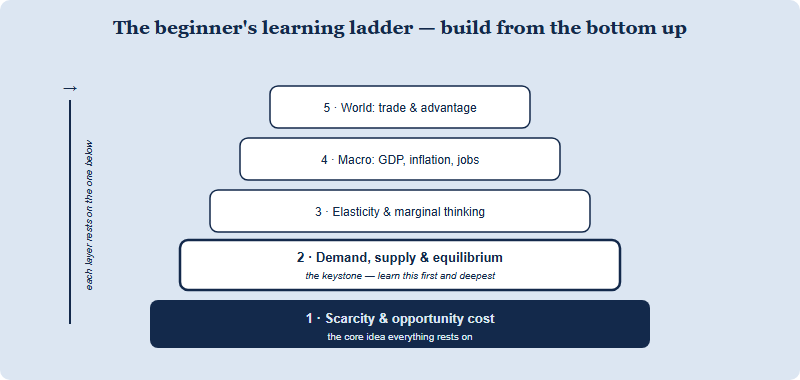
Beginners waste weeks because they open a textbook at page one and grind linearly, hitting heavy theory before the foundations are set. A better path front-loads the ideas that unlock everything else. From coaching first-time CNEC students, we find a small spine of concepts carries most of the early payoff — learn these and a surprising share of entry-level micro and macro suddenly reads as familiar. The table below is that spine, ordered so each idea rests on the one above it.
| Order | Foundation concept | The one question it answers | Area |
|---|---|---|---|
| 1 | Scarcity & opportunity cost | Why must we choose, and what does a choice cost? | Core |
| 2 | Demand & supply | How do buyers and sellers set a market price? | Micro |
| 3 | Market equilibrium & shifts | What moves price and quantity when conditions change? | Micro |
| 4 | Elasticity | How much does quantity react to a price change? | Micro |
| 5 | Marginal thinking | Is one more unit worth it? | Micro |
| 6 | GDP & economic growth | How big is an economy, and is it growing? | Macro |
| 7 | Inflation & the price level | Why does money buy less over time? | Macro |
| 8 | Unemployment | Who is out of work, and why? | Macro |
| 9 | Trade & comparative advantage | Why do countries trade at all? | World |
Notice the shape: demand and supply (rows 2–3) is the keystone. It is the single highest-leverage thing a beginner can learn, because equilibrium, elasticity, price controls, taxes and most “what happens to the market for X?” questions are all the same diagram with a different shock. If you only deeply understand one thing in week one, make it this. The four macro indicators (rows 6–8 plus growth) then give you the vocabulary to read any news headline about “the economy,” and comparative advantage (row 9) opens the door to the world-economy material without yet needing exchange rates or the balance of payments.
Your first 30 days, week by week
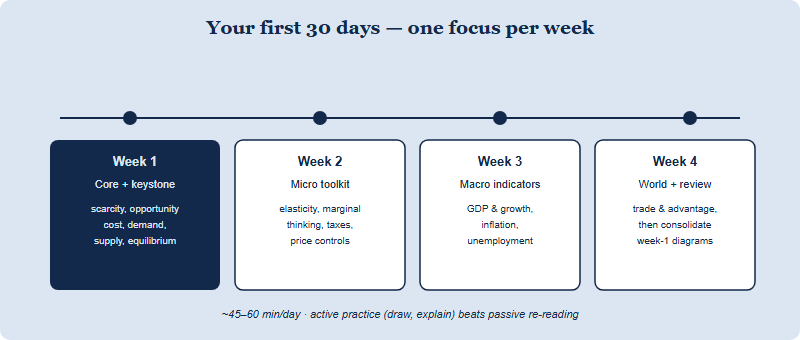
A foundation is built by short, daily contact rather than weekend cram sessions, so this plan assumes roughly 45–60 minutes a day across four weeks. The aim is not to “finish economics” but to walk out of month one able to read an entry-level question, draw the basic diagrams, and hold a conversation with teammates. Each week has one centre of gravity; resist the urge to run ahead, because the keystone in week one is what makes weeks two to four click.
- Week 1 — The core + the keystone. Lock in scarcity and opportunity cost, then spend most of the week on demand, supply and market equilibrium. Practise drawing the two curves, finding equilibrium, and shifting one curve at a time to predict price and quantity. End the week able to answer “what happens to the market for X if Y changes?” out loud.
- Week 2 — The micro toolkit. Add elasticity (how strongly quantity reacts to price) and marginal thinking (is one more unit worth it?). Layer on a first look at how taxes, subsidies and price ceilings or floors move the same diagram. This is where micro stops being abstract and starts feeling like a tool you wield.
- Week 3 — The four macro indicators. Switch to the big picture: GDP and economic growth, inflation and the price level, and unemployment. Learn what each measures, why it matters, and how they relate. By Friday you should be able to read an economic news headline and say which indicator it is about.
- Week 4 — A first pass at the world economy + consolidation. Take a light pass over why countries trade (comparative advantage) so the world-economy area is no longer a blank. Then spend the back half of the week revisiting week-one diagrams under light time pressure, and doing a few mixed entry-level questions to see how micro and macro show up together.
Two rules keep this realistic. Depth over coverage: it is far better to truly own demand and supply than to skim all three subject areas and retain none. And active over passive: drawing a diagram from a blank page, or explaining a concept to a teammate, builds far more than re-reading notes. The NEC is a team event, so the act of explaining is itself practice — if you can teach week one to a teammate, you have learned it.
What to read (and what to skip) in month one
A beginner does not need a stack of advanced books in the first 30 days — they need one clear introductory source plus a little real-world reading to make it stick. The skill that matters most is matching the resource to the week, so the reading reinforces the concept you are already drilling rather than dragging you off into theory you are not ready for.
- One introductory textbook or course, used as a spine. Pick a single mainstream introductory economics text or a beginner online course and follow its early chapters in the concept order above. The CEE sets the NEC's academic standard, so a standard introductory micro-then-macro sequence aligns well; the exact recommended materials and any official study lists are details to confirm on the official CNEC channels.
- A reputable economics explainer for intuition. Short explainer articles or videos that walk through one concept (say, why a tax changes a market) are excellent for turning a graph back into a story. Use them after you have met the concept, not instead of the textbook.
- Light news reading from week three. Once you know the macro indicators, skim a quality business-news source and try to label each story — “this is about inflation,” “this is unemployment.” It is the cheapest way to make macro feel real.
- Skip for now: advanced calculus-heavy treatments, niche subfields, and anything promising shortcuts. Past papers and timed drills matter, but they are a week-four-onward tool once you have the foundations — not a week-one starting point.
If you are unsure whether a resource is right, apply one test: does it explain the concept you are studying this week at a level you can follow without three other tabs open? If yes, it belongs in month one. If it sends you down a rabbit hole, save it for later. Beginners who keep their reading narrow and aligned to the weekly focus build a sturdier foundation than those who collect ten books and finish none.
From foundation to team: what month two looks like
Month one is deliberately solo and conceptual, but the NEC is a team competition, so it helps to know where the foundation leads. Once you can read entry-level questions and draw the basic diagrams, the natural next steps are to slot into a team, learn how the various rounds work, and start timed practice — the format, divisions and round structure are exactly the things to verify on the official CNEC channels rather than guess. As a beginner you are not expected to start in the most advanced division; the point of a strong first 30 days is that you arrive at team formation able to contribute and to learn fast, instead of starting cold while everyone else moves.
A first-party note from coaching beginners: the students who progress most are rarely the ones who knew the most economics on day one — they are the ones who built the foundation in the right order and then kept explaining concepts to teammates. Economics rewards the person who can make an idea clear, and a team round is just that skill under time pressure. Get the spine right this month, and the rest of the journey — divisions, rounds and the path toward the global stages — becomes a question of practice rather than a question of starting over.
FAQ
Do I need to have studied economics before joining the NEC?
No. The school subject is a head start, not a prerequisite. A focused first 30 days on the core concepts is enough to reach the start line.
What is the single most important concept to learn first?
Demand and supply with market equilibrium. It is the keystone — elasticity, taxes and most micro questions are the same diagram with a different shock.
How much time does a beginner need in the first month?
Roughly 45–60 minutes a day. Short daily contact and active practice build a foundation faster than weekend cram sessions.
Which division should an absolute beginner enter?
That depends on the current season’s rules — confirm the divisions and eligibility on the official CNEC channels before deciding.
Published by the NEC / CNEC editorial desk, operated by Hanlin Education as the officially authorized China National Economics Challenge (CNEC) test center. The NEC is run by the Council for Economic Education, which sets the official rules — always confirm current dates, divisions, fees and awards on the official CNEC channels. Errors are corrected within 7 working days.