
On a National Economics Challenge (NEC) competition day you arrive, check in with your team, sit the written Qualifying Test, then move through the live rounds — Super Econ, Quiz Bowl, Critical Thinking and the others — before scores are tallied and awards announced. It is part exam hall, part quiz show. This walkthrough describes what the day feels like, hour by hour, so you turn up knowing what to expect instead of guessing.
Before you walk in: what competition day even is
The NEC is run by the Council for Economic Education (CEE), founded in 1949, and tests microeconomics, macroeconomics, and the world/international economy across roughly 10,000 US students each year. For students in China, the day you attend is the CNEC — the China National Economics Challenge, operated by Hanlin (SKT) since 2016 across 20+ provinces and 300+ schools, and the only official path from China to the NEC global rounds. So the “competition day” in this article is the CNEC National Round experience.
You compete in one of three divisions, and which one you are in shapes the whole day. The Pre division is the entry level and can be entered individually or as a small group of two to four; David Ricardo (intermediate) and Adam Smith (advanced) are both fixed teams of four. If you are in a four-person team, you will spend most of the day moving as a unit — sitting together, conferring between rounds, and walking to team events as a group.
One honest caveat before the play-by-play: the NEC has seven recognised round types — Qualifying Test, Super Econ, Quiz Bowl, Critical Thinking, Econ Lab, Econ Immersion and U20 Youth Voice — but exactly which run on your day, in what order, and how the schedule is blocked can change year to year and by division. Treat the timeline below as a realistic working model, and confirm the actual running order, start times and venue logistics on the official CNEC channels — the round overview lives on the CNEC home page.
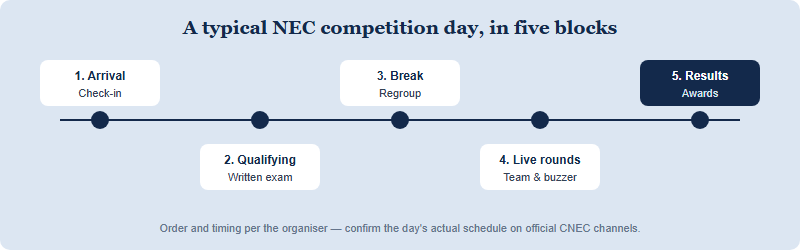
Arrival and check-in: the first half hour
Plan to arrive early — well before the published start time. The first thing that happens is check-in: confirming your registration, your division, and (for team divisions) that all four members are present and accounted for. This is also when you typically receive whatever the venue issues for the day, which may include a seat or room assignment, a name badge or candidate number, and instructions for which materials you can bring into the exam room. Bring photo ID and your registration confirmation; if anything about permitted calculators, scratch paper or devices is unclear, the official CNEC channels are the place to check the rules in advance rather than discovering a problem at the door.
The first half hour is mostly about settling nerves. Teams find their spot, double-check that everyone knows which room the written test is in, and silence phones. If you are competing as a Pre-division individual, this is simpler — you just need yourself, your ID and your seat. If you are a David Ricardo or Adam Smith team of four, use these minutes to agree on the obvious logistics: where you will meet during the break, who carries what, and that nobody wanders off before the team rounds.
The written rounds: a quiet, exam-hall hour
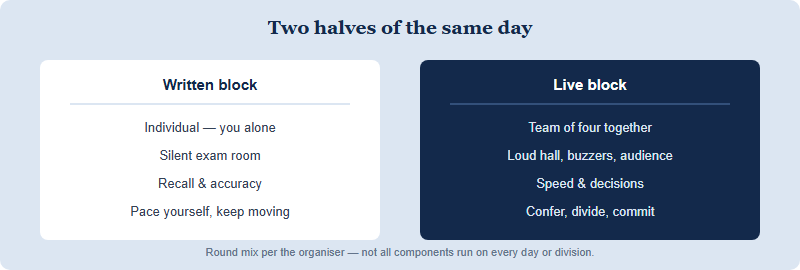
The day’s first competitive event is usually the Qualifying Test — an individual, written multiple-choice exam. The atmosphere flips immediately: from the buzz of check-in to a silent room with invigilators, where you sit at your own desk and work alone against the clock. Even in a team division, this round is each member competing individually; your individual scores are what get recorded here. Read each question carefully, watch your pace, and remember the standard exam-hall rule of not getting stuck — if a question is fighting you, mark it and move on.
Depending on the year and division, the written portion may include more than one paper or be structured to cover the three subject areas the NEC is known for: microeconomics, macroeconomics, and the world/international economy. Because the precise number of questions, the time limit and whether papers are split by subject can vary, do not anchor your expectations to a figure you read on a forum — confirm the current written-round format on the official CNEC channels. What is reliably true is the experience: a focused, silent, individual block where the only thing that matters is you, the paper and the clock.
| Block | Setting | You compete as | What it feels like |
|---|---|---|---|
| Check-in | Lobby / registration desk | Yourself / your team | Busy, social, logistics |
| Qualifying Test | Silent exam room | Individual | Focused, solitary, timed |
| Break | Common area | Team regroups | Decompress, refuel |
| Live / team rounds | Hall or breakout rooms | Team of four (where applicable) | Fast, loud, collaborative |
| Results | Auditorium / announcement | Team & individual | Tense, then celebratory |
The table above is a model of the day’s rhythm, not a fixed schedule. Some events may be combined into a single block, and the venue may run divisions on slightly different tracks. Always cross-check against the day’s official programme.
The live and team rounds: the day gets loud
After the quiet exam block, the energy changes completely. This is where the team rounds and live events live — and where a four-person team earns its keep. Several round types can appear here, and each has its own feel:
- Super Econ — a team round where the four of you work together on a set of problems, conferring and dividing questions rather than sitting in silence. The skill is fast, quiet coordination under time pressure.
- Quiz Bowl — the most “quiz show” part of the day: a live, head-to-head format, often with buzzers, where speed and nerve matter as much as knowledge. Expect an audience feel, a moderator reading questions, and quick risk calls about whether to buzz.
- Critical Thinking — an open-ended, case-style round where a team analyses a problem and presents or defends a position. This is the most “stand up and talk” moment of the day, closer to a presentation than a test.
- Econ Lab, Econ Immersion and U20 Youth Voice — applied, project- or discussion-style components the NEC also recognises. Whether these run on your specific competition day, and in what form, depends on the year and division — confirm officially.
As a first-party note from running the China round: the contrast between the morning and this stretch is the thing most first-timers underestimate. Students who treat the whole day like one long exam tend to be flat-footed when the buzzer rounds start; the ones who do well mentally “switch modes” — from solitary exam discipline to loud, decisive teamwork — at the break. Knowing the switch is coming is half of handling it.
The break, results and the walk home
Between blocks there is usually a break — and how you use it matters more than students expect. This is not just lunch; it is your team’s only real window to reset. Eat something, hydrate, and resist the urge to re-litigate the written test question by question, which only spikes anxiety before the live rounds. If you are a team of four, a quick, calm huddle — “we did our part, now we play as a team” — does more good than a post-mortem. Then it is back in for the live events.
When competition ends, scoring is tallied and results are announced. The exact format varies — sometimes a live ceremony reading out award tiers, sometimes results published shortly after — and the precise award names, tiers and how individual versus team standings are recognised should be confirmed on the official CNEC channels rather than assumed. What is consistent is the feeling: a tense wait, then names called. Whatever the outcome, the day ends as a real, structured competition experience — and for China students, a result here is what feeds into the official path toward the NEC global rounds. You can see how that advancement is framed on the CNEC home page.
A final, practical first-party tip: the students who enjoy the day most are the ones who arrive having already pictured it. Knowing that there is a quiet morning and a loud afternoon, that you’ll check in with ID, that there’s a break to manage, and that results come at the end removes the low-grade stress of the unknown — and lets you spend your attention on the economics instead of on “what happens next?”
Frequently asked questions
How long does NEC competition day last?
It typically runs most of a day, from morning check-in through the written and live rounds to results. Confirm the exact hours on official CNEC channels.
Do I compete alone or with my team?
The written Qualifying Test is individual even for teams; the live and team rounds are where a David Ricardo or Adam Smith four-person team competes together.
What should I bring on the day?
Bring photo ID and your registration confirmation. Check permitted calculators, paper and devices in advance on the official CNEC channels before arriving.
When do I find out my result?
Results are tallied and announced after competition ends, by ceremony or published shortly after. The award format and tiers should be confirmed officially.
Published by the NEC / CNEC editorial desk, operated by Hanlin Education as the officially authorized China National Economics Challenge (CNEC) test center. The NEC is run by the Council for Economic Education, which sets the official rules — always confirm current dates, divisions, fees and awards on the official CNEC channels. Any error will be corrected within 7 working days.