Once your National Economics Challenge (NEC) team of four is formed, the next decision is role specialization: who owns microeconomics, who owns macroeconomics, who owns the world/international economy, and who anchors each round. The strongest teams assign a primary and a backup for every subject, then map those owners onto the rounds, so no topic and no round is ever left unguarded on competition day.
Why role division — not just talent — wins rounds
The NEC, run by the Council for Economic Education (CEE, founded 1949), tests three bodies of knowledge: microeconomics, macroeconomics, and the world/international economy (the official CNEC site frames the third strand as “international & current events”). It reaches close to 10,000 students a year in the United States. Both the David Ricardo (intermediate) and Adam Smith (advanced) tracks are run as a team of four — a format that only pays off if four people deliberately divide that surface area instead of all revising the same comfortable topic.
The failure mode is predictable. Four teammates who each “just study everything” tend to converge on the same micro core they already know, leaving the world economy — exchange rates, comparative advantage, the balance of payments, trade institutions — thinly covered. When a hard international question lands in a live round, nobody has owned it. Role division fixes this by making each subject somebody's job, with clear depth targets, while still keeping a shared baseline so every member can answer fundamentals.
Two principles keep specialization from becoming fragility:
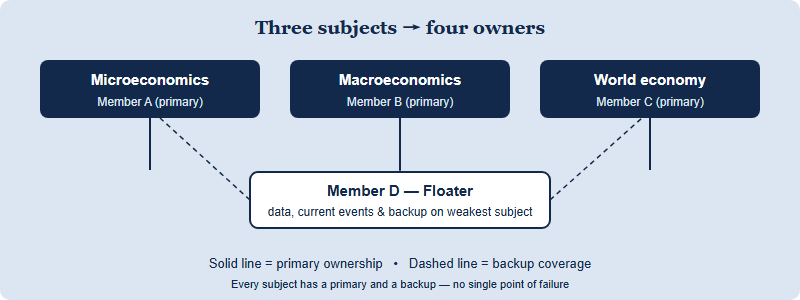
- Primary plus backup. Every subject gets one owner who goes deepest and one secondary who can cover if the owner freezes or is reading another question. No single point of failure.
- A shared floor. Specialists still drill the common core — supply and demand, GDP, inflation — so the team can answer rapid fundamentals collectively in a buzzer round without waiting for “the macro person.”
Mapping the three subjects to four people
Three subjects, four students — so the fourth role is a deliberate choice, not a leftover. A common and durable split: one micro owner, one macro owner, one world-economy owner, and a fourth member who takes the floater / data-and-current-events role. That fourth person becomes the backup on whichever subject is weakest, handles cross-cutting data interpretation (tables, indices, quick calculations) that appears across all three strands, and tracks current events — which the official framing folds into the international strand.
The reason the world economy usually deserves a dedicated owner is that it is the strand students most often under-prepare. Micro and macro are anchored by school courses (AP, IB, A-Level); international economics and current affairs are frequently the thinnest slice of a Chinese international-school student's prior coursework, so naming an owner forces that gap closed.
| Role | Primary ownership | Backs up | Representative topics |
|---|---|---|---|
| Member A — Micro | Microeconomics | Macro fundamentals | Supply/demand, elasticity, market structures, surplus & deadweight loss, externalities |
| Member B — Macro | Macroeconomics | Micro fundamentals | GDP & national income, inflation, unemployment, fiscal & monetary policy, AD–AS |
| Member C — World economy | International economics | Macro policy overlap | Comparative advantage, exchange rates, balance of payments, tariffs, trade institutions |
| Member D — Floater / data | Data & current events | The team's weakest subject | Tables, indices, quick calculations, current-affairs context across all three strands |
Assigning subject owners to the rounds
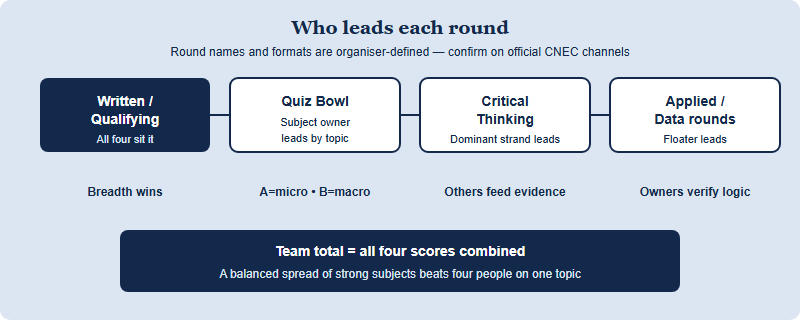
Subject ownership is only half the system; the other half is mapping those owners onto the competition's rounds. The CNEC structure is commonly described as a sequence of rounds — the Qualifying Test, Super Econ, Quiz Bowl, Critical Thinking, Econ Lab, Econ Immersion and a U20 Youth Voice component. Exactly which rounds run, and their precise format, are organiser-defined and change year to year, so confirm the current round list and rules on the official CNEC channels before you lock responsibilities. With that caveat, role-to-round mapping follows a few stable logics.
- Individual written / qualifying rounds: here breadth matters and every member sits the test, but specialists raise the team total by going deep in their strand. The official site notes that the team total combines all four students' scores — so a balanced spread of strong subjects beats four people clustered on one topic.
- Quiz Bowl (live, head-to-head): assign a lead by subject. When a micro question is read, Member A is the designated first-thinker; the world-economy owner leads on a trade or currency prompt. A pre-agreed signal stops two people answering over each other.
- Critical Thinking (case analysis & defence): this rewards integration across subjects, so let whichever owner's strand dominates the case lead the argument, with the others feeding evidence. The floater often runs the data inside the case.
- Applied / data rounds (e.g. Econ Lab, Econ Immersion): the floater's data-interpretation role takes the front seat, with subject owners checking that the economics behind the numbers is sound.
A worked example makes the logic concrete. Suppose a Quiz Bowl question asks about the welfare effect of a tariff. The world-economy owner (Member C) is the designated first-thinker because tariffs sit in their strand; the macro owner (Member B) backs up because the policy overlaps with trade balances; and the floater (Member D) is ready to supply any data point the question hangs on. Because that sequence was rehearsed, the team commits in seconds rather than three people glancing at each other. Now flip it: a question on monopoly pricing routes to Member A first, with the others holding back. The ownership map turns “who knows this?” into “whose turn is this?” — a faster question to answer under a buzzer.
The point of writing this down before competition day is speed under pressure. In a live round, hesitation about who answers costs as much as not knowing the answer. A team that has rehearsed “trade question → C leads, B backs” converts faster than one improvising the hand-off in real time.
A four-week routine to lock the roles in
Roles assigned on paper but never rehearsed collapse under buzzer pressure. The first-party pattern we see work in CNEC cohorts is to test the division early, then adjust before it is expensive to change.
- Weeks 1–2 — provisional ownership. Run a short diagnostic across all three subjects, hand each person their strongest strand, and name the floater. Treat these as provisional, not final.
- Week 3 — pressure-test with mocks. Run a mock Quiz Bowl and a mixed written set. Watch for collisions (two people lunging at the same question) and gaps (a topic nobody owns). Re-assign where the diagnostic mispredicted real performance.
- Week 4 — lock and rehearse hand-offs. Fix the primary/backup map, agree the buzzer signals, and rehearse the round-to-owner mapping until the hand-offs are automatic. From here, each owner deepens their strand while everyone keeps drilling the shared floor.
For the broader season — registration, the CNEC-to-global calendar and division choice that frame these roles — see the official CNEC site, and decide your division first, since David Ricardo and Adam Smith both require the full team of four that this role system assumes.
Common role-division mistakes to avoid
A handful of errors recur across teams new to the format:
- Leaving the world economy ownerless. The most common gap. If no one owns international economics and current events, the team is exposed on exactly the strand schools cover least.
- Over-specializing with no shared floor. If only the macro owner can answer a basic GDP question, rapid buzzer rounds stall. Keep the common core collective.
- No backup. One owner per subject with no secondary means a single frozen moment leaves a whole strand silent.
- Never rehearsing hand-offs. Knowing who owns what is useless if the team has not practised handing the question over at speed. Mock rounds, not just solo revision, build that reflex.
Done well, role division turns four individuals into a system that covers more of the CEE syllabus than any of them could alone — which is the entire reason the NEC is a team event.
Frequently asked questions
There are three subjects but four people — what does the fourth member do?
Make the fourth a floater: backup on the team's weakest subject plus owner of cross-cutting data interpretation and current events, which span all three strands.
Should each member only study their own subject?
No. Owners go deepest in their strand, but everyone drills a shared floor of fundamentals so the team can answer rapid basics collectively in a buzzer round.
Which subject most needs a dedicated owner?
Usually the world/international economy — exchange rates, trade and current events — because it is the strand students cover least in school coursework.
Are the NEC rounds fixed each year?
Round names and formats are organiser-defined and can change. Confirm the current round list and rules on the official CNEC channels before locking responsibilities.
Published by the NEC / CNEC editorial desk, operated by Hanlin Education as the officially authorized China National Economics Challenge (CNEC) test center. The NEC is run by the Council for Economic Education, which sets the official rules — always confirm current dates, divisions, fees and awards on the official CNEC channels. Any error will be corrected within 7 working days.