
The David Ricardo division suits Grade 8–10 students as a first team competition because this is the age when a team of four can genuinely function — old enough to share a workload, debate an answer and trust a teammate, but early enough that there is room to grow before the advanced Adam Smith track. The Council for Economic Education sets David Ricardo as the entry tier for first-time competitors with at most one economics course; that gentle academic bar is exactly what lets the team experience, not the content, become the lesson.
The real question is not “can they do the economics” — it is “can they compete as a team”
Most coverage of the National Economics Challenge (NEC) asks whether a younger student knows enough economics. That framing misses what is actually new for a Grade 8–10 student. The NEC is, at its core, a team event: the David Ricardo and Adam Smith divisions are contested by a team of four, and the China National Round (CNEC) carries the live, head-to-head Quiz Bowl where four students answer together under a clock. For many students this is the first time their result depends on coordinating with three other people rather than on their own paper alone.
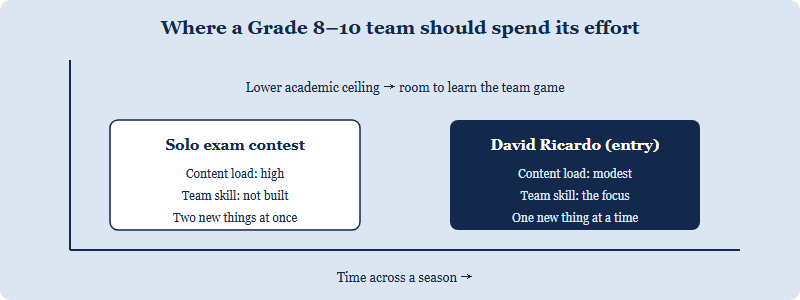
That is a skill, and like any skill it is best learned on an easy gradient. David Ricardo is that gradient. Per the CEE, it is designed “for students participating in the NEC for the first time and who have taken no more than one economics course.” Because the academic ceiling is deliberately lower than Adam Smith — which the CEE reserves for “advanced placement, baccalaureate, honors students, and returning competitors” — a Grade 8–10 team is not fighting the syllabus and the format at the same time. They can spend their attention on the genuinely hard, genuinely transferable part: working as a unit.
Why Grade 8–10 is the right developmental window
There is a maturity argument, separate from the academic one. Competing as a team of four asks for capacities that tend to come online in the early-to-mid secondary years: dividing a shared task fairly, disagreeing about an answer without it becoming personal, and holding your nerve when a buzzer round speeds up. A student in Grade 8–10 is usually ready to practise these — and still has multiple seasons ahead to refine them — in a way that a much younger child often is not, and that a Grade 12 student is arguably leaving a bit late if it is their very first team event.
- Old enough to share a workload. A four-person team naturally splits into rough lanes — microeconomics, macroeconomics, the world-economy / international topics, and case discussion. Grade 8–10 students can own a lane and be accountable for it.
- Old enough to debate productively. The Critical Thinking case round rewards a team that can argue toward one answer. Learning to challenge a teammate's reasoning respectfully is a Grade 8–10-appropriate skill that pays off everywhere later.
- Early enough to have a runway. Treating David Ricardo as Season 1 leaves Seasons 2 and 3 to move up. Starting the team habit young compounds; starting it in the final year does not.
- The stakes are calibrated, not crushing. Because the entry tier does not assume AP/IB-level economics, a first wobble as a team is a rehearsal, not a verdict on whether they “belong.”
A first team competition teaches things a solo paper cannot
Many of the strongest pre-university activities for Grade 8–10 are still individual: a solo maths olympiad, an essay competition, a science exam. Those build depth, but they do not build the muscle of performing with others. The David Ricardo division is a low-risk place to build exactly that, because the format bundles individual written work and shared rounds into one event. Students get a measured dose of collaboration without being thrown into the deep end.
| What a Grade 8–10 student practises | Solo exam / essay contest | David Ricardo (first team event) |
|---|---|---|
| Owning a topic lane within a group | No | Yes — micro / macro / world economy split |
| Reaching one answer under time pressure with peers | No | Yes — the live Quiz Bowl round |
| Defending reasoning in a case discussion | Rarely | Yes — the Critical Thinking case round |
| Individual subject knowledge | Yes | Yes — written micro / macro exams |
| Academic barrier to entry | Often high | Low — entry tier, ≤ one economics course |
This is the genuine first-party point we make as the CNEC operator: in our experience running the China National Round, the students who later thrive in the Adam Smith division are very often the ones who learned the team game early in David Ricardo — how to brief each other quickly, how to trust a teammate's lane, how to stay composed in a buzzer round. The content can be caught up. The team instinct is harder to retrofit, and Grade 8–10 is a forgiving place to acquire it.
How David Ricardo sets up a multi-year ramp
The clearest reason to start younger is the ramp it creates. The three divisions are not three unrelated contests; they form a progression. A Grade 8–10 team that begins at David Ricardo can run the same four-person engine for several seasons, deepening the economics and tightening the teamwork each year, and graduate to Adam Smith when the depth of micro, macro and the world economy is genuinely within reach — rather than meeting that depth and the unfamiliar team format in the same nerve-racking season.
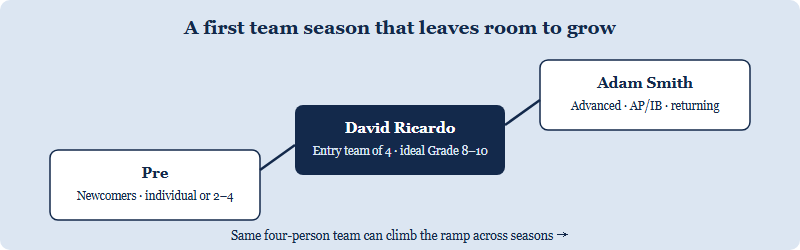
Practically, a Grade 8–10 team building its first season can lean on the structure the China National Round already provides. Read the division and round overview on the NEC / CNEC home page, and treat the first year as a deliberate apprenticeship in teamwork: assign lanes early, rehearse the live round as a four, and review every case discussion together. The economics will deepen naturally; the habit you are really installing is the four-person engine.
Building the four-person team in a first season
If David Ricardo is the place to learn the team game, it helps to be deliberate about how a Grade 8–10 team is built and run. The entry-tier academic bar buys you the bandwidth to invest in team-building from week one rather than treating it as an afterthought. A few principles travel well into later seasons and into life beyond the competition.
- Pick lanes that match strengths, not seniority. Let the strongest grapher take micro, the news-follower take the world-economy questions, and a calm communicator anchor the case discussion. In a first season, fit-to-strength beats hierarchy.
- Build a shared vocabulary early. A young team that agrees on how it will describe a demand shift or a fiscal lever can brief each other in seconds during a live round. This shared shorthand is itself a Grade 8–10-appropriate teamwork skill.
- Rehearse the live round as a four, not as four soloists. The Quiz Bowl rewards whoever is fastest and surest among the four; practising who speaks, who defers and who double-checks is the rehearsal that matters most.
- Debrief together, blame no one. After every mock, review what the team got wrong, not who. A no-fault debrief habit, learned young, is the difference between a team that improves across seasons and one that fractures.
Because the division is calibrated as a fair entry point, none of this requires advanced economics to start — it requires a willingness to practise the human side of competing. That is precisely the muscle a Grade 8–10 student is ready to develop, and the reason a first David Ricardo season tends to pay forward. To plan that season around real milestones, check the dates on the CNEC competition schedule and confirm them on the official CNEC channels before committing.
Common questions parents and students ask
Is David Ricardo academically “too easy” for a capable Grade 9 or 10 student? Not when the goal is a first team season. The lower academic ceiling is a feature: it frees a strong student to lead a team well instead of being buried in unfamiliar content. The depth comes next, in Adam Smith. Below are the points families raise most often.
Does my child need to have studied economics already?
No. Per the CEE, David Ricardo is for first-time competitors with no more than one economics course; confirm the current rule on the official CNEC channels.
How many students form a David Ricardo team?
A team of four, the same size as the Adam Smith division. The Pre division may be entered individually or as a small group.
Is it only Grade 8–10 students in David Ricardo?
No — the division is defined by experience, not grade. It simply suits Grade 8–10 as a first team event; check eligibility details on the official CNEC channels.
What if our team is strong — should we skip to Adam Smith?
If the economics depth and team experience are both there, yes. If only the knowledge is there, a David Ricardo season first builds the team habit on an easier gradient.
How does a China-based team enter?
Through the official China National Round. See the CNEC registration page and confirm the current window, fees and rules on the official CNEC channels.
Published by the NEC / CNEC editorial desk, operated by Hanlin Education as the officially authorized China National Economics Challenge (CNEC) test center. The NEC is run by the Council for Economic Education, which sets the official rules — always confirm current dates, divisions, fees and awards on the official CNEC channels. Any error will be corrected within 7 working days.