
Once your NEC results arrive, the goal shifts from competing to diagnosing. A score report is not just a placing — it is a per-round record of where your points came from and where they leaked away. Read it as a diagnosis: find your weakest counted round, separate a knowledge gap from a format gap, and convert that single page into a focused plan for next season rather than a number to celebrate or mourn.
A score report is a diagnosis, not a verdict
The first instinct after the National Economics Challenge (NEC) is to look at one figure — the final rank or the award band — and stop there. That wastes the most useful thing the results give you. Because the NEC, run by the Council for Economic Education (CEE, founded 1949) and taken by roughly 10,000 US students a year, is built from seven distinct rounds, your report is really seven smaller results stacked together. The headline placing is just their sum. The diagnostic value lives in the breakdown beneath it.
Treating the report as a diagnosis changes what you do with it. A verdict invites a feeling: relief, disappointment, a shrug. A diagnosis invites a question — which round cost me the most relative to the field, and was that because I didn't know the economics or because the format caught me out? Those are different problems with different fixes, and you can only tell them apart by reading the round-by-round detail rather than the total. The students who improve most between seasons are usually the ones who treated last season's report as a worked problem, not a grade.
Two guardrails frame everything below. First, exactly what your report shows — whether it lists per-round marks, percentiles, a rank, or only an award band — is set officially and varies by stage, division and season; what you actually receive must be read off your own report and confirmed on the official CNEC channels, not assumed from this article. Second, this is a guide to interpreting results and planning next steps — it is not a scoring-mechanics explainer and it promises no particular outcome. For students in China, the official route into the NEC global rounds is the China National Economics Challenge (CNEC), run by Hanlin (SKT) as the officially authorized China test center since 2016, now spanning 20-plus provinces and 300-plus schools. You can revisit the round line-up on the NEC / CNEC home page as you map your own report against it.
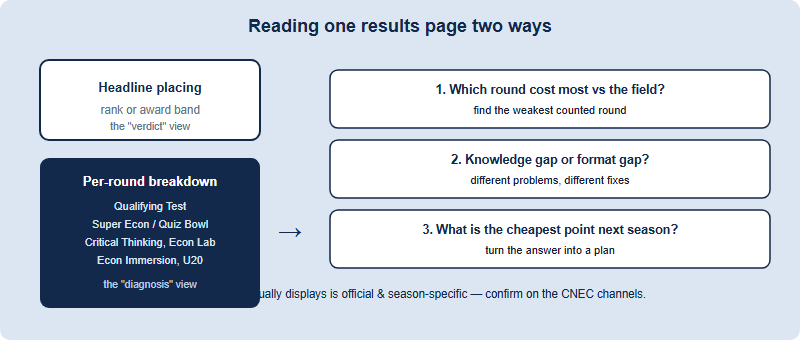
Step one: find the round that cost you the most
Start by locating your weakest counted round — but weakness here means relative to the field, not relative to your own other rounds. A round where you scored modestly but most teams also scored modestly did not cost you much; a round where you were comfortably below where comparable teams landed is where your placing actually leaked. If your report gives any comparative signal — a percentile, a rank within a round, or a published average — that comparison is the most valuable number on the page, far more than your raw mark.
If your report shows only your own marks with no comparison, you can still reason carefully. Rank your rounds from strongest to weakest, then ask which of the weak ones were controllable. A thin result in an objective round — the kind where points come from coverage and accuracy — is a louder warning than a middling result in a judged round, because objective points are the ones you could most plausibly have secured. A useful framing is to walk the rounds in this order when you read the breakdown:
- Objective rounds first. The written Qualifying Test and the timed Super Econ are where a prepared team expects a high, reliable floor. If your weakest result sits here, you have found a high-priority gap, because these points are the most recoverable.
- The live buzzer round next. Quiz Bowl is volatile by nature, so one weak showing may be variance rather than a true gap. Look for a pattern across practice and the real event before you conclude it is a weakness.
- The judged rounds last. Critical Thinking, Econ Lab, Econ Immersion and U20 Youth Voice reward structure and rehearsal. A weak result here usually points to a format or delivery gap rather than missing economics.
One first-party observation from operating the China round: when teams debrief, they tend to over-attribute a disappointing placing to the most memorable round — usually the high-pressure live event — rather than the one that actually drained the most points. The buzzer round feels decisive because it is stressful, but the breakdown frequently shows that a quietly under-trained objective or judged round did more damage to the total. Reading the page coldly, in the order above, corrects for that memory bias.
Step two: separate a knowledge gap from a format gap
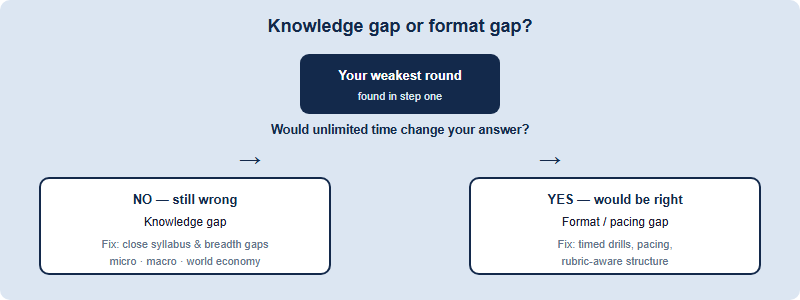
Once you have your weakest counted round, the decisive question is why it was weak — and there are essentially two answers, with very different remedies. A knowledge gap means you didn't know the economics: a topic you hadn't covered, a concept you half-remembered, a part of the US-style breadth (micro, macro and the international/world economy) that your school course never reached. A format gap means you knew the economics but the round's shape cost you: you ran out of time, mis-paced a written section, fumbled buzz timing, or wrote a case response that was correct but unstructured.
Telling them apart is the whole game, because the fixes do not transfer. More content revision will not fix a timing problem, and more timed drills will not fill a topic you never studied. The table below gives a practical way to read the symptom on your report and infer which gap you are looking at.
| What you notice on the report | Likely gap | Next-season fix |
|---|---|---|
| Low objective score, and you recall not knowing several topics | Knowledge | Close syllabus gaps — especially US-style breadth your course skips |
| Objective score below your practice level, topics felt familiar | Format / pacing | Timed full-length drills; pacing strategy under the clock |
| Strong on knowledge rounds, weak on judged rounds | Format / structure | Rehearse rubric-aware structure for case and presentation rounds |
| One volatile live round low, others solid | Possibly variance | Check the pattern over practice before over-correcting |
| Uniformly mid across every round | Breadth of preparation | Raise the floor everywhere; no single round to target |
A quick test helps when you are unsure. Ask: if I had been given unlimited time and no pressure, would my answer have changed? If yes, it is a format or pacing gap — the knowledge was there. If no — you still would not have known — it is a knowledge gap. This single question resolves most ambiguous cases, and it keeps you from the common error of grinding more content when the real problem was the clock, or drilling speed when the real problem was an unstudied topic.
For team divisions, run this diagnosis per person where you can, not just for the team. Because David Ricardo (intermediate) and Adam Smith (advanced) are teams of four, while Pre (entry) can be entered individually or as a small group of 2–4, a team total can hide a single member who carried a particular round or a single member who lagged on it. Where the format gives individual signals, use them to assign next season's preparation precisely instead of having everyone redo the same drills.
Step three: turn the read-out into next season's plan
A diagnosis is only useful if it changes what you do. The bridge from report to plan is the idea of your cheapest next point — the place where an hour of preparation is most likely to convert into marks you didn't earn this time. Early in a preparation cycle that is almost always the objective rounds, because closing a syllabus gap or building retrieval speed reliably turns study time into points. Once that floor is high, the curve flattens and the cheapest remaining points move to the judged rounds, where a rehearsed presentation or a tighter, rubric-aware case write-up is worth more than another quiz. Your report tells you which side of that curve you are on.
Build the plan in that order of leverage:
- If a controllable objective round was your weak point, that is your first and highest-return target — the points are recoverable with disciplined coverage and timed practice, and they are the foundation a high placing is built on.
- If you already have a strong objective floor and lost ground in judged rounds, shift effort to structure and delivery: practise to the kind of reasoning and communication those rounds reward, ideally against the round's actual format rather than generic essays.
- If your read-out is uniformly mid, resist the urge to find a single villain round. Your plan is to raise the floor across the board, since no one round is dragging you alone.
- If you are moving up a division next season — Pre to David Ricardo, or David Ricardo to Adam Smith — re-baseline rather than assume this year's read-out transfers, because the counted rounds, their weighting and the depth expected can differ by division.
Write the plan down while the competition is fresh, ideally within a week of getting your results, and attach each item to a specific round and a specific gap type so it is a worklist rather than a vague resolution. If you are preparing through us, this is exactly the input a coach uses to build a targeted programme; you can see how the rounds and breadth map to preparation in our CNEC preparation resources and align your read-out to it. On authority and honesty: the CEE sets the official academic standard and the NEC rules, while the CNEC, run by Hanlin as the authorized China test center, operates the national round and the only official path from China to the global rounds. Any named question-setters or judges associated with the contest are organiser claims and should be confirmed on the official CNEC channels rather than treated as established fact. We make no promise about results or admissions outcomes — the value of a results page is the clear-eyed plan you build from it, not a guarantee it implies.
Frequently asked questions
What does an NEC score report actually show?
It depends on the stage and season — it may show per-round marks, a percentile, a rank or only an award band. Read your own report and confirm specifics on the CNEC channels.
How do I find which round held me back?
Compare each round to the field, not to your other rounds. A round well below comparable teams — especially a controllable objective one — is where your placing leaked.
How do I tell a knowledge gap from a format gap?
Ask whether unlimited time would have changed your answer. If yes, it's a pacing or format gap; if no, it's a knowledge gap. The fixes differ completely.
When should I plan next season's prep?
Within about a week, while the competition is fresh. Attach each action to a specific round and gap type, and re-baseline if you change division.
Published by the NEC / CNEC editorial desk, operated by Hanlin Education as the officially authorized China National Economics Challenge (CNEC) test center. The NEC is run by the Council for Economic Education, which sets the official rules — always confirm current dates, divisions, fees and awards on the official CNEC channels. Corrections are made within 7 working days.