
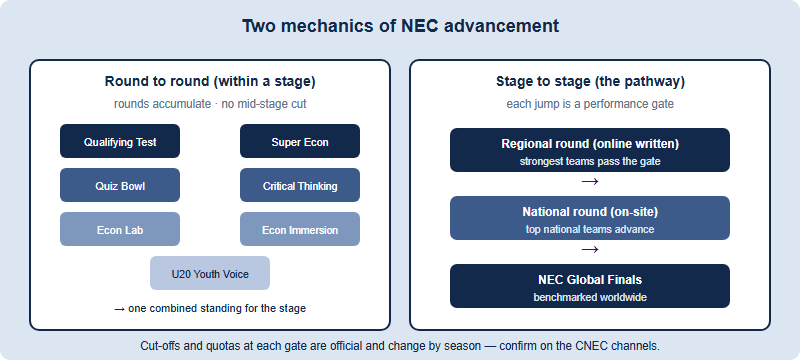
NEC advancement has two different mechanics, and confusing them costs teams a season. Within a stage, the rounds accumulate — you are not eliminated between, say, the Qualifying Test and Quiz Bowl; you carry a running result forward. Between stages, performance is a gate: only the strongest teams pass from the Regional round to the National round, and from National up to the NEC Global Finals. This guide maps that progression — not the points maths, and not what the awards mean.
Two kinds of “moving forward” you must not confuse
The National Economics Challenge (NEC) is run by the Council for Economic Education (CEE, founded 1949), covers microeconomics, macroeconomics and the world/international economy, and is taken by roughly 10,000 US students a year. For teams competing from China, the official route is the China National Round (CNEC), operated by Hanlin (SKT) as the authorized China test center since 2016 across 20-plus provinces and 300-plus schools — the only sanctioned bridge from China into the NEC global rounds.
Before you plan a single revision week, separate the two senses of “advancing”, because they obey opposite rules:
- Round to round (within a stage). A stage is built from several rounds — the Qualifying Test, Super Econ, Quiz Bowl, Critical Thinking, Econ Lab, Econ Immersion and U20 Youth Voice. You move through these rounds in sequence, and they build a combined standing. There is no sudden-death cut that drops you after one weak round inside a stage; a poor round hurts your standing, but you keep competing in the rest.
- Stage to stage (across the pathway). The competition is also a relay of stages — Regional, then National, then the Global Finals. Here the logic flips: each transition is a gate. Only teams that perform well enough at one stage are carried into the next, and the field narrows at every step.
This article is about the second mechanic above — the progression and gating rules — and how the first feeds it. It is not a points-and-tie-break explainer, and it is not about what a national or global award signals to a university; those are separate questions. The exact cut-offs, quotas and dates that govern each gate are set officially and change by season, so confirm them on the official CNEC channels rather than treating any figure here as a rule. You can see the current pathway laid out on the NEC / CNEC home page before mapping your own plan onto it.
The progression chain: Regional, then National, then Global
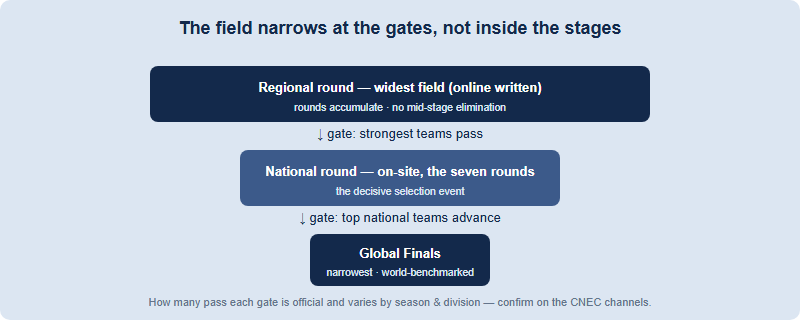
The pathway the official CNEC schedule sets out is a three-link chain — Regional → National → Global — and each link is a gate that only the better-performing teams pass. Understanding the shape of the chain tells you where the real selection pressure sits, which is the first step in budgeting your preparation sensibly.
- The Regional round — the opening gate. Per the official CNEC schedule, the Regional round is held online as a written test, and it is the first filter: "the strongest teams from the Regional round" are the ones who go through to the national stage. In other words, you do not register straight into the on-site National round — you first have to clear a written qualifier. This is the gate most newcomers underestimate, because it happens early and online and feels low-stakes; in advancement terms it is anything but, since a team that does not pass it never reaches the stage everyone is actually training for.
- The National round — the decisive selection event. The teams that pass the Regional gate compete on-site at the China National Round. This is where the seven competition rounds are contested in earnest and where the field for the next gate is chosen: per the official schedule, the top national teams are the ones who advance to the Global Finals. The National round is therefore the centre of gravity of the whole season — not a formality before the "real" finals, but the stage at which your eligibility to reach the finals is decided.
- The Global Finals — the international stage. Teams that clear the National gate advance to the NEC Global Finals, hosted — per the official CNEC pages — in New York, Hong Kong and the UK. At this stage a team is benchmarked against students worldwide rather than only against the China field. Reaching it at all is a function of having passed both earlier gates.
A useful way to hold the chain in mind: the population of teams is widest at the Regional round and narrowest at the Global Finals, and the narrowing happens at the transitions, not inside the stages. Note one boundary deliberately: how many teams pass each gate, and the exact score or rank needed to do so, are official figures that vary by season and by division — this article gives you the structure, not the numbers, and the numbers must come from the official CNEC channels. Treat any specific quota or cut-off you read elsewhere as something to verify, never as a fixed rule.
| Stage | Format | Role in advancement | What gates entry to the next stage |
|---|---|---|---|
| Regional round | Online, written test | Opening qualifier — widest field | Strong Regional result; the strongest teams pass through |
| National round (CNEC) | On-site, the seven rounds | Decisive selection event | Top national teams advance; the rest finish at national level |
| Global Finals (NEC) | International finals | World-benchmarked stage | End of the China advancement chain |
Round-to-round: how you move inside a stage
Inside a stage, the progression rule is the opposite of elimination. You compete in the stage's rounds in turn, and they combine into one standing for that stage — there is no checkpoint that removes you mid-stage for a single bad round. That has a concrete planning consequence: because every counted round contributes to the standing that the next gate reads, you cannot afford to write off a round as unimportant just because it is not your strength. A round you neglect does not eliminate you on the spot, but it lowers the standing you carry into the gate, and at a gate a lower standing is exactly what fails to pass.
This is where the two mechanics connect. The within-stage rounds do not gate each other, but together they determine whether you clear the between-stage gate. So the correct mental model is: play every round of the stage you are in, because the gate at the end judges the whole stage, not your best round. The order in which the specific rounds run, and which rounds belong to the online Regional stage versus the on-site National stage, are set officially and can change by season — confirm the current line-up on the official CNEC pages rather than assuming a fixed running order. For a round-by-round breakdown of what each event tests, our CNEC competition pages are the reference; here the point is only how the rounds feed the gate.
One more structural fact shapes how you progress: your division frames the bracket you advance within. The NEC's China divisions are Pre (entry level; entered individually or as a team of two to four), David Ricardo (intermediate; a team of four) and Adam Smith (advanced; a team of four). Advancement is comparative within a division — you are measured against the other teams in your bracket at each gate, not against the whole field at once. That is why an honest division choice is itself an advancement decision: clearing a gate near the top of an intermediate bracket is a stronger upward position than sitting mid-pack in the advanced one. Which division's results map to which level of the next stage can vary by season, so verify the current mapping officially before you lock a roster.
Planning backward from the gates: a first-party note
Running the China National Round, the CNEC desk sees the same advancement misreadings every cycle, and they are planning errors rather than economics gaps. The most common is treating the Regional round as a soft opener. Because it is the first gate, a team that under-prepares for the online written qualifier can be filtered out before it ever reaches the on-site stage it actually trained for — the season ends at the gate nobody took seriously. Plan as though the Regional round decides your access to everything downstream, because structurally it does.
The second misread is the inverse: assuming the National round is a formality on the way to a "real" global final. It is the opposite — the National round is the selection event that decides who is gated through to the finals, so it deserves the heaviest share of your preparation, not the lightest. The third is division over-reach: because advancement is comparative within a bracket, a team usually advances further by competing honestly at the right level than by reaching for the most advanced division and finishing mid-field. None of this is a promise of advancement or any admissions outcome; the NEC is an academic economics competition, and clearing a gate is earned, not guaranteed.
A note on authority and on facts. The CEE sets the official academic standard and the NEC rules; the CNEC, operated by Hanlin as the authorized China test center, runs the national round and is the only official path from China to the global rounds. The specific gate cut-offs, the number of teams advancing, the round order, the registration windows and the live-season dates are all official and change by cycle — this guide deliberately gives you the shape of the progression and asks you to confirm the numbers on the official CNEC channels. Any economists named in connection with the contest's question-setting or judging are organiser claims to verify, not established facts. The constant you can plan around is the chain itself: clear the Regional gate, treat the National round as decisive, and the Global Finals follow from passing both.
Frequently asked questions
Are teams eliminated between rounds within a stage?
No. Inside a stage the rounds accumulate into one standing; there is no mid-stage cut. Elimination happens at the gates between stages.
How does a team advance from the Regional round to the National round?
By performing strongly enough in the online written Regional round; the strongest teams pass through. Exact cut-offs are official — confirm on the CNEC channels.
What gates entry to the NEC Global Finals?
Results at the on-site National round — top national teams advance. The number that advance varies by season and division; confirm officially.
Does my division affect how I advance?
Yes. Advancement is comparative within your division's bracket (Pre, David Ricardo or Adam Smith), so pick the track matching your team's real depth.
Published by the NEC / CNEC editorial desk, operated by Hanlin Education as the officially authorized China National Economics Challenge (CNEC) test center. The NEC is run by the Council for Economic Education, which sets the official rules — always confirm current dates, divisions, fees and awards on the official CNEC channels. Any errors will be corrected within 7 working days.