
On the National Economics Challenge (NEC), public-goods questions reward a precise chain: classify the good using two yes/no tests — excludability and rivalry — then read off the failure (free-riding for public goods, over-use for common resources), and finally justify whether and how government should step in. This guide drills that goods-taxonomy and government-role micro-topic only; it deliberately leaves externalities and Pigouvian taxes to a separate piece.
The two questions that classify every good
The microeconomics syllabus the NEC draws on — the Council for Economic Education (CEE) sets that academic standard — defines goods not by what they are but by two independent properties. Excludability asks: can a supplier prevent people who do not pay from consuming the good? Rivalry (sometimes called subtractability) asks: does one person's consumption reduce the amount available for everyone else? Crucially, these are two separate axes, not one spectrum — and the strongest NEC answers treat them separately.
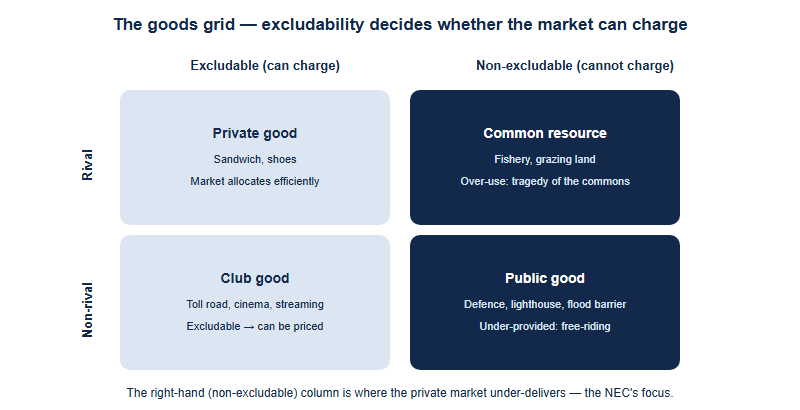
Cross the two questions and you get four categories. The diagonal you already understand intuitively: ordinary private goods (excludable and rival) are exactly what competitive markets handle well. The off-diagonal is where markets struggle, and it is where the NEC concentrates its questions. The single discipline graders look for is this: identify the good's cell first, because the cell dictates both the nature of the failure and the candidate remedies.
| Category | Excludable? | Rival? | Core problem | Example |
|---|---|---|---|---|
| Private good | Yes | Yes | None — market allocates efficiently | A sandwich, a pair of shoes |
| Club good | Yes | No | Possible under-use / congestion at capacity | Cinema seat, toll motorway, streaming service |
| Common resource | No | Yes | Over-use ("tragedy of the commons") | Ocean fishery, shared grazing land, aquifer |
| Public good | No | No | Under-provision via free-riding | National defence, a lighthouse beam, flood barriers |
Notice that the problems differ in direction. Public goods are under-supplied because no one can be charged; common resources are over-used because no one can be excluded but the resource can run down. A candidate who can name the direction of the distortion in a single sentence has earned the structure marks before writing anything else. For the broader contest context these micro-topics sit inside, the CNEC homepage is the reference point.
The free-rider problem, step by step
The defining failure of a pure public good is the free-rider problem, and NEC graders want the mechanism spelled out, not just named. Because a public good is non-excludable, once it exists everyone benefits whether or not they paid. Because it is non-rival, one more person enjoying it costs nothing extra. Put those together and a self-interested individual reasons: "The good will be there regardless of my contribution, and my single payment barely moves whether it gets built — so I will let others pay and consume for free." When enough people reason this way, voluntary contributions collapse and the good is under-provided or never supplied at all.
A worked illustration sharpens it. Suppose a coastal village of 100 households would each value a flood barrier at $200 — a total social benefit of $20,000 — and the barrier costs $12,000 to build. Society clearly should build it: benefit exceeds cost. Yet ask each household to chip in voluntarily and the dominant move is to under-pledge, hoping neighbours cover the bill; the barrier protects everyone once raised, so why pay your full share? The result is that a project worth $8,000 in net social value can fail to attract enough private money. That gap between obvious social value and private under-funding is precisely what justifies collective (government) provision financed through compulsory taxation.
- Non-excludability is the trigger. If non-payers cannot be shut out, a price cannot be enforced, and the usual market signal disappears.
- Non-rivalry makes charging undesirable anyway. Since an extra user adds no cost, the efficient price for the marginal user is effectively zero — a private firm charging a positive price would inefficiently exclude people who value the good.
- The demand-revelation problem. Because no one pays per unit, people have no incentive to truthfully reveal how much they value the good, so even a willing government must estimate aggregate demand indirectly (surveys, voting, cost-benefit analysis).
A subtle exam point: the efficient quantity of a public good is found by adding willingness-to-pay vertically across all consumers (everyone consumes the same quantity simultaneously), whereas private-good demand is added horizontally. Citing that vertical-summation detail is a reliable signal of depth in a Critical Thinking response.
Common resources and the case — and limits — of government’s role
A common resource flips one property: it is rival (a fish caught is gone) but non-excludable (the open sea cannot easily be fenced). The failure here is over-exploitation. Each user captures the full private gain of taking one more unit while the cost of depletion is spread across all users, so everyone races to extract before others do — the tragedy of the commons. Where a public good is under-provided, a common resource is over-consumed, even though both stem from the same root cause: missing excludability.
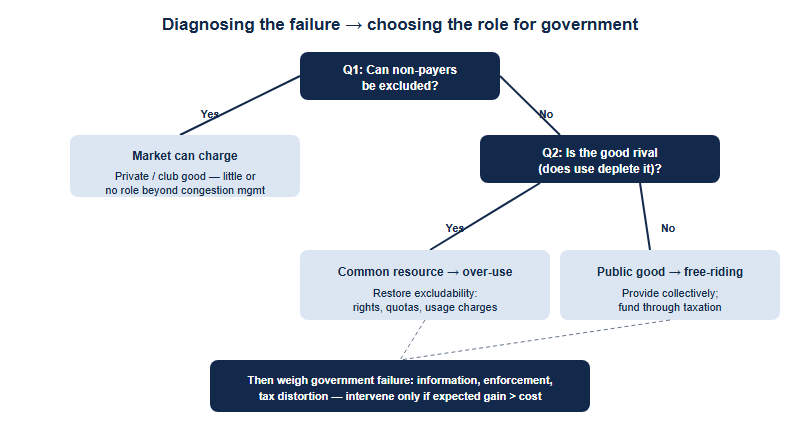
This is where the "government's role" question gets interesting, and where the NEC rewards balance rather than reflexive intervention. The rationale for a public role is genuine: when free-riding or open access prevents the market from delivering a good society values, a collective body that can tax, regulate, assign rights, or provide directly can move the outcome toward efficiency. But economists — and good NEC answers — immediately add the caveats. Government provision must be funded by taxes that themselves distort behaviour; deciding the right quantity requires information the state may not have; and government failure (poor information, lobbying, weak incentives, bureaucratic cost) can leave society worse off than the imperfect market. The mature claim is conditional: intervention is justified when its expected gain exceeds its own costs and risks, not automatically.
| Aspect | Public good | Common resource |
|---|---|---|
| Excludable / Rival | No / No | No / Yes |
| Direction of failure | Under-provided | Over-used |
| Root behaviour | Free-riding | Over-extraction race |
| Typical instruments | Direct provision; tax funding; mandates | Property rights; quotas/catch limits; usage charges |
| What the instrument does | Overcomes inability to charge | Restores excludability / caps use |
| Key risk to weigh | Estimating true aggregate demand | Setting the cap; enforcement cost |
Observe how the remedies mirror the diagnosis. For a common resource the fixes — tradable fishing quotas, grazing permits, congestion charges — all work by manufacturing excludability that nature did not provide. For a public good, where charging is impossible and undesirable, the fix instead bypasses the price mechanism with collective funding. Showing that the instrument is tailored to which property is missing — rather than listing remedies generically — is exactly the judgement examiners reward. The seven NEC rounds and division structure are summarised on the official CNEC homepage; the CEE sets the underlying academic standard, so confirm any specific syllabus framing on the official CNEC channels.
Where the lines blur — the nuances graders reward
Top NEC scripts go beyond the four tidy boxes by acknowledging that excludability and rivalry are matters of degree and can change with technology and scale. A motorway is non-rival when empty but becomes rival once congested — a non-rival good that turns rival at capacity, which is exactly why congestion pricing exists. A previously non-excludable broadcast becomes excludable the moment encryption is invented, converting a near-public good into a club good. And almost no real good is "pure"; most sit somewhere between the corners, which is why blanket statements like "all public goods must be state-provided" are penalised.
- Quasi-public goods. Roads, beaches and parks are partly excludable (tolls, gates, fees) and partly rival (congestion), so the right answer is often a mix of pricing and provision rather than one pure remedy.
- Excludability is endogenous. Technology can create it (encrypted signals, electronic road tolling), shifting a good across the grid — a great point to raise when asked about policy options over time.
- Provision need not mean production. Government can fund a public good while a private firm builds it (defence contractors, outsourced refuse collection); separating "who pays" from "who produces" is a sophisticated distinction.
How this cluster shows up across NEC rounds — a first-party note
As the officially authorized China test center for the NEC, the CNEC desk sees a consistent pattern in how this micro-topic is examined. In the multiple-choice Qualifying Test, the task is recognition: read a short scenario and place the good in the correct cell, or pick which property (excludability or rivalry) a policy is trying to fix. In Critical Thinking and Econ Lab, the bar rises to application and judgement — given a real case such as overfishing or under-funded public health, argue which instrument fits and defend it against the risk of government failure.
The recurring weakness we observe is the "public good → government must provide" reflex applied without thought. Examiners reward the candidate who instead runs the full chain: classify using the two properties, diagnose the direction of failure (under-provision versus over-use), match an instrument to the missing property, and then weigh whether intervention genuinely improves on the market once its own costs are counted. That four-step discipline — not a memorised list of examples — is what separates a high-scoring answer from an average one. This article covers the public-goods, common-resource and government-role micro-topic only; externalities and corrective taxes are treated separately so each NEC concept gets its own focused treatment.
Frequently asked questions
What makes a good a "public good" on the NEC?
It is both non-excludable (non-payers cannot be shut out) and non-rival (one person's use does not reduce what is left for others), like national defence.
What is the free-rider problem?
Because a public good benefits everyone once supplied, individuals let others pay and consume for free, so voluntary funding collapses and the good is under-provided.
How is a common resource different from a public good?
A common resource is rival but non-excludable, so it is over-used (tragedy of the commons); a public good is non-rival, so it is under-provided instead.
Does a public good always require government?
Not automatically. Intervention is justified only when its expected gain beats its own costs and the risk of government failure — confirm framing on the official CNEC channels.
Published by the NEC / CNEC editorial desk, operated by Hanlin Education as the officially authorized China National Economics Challenge (CNEC) test center. The NEC is run by the Council for Economic Education, which sets the official rules — always confirm current dates, divisions, fees and awards on the official CNEC channels. Any errors will be corrected within 7 working days.