
Most points lost at the National Economics Challenge (NEC) are not lost to hard questions — they are lost to avoidable mistakes: a misread graph axis, a flipped sign on a multiplier, buzzing a beat too early, or a Critical Thinking answer with no structure. This is a catalogue of the errors we watch teams repeat across the China National Round, paired with the specific fix for each one.
The NEC is run by the Council for Economic Education (CEE, founded 1949) and draws roughly 10,000 students a year in the United States; its subjects are microeconomics, macroeconomics, and world / international economics. The China National Round (CNEC) has been operated by Hanlin (SKT) since 2016, across 20+ provinces and 300+ schools, and is the only official path from China into the NEC global rounds. Exact round mechanics, scoring weights and dates change season to season and should always be confirmed on the official CNEC channels; the patterns below are about execution, which stays remarkably constant.
The graph and diagram errors that quietly cost the most
Economics is a discipline of diagrams, and the most common silent point-losers live there. Under exam pressure students stop reading the graph and start pattern-matching it — which is exactly when avoidable mistakes appear. The fixes are not about knowing more economics; they are about slowing down for three seconds before you commit.
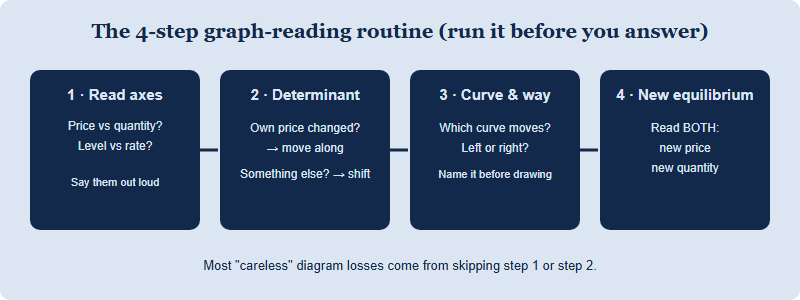
- Misreading the axes. Confusing price with quantity, or a level (e.g. price level) with a rate (e.g. inflation), flips an entire answer. Fix: say the axis labels out loud — “vertical is price, horizontal is quantity” — before touching the curves.
- Shift vs. movement-along. A change in a good’s own price moves you along the curve; a change in any other determinant shifts it. Treating a price change as a demand shift is one of the most penalised errors in micro. Fix: ask “did the good’s own price change, or something else?” first, every time.
- Curve direction and which one moves. Shifting supply when the scenario changed demand — or sliding the wrong way — turns a correct concept into a wrong answer. Fix: name the determinant, then name the curve, then the direction, in that fixed order.
- Forgetting the new equilibrium. Many questions want the resulting price and quantity, not just the shift. Fix: always read off both coordinates of the new intersection before answering.
A first-party note from running CNEC: in our experience the single most repeated diagram error among otherwise strong students is the shift-versus-movement confusion. Teams that build a fixed reading routine — axes, then determinant, then curve, then equilibrium — convert a large share of “careless” losses back into points without learning a single new model.
Calculation slips: sign errors, units and the multiplier
The second cluster of avoidable losses is arithmetic that goes wrong because of a sign, a unit, or a half-remembered formula. These cost points on the Qualifying Test and Super Econ, where speed pressure makes them more likely, not less.
| The slip | What it looks like | The fix |
|---|---|---|
| Elasticity sign | Reporting price elasticity of demand as a positive number, or confusing elastic with inelastic | Expect a negative for PED; interpret the magnitude (>1 elastic, <1 inelastic) separately from the sign |
| Multiplier flip | Using 1/MPC instead of 1/(1−MPC); or forgetting MPC + MPS = 1 | Write the identity first, substitute second; sanity-check that a higher MPC gives a larger multiplier |
| % change vs. level | Treating a growth rate as a level, or adding percentages that should compound | Label every number as a level or a rate before you compute |
| Real vs. nominal | Comparing nominal values across years without deflating | Flag whether the question is in real or nominal terms before answering |
| Marginal vs. total | Answering with total cost/utility when the question asks for the marginal change | Underline “marginal” or “total” in the prompt and answer the one asked |
The meta-fix for all of these is a ten-second habit: write the formula or identity before you plug in numbers, and sanity-check the direction of your answer. If a tax is supposed to reduce quantity and your working shows it rising, stop — you have a sign error, not a new economic insight. Teams that adopt “formula first, sanity-check last” lose markedly fewer points to arithmetic than teams that compute from memory under the clock.
Quiz Bowl: mismanaging the buzzer
The live, buzzer-style Quiz Bowl round is where the most dramatic avoidable points are lost, because a single mistake hands the question — or the penalty — to the other side. Two opposite failure modes dominate, and both are coordination problems, not knowledge problems.
- Buzzing too early and being wrong. Interrupting before the question is fully understood — or before a guess is confirmed — converts a question you might have won into points lost. Fix: agree a team rule on when a member is allowed to buzz (e.g. only when they can finish the answer, not merely recognise the topic).
- Buzzing too late. Hesitating on a question the team knew, and being beaten to it. Fix: build the reflex on a buzzer simulator so the hand moves the instant certainty arrives.
- No lanes. Four students all reaching for the same questions, or all freezing on the same gap, because nobody owns a domain. Fix: assign loose lanes — one anchors macro, one micro, one international / current events, one as a generalist backup — agreed before the match.
- Talking over a teammate mid-answer. Stepping on a correct answer in progress. Fix: agree who speaks once a buzz lands, and practise the handoff out loud.
Composure under a clock is a trainable skill, and Quiz Bowl rewards it as much as content. A first-party observation: the teams that win close Quiz Bowl matches are rarely the ones with the most knowledge — they are the ones who decided in advance who buzzes when, and who practised the buzzer reflex until it was automatic. Knowledge gets you into the room; buzzer discipline wins the round.
Critical Thinking: weak structure and no defence
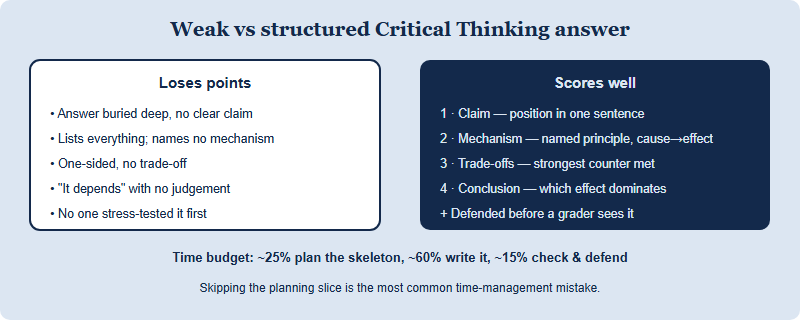
In the Critical Thinking round, the recurring error is not being wrong — it is being unstructured. A correct insight buried in a wandering, list-of-everything-I-know answer scores worse than a narrower argument delivered cleanly. Graders reward a visible chain of reasoning, and teams that ramble lose points they had earned on substance.
The fix is a reusable skeleton. Train every case write-up to follow a fixed shape — claim → mechanism → trade-offs → conclusion — so structure becomes automatic under pressure:
- Claim. State your position in one sentence before any explanation. The most common error is burying the answer three paragraphs deep.
- Mechanism. Explain the cause-and-effect chain — and name the economic principle driving it, rather than gesturing at “supply and demand” generically.
- Trade-offs. Acknowledge the strongest counter-argument or cost. Teams that present one-sided answers leave easy marks on the table.
- Conclusion. Resolve it — say which effect dominates and why. “It depends” with no judgement reads as indecision, not nuance.
The second Critical Thinking error is having no defence. Once an answer is on paper, a coach or teammate should attack it — find the weak link, the missing trade-off, the unstated assumption — so the team has already met its own counter-arguments before a grader does. We cover this drilling approach in our CNEC preparation resources.
Time and prep mistakes that decide the whole result
The last cluster is about how teams spend time — both inside a round and across a season — and it is where the largest, most avoidable losses hide because they are invisible until the result arrives.
- Sinking minutes into one hard item. Spending five minutes wrestling one question while three answerable ones go untouched. Fix: set a per-question ceiling, flag-and-move, and return only if time allows.
- Skipping the planning slice in written rounds. Diving straight into prose with no skeleton, then running out of time before the conclusion. Fix: spend the first quarter of the time planning the structure — it is faster overall, not slower.
- Over-training the knowledge rounds, under-training the rest. The most common season-long error we see: teams drill multiple-choice recall because it feels productive, and arrive under-rehearsed at the applied and spoken rounds, where live reasoning and communication carry real weight.
- Practising solo for a team event. Quiz Bowl and the team rounds reward coordination that only develops by rehearsing together. Fix: schedule full-team mock rounds, not just individual study.
- Building a study plan around the wrong thing. Some teams plan their whole season around which division to enter and never plan how to train each round differently. Fix: after registering through CNEC, build the plan around the rounds your division actually faces — confirm that line-up on the official pages first.
None of these fixes requires more economics. They require deciding, before competition day, how the team will read graphs, check arithmetic, manage the buzzer, structure an argument, and budget its minutes. That is the difference between a team that knows the material and a team that converts it into points. For where these rounds sit in the calendar, see our CNEC season overview.
Frequently asked questions
What is the most common NEC mistake?
Diagram errors — especially confusing a movement along a curve (own-price change) with a shift (any other determinant). A fixed reading routine fixes most of them.
Why do strong students still lose Quiz Bowl?
Because it tests coordination, not just knowledge. Buzzing too early when wrong, or too late when right, loses matches. Agree buzz rules and lanes in advance.
How do I avoid losing Critical Thinking points?
Use a fixed skeleton — claim, mechanism, trade-offs, conclusion — and have a teammate attack the answer before a grader does. Structure beats rambling.
Where can I confirm NEC rules and dates?
The CEE sets the official academic standard; always confirm current divisions, round formats, scoring and deadlines on the official CNEC channels, as they can change yearly.
Published by the NEC / CNEC editorial desk, operated by Hanlin Education as the officially authorized China National Economics Challenge (CNEC) test center. The NEC is run by the Council for Economic Education, which sets the official rules — always confirm current dates, divisions, fees and awards on the official CNEC channels. Errors are corrected within 7 working days.