
The National Economics Challenge (NEC) tests taxation and subsidies not as accounting questions but as incidence problems: who actually bears the burden, regardless of who legally pays. A tax drives a wedge between the price buyers pay and the price sellers keep, and elasticity decides how that wedge splits. Master four moves — the wedge, the burden split, the welfare cost, and the subsidy mirror — and these items become some of the fastest points on the test.
Legal vs economic incidence: the move that catches everyone
The single most common NEC tax question hinges on one idea: statutory incidence (who the law tells to remit the tax) is not the same as economic incidence (who actually ends up poorer). A government can collect a per-unit tax from sellers or from buyers, and a multiple-choice item will often ask which arrangement leaves consumers worse off. The trap answer is "whoever pays it." The correct answer is that it does not matter who remits the tax — the equilibrium quantity, the buyer price, and the seller price come out identical either way.
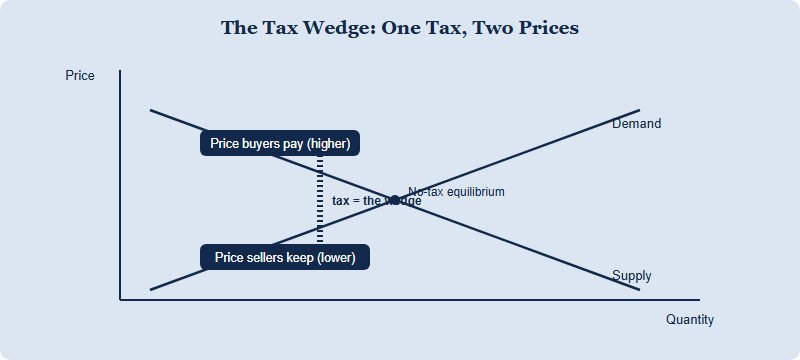
Why? A tax levied on sellers shifts the supply curve up by the tax amount; a tax levied on buyers shifts the demand curve down by the same amount. Both shifts open the same gap between what buyers pay and what sellers receive, and that gap is the wedge. The burden is then divided by the relative steepness of the two curves, not by the wording of the statute. This is exactly the kind of counter-intuitive result NEC writers favour, because it separates students who memorised "tax = bad for the taxed party" from those who reason from the diagram. A clean grasp of microeconomic supply and demand — the foundation laid out on the CNEC site — is what makes this automatic.
Elasticity decides the burden split
Once you accept that the statute does not matter, the next NEC question is always: how is the wedge shared between buyers and sellers? The governing rule is short enough to recite: the more inelastic side bears the larger share of the tax. Intuitively, whichever party has fewer alternatives — less ability to walk away when price moves — gets stuck with more of the burden.
- Inelastic demand, elastic supply: buyers can't easily substitute, so the buyer price rises by most of the tax and consumers bear the larger share. Classic exam examples: cigarettes, insulin, gasoline in the short run.
- Elastic demand, inelastic supply: buyers flee to substitutes, so sellers must absorb most of the tax through a lower net price. Think of perishable goods or a niche product with many alternatives.
- Equal elasticities: the burden splits roughly fifty-fifty, the default assumption when an item gives you no elasticity information.
A first-party tip from coaching CNEC teams: students lose points by confusing "who pays more" with "who the tax is on." Build the habit of asking one question first — which curve is steeper? — before touching the answer choices. The steeper (more inelastic) curve marks the side that pays more. This single reflex resolves a large fraction of incidence multiple-choice items in seconds, which matters in timed rounds where pace is everything; the Qualifying Test and Quiz Bowl rounds reward students who can decide and move on.
| Scenario | Who bears more of the tax | Why | Typical exam good |
|---|---|---|---|
| Demand inelastic, supply elastic | Buyers (consumers) | Few substitutes; buyers can't avoid the price rise | Cigarettes, insulin, petrol (short run) |
| Demand elastic, supply inelastic | Sellers (producers) | Buyers switch away; sellers must absorb the tax | Perishables, a brand with many rivals |
| Both similarly elastic | Split roughly evenly | Neither side has a decisive advantage | Default when no elasticity is stated |
| One side perfectly inelastic | That side bears 100% | It cannot adjust quantity at all | Fixed land supply; an absolute necessity |
The welfare cost of a tax: tax revenue plus deadweight loss
NEC welfare items pair the wedge with its efficiency cost. Because a tax pushes output below the competitive quantity, total surplus falls. That lost value divides into two parts you must keep separate. The first is tax revenue — the per-unit tax multiplied by the quantity that still trades — which is a transfer from market participants to the government, not destroyed. The second is the deadweight loss: the value of the trades that no longer happen because the wedge made them unprofitable. (The geometry of measuring those triangular areas is its own topic, covered separately; here the point is the economic split, not the area arithmetic.)
The exam-critical link back to elasticity: the more elastic the curves, the larger the deadweight loss for a given tax, because elastic responders cut quantity sharply, killing more mutually beneficial trades. The flip side explains real policy — governments tax inelastic goods (tobacco, fuel) partly because the efficiency loss is small and the revenue is reliable. NEC critical-thinking prompts love this tension between raising revenue and minimising distortion, so be ready to argue both sides. Notice the elegant consistency: the inelastic side both bears more of the burden and generates less deadweight loss — one property of elasticity driving two results graders test.
Subsidies: the wedge run in reverse
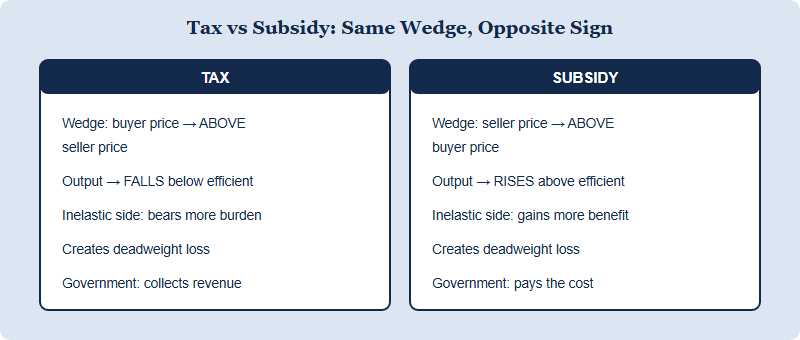
A subsidy is the mirror image of a tax, and NEC questions exploit students who memorised taxes without seeing the symmetry. Where a tax opens a wedge with the buyer price above the seller price, a per-unit subsidy opens a wedge the other way: the price sellers receive sits above the price buyers pay, with the government covering the difference. Output rises above the free-market quantity instead of falling.
The incidence logic carries over intact. The benefit of a subsidy is shared by the relative elasticities, and — here is the result that surprises students — the more inelastic side captures the larger share of the benefit, just as it bore the larger share of a tax. And because a subsidy also pushes output away from the efficient quantity (this time by over-producing), it too creates a deadweight loss: the cost of the subsidy exceeds the gain in combined surplus. A government can spend more on a subsidy than the welfare it adds. Stating that cleanly — subsidies are not "free" even though they look generous — is the kind of nuanced point that separates strong written answers in the higher divisions described on the official CNEC programme.
A four-step checklist for any tax or subsidy item
Turn the theory into a repeatable routine. When a taxation or subsidy question appears, run these in order and most answer choices eliminate themselves:
- 1. Draw the wedge. Tax → buyer price above seller price, output down. Subsidy → seller price above buyer price, output up. Ignore who legally pays — it never changes the equilibrium.
- 2. Find the steeper curve. The more inelastic side bears more of a tax (or captures more of a subsidy). This one comparison answers most incidence items.
- 3. Separate transfer from loss. Tax revenue and subsidy outlay are transfers; the deadweight loss is destroyed value. More elastic curves → bigger deadweight loss.
- 4. State the trade-off. For written and critical-thinking rounds, name the tension — revenue or correction versus efficiency cost — rather than declaring a tax simply "good" or "bad."
Because these four moves recur across the Qualifying Test, Quiz Bowl, and the analytical written rounds, drilling them is high-leverage preparation. The same supply-and-demand reasoning that powers incidence also underpins price controls and welfare analysis, so the payoff compounds across the whole microeconomics section of the NEC.
Frequently asked questions
Does it matter whether the tax is collected from buyers or sellers?
No. Economic incidence is identical either way — the same wedge, quantity, and burden split result. Statutory incidence is a distractor NEC writers use.
Who bears more of a tax, buyers or sellers?
The more inelastic side. Whichever party has fewer substitutes and a steeper curve absorbs the larger share, regardless of who remits the tax.
How does a subsidy differ from a tax on the diagram?
It reverses the wedge: sellers receive more than buyers pay, output rises above the efficient level, and the inelastic side captures most of the benefit.
Do subsidies cause deadweight loss too?
Yes. By pushing output above the efficient quantity, a subsidy's cost exceeds the surplus it adds, so it distorts the market just as a tax does.
Published by the NEC / CNEC editorial desk, operated by Hanlin Education as the officially authorized China National Economics Challenge (CNEC) test center. The NEC is run by the Council for Economic Education, which sets the official rules — always confirm current dates, divisions, fees and awards on the official CNEC channels. Corrections are made within 7 working days.