
You manage the NEC clock by spending time where it earns points and refusing to spend it where it doesn't. On the Qualifying Test that means a fixed seconds-per-question budget, a hard skip rule for any item that stalls you, and a reserved sweep at the end to bank every blank as a guess. In the timed team rounds it means deciding before the buzzer who answers and how long you debate. Pacing, not extra theory, is what converts knowledge into a score.
Most NEC guides — including several already on our own site — survey the seven rounds, list the divisions, and explain registration. Useful once. This one ignores all of that and stays on a single problem: the clock. The National Economics Challenge is run by the Council for Economic Education (CEE, founded 1949) and draws roughly 10,000 students a year in the United States across microeconomics, macroeconomics and world economics. The China National Round (CNEC) has been operated by Hanlin (SKT) since 2016, across 20+ provinces and 300+ schools, and is the official path from China into the NEC global rounds. The economics standard below comes from the CEE; the exact question counts, time limits and round line-up for your division can change season to season, so confirm those on the official CNEC channels before you build a plan around them.
Why pacing, not knowledge, decides most Qualifying Test scores
Among Chinese international-school students, the most common way to lose marks on the NEC Qualifying Test is not a gap in economics — it is time spent in the wrong place. A strong candidate sinks ninety seconds into one stubborn elasticity calculation, gets flustered, and then rushes the final stretch where three easier questions were waiting to be banked. The economics was never the problem; the allocation of seconds was. In a fixed-time multiple-choice test, every question is worth the same on the score sheet but costs a wildly different amount of your clock — so the skill being measured is partly triage.
The Qualifying Test is the individual gate that filters most of the field before any team event begins, which makes it the highest-leverage place to install clock discipline. The fix is to stop treating the paper as a single long effort and start treating it as a budget you draw down. You decide in advance how many seconds an average question may have, you watch a clock instead of your gut, and you build in a reserved window at the end so that no question is ever left blank for free. The precise number of questions and the exact time limit are set by the organiser and can vary by year and division — confirm them on the official CNEC pages — but the method that follows works for whatever those numbers turn out to be.
The seconds-per-question budget: do the division before you sit down
Before the test, turn the format into one number: your per-question budget. Take the total minutes for the section, convert to seconds, subtract a reserved review block (a sensible default is the time it would take to revisit your skipped items plus a final guessing sweep), then divide what remains by the number of questions. That quotient is your average pace — the speed at which you finish with margin to spare. Because you do not yet know your real numbers, work it out from whatever the official CNEC materials state for your division and division year.
The table below shows the arithmetic with three illustrative formats so you can see how the budget moves. These figures are examples to demonstrate the calculation only — they are not official NEC values, and you must substitute the real question count and time limit for your division as published by the organiser.
| Illustrative format (example only) | Total time | Reserve held back | Working time ÷ questions | Average pace |
|---|---|---|---|---|
| 40 questions | 40 min | 8 min | 32 min ÷ 40 | ~48 sec / question |
| 50 questions | 45 min | 9 min | 36 min ÷ 50 | ~43 sec / question |
| 60 questions | 50 min | 10 min | 40 min ÷ 60 | ~40 sec / question |
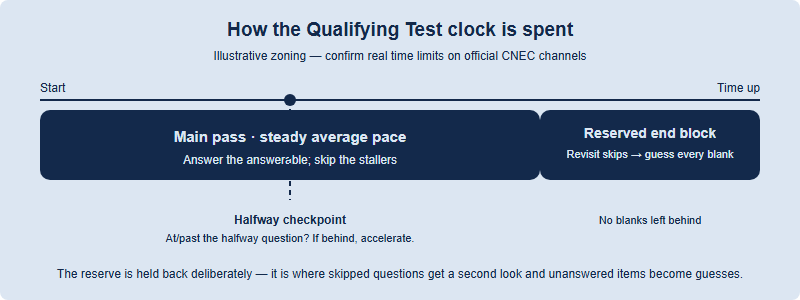
Two habits make the budget real once you are in the room. First, set a checkpoint: at the halfway mark on the clock you should be at (or past) the halfway question — if you are behind, you speed up immediately rather than discovering the deficit at question fifty. Second, the budget is an average, not a ceiling on every item: a one-line definition might take ten seconds and bank you forty seconds of credit toward a harder graph question later. You are managing a pool of time across the whole paper, not rationing each question identically.
The skip rule: a two-pass system that protects your reserve
The single most valuable clock habit is a pre-committed skip rule: if a question is not yielding within roughly 1.5× your per-question budget, you flag it and move on — no negotiation with yourself. This works because a multiple-choice paper is a two-pass exercise, not a one-pass march. Pass one banks every point you can earn cheaply; pass two, funded by your reserve block, returns to the flagged items with fresh eyes and the calm of having already secured most of the score.
Skipping feels uncomfortable for diligent students who were trained to finish every problem in order, so it is worth being explicit about why it wins. A stalled question is a compounding cost: the longer you stay, the more anxious you get, and anxiety bleeds into the next questions too. Cutting your losses caps that damage. The mechanics are simple — circle the question number on your sheet, leave the bubble empty for now, and physically move your pen down the page. Whether the test permits any on-screen flagging or only paper marking depends on the delivery format the organiser uses, so check the official CNEC instructions; the discipline is the same either way.
- Free-win questions (definitions, one-step recall): answer on sight, well under budget — these fund the rest of the paper.
- On-budget questions (a short calculation, a clear graph read): solve at pace; commit and move.
- Stallers (multi-step, ambiguous, or simply not clicking): hit the 1.5× ceiling, flag, skip — revisit in the reserve block.
The guessing sweep: turn the final minutes into points
The last action of the Qualifying Test is non-negotiable: with your reserve block, revisit flagged items first, then run a guessing sweep so that no answer is left blank. A blank scores nothing; a guess on a four-option item carries a real expected value. Whether NEC applies any penalty for wrong answers is a scoring rule set by the organiser and it can differ by event — confirm it on the official CNEC channels — but where there is no penalty for an incorrect response, every blank you leave is points you declined to attempt.
Guess intelligently rather than randomly. If you can eliminate even one option as clearly wrong, your odds on the remainder improve; eliminate two and a guess becomes a coin flip on the right answer. Decide your tie-breaker in advance — for instance, a default letter for true blanks where you can eliminate nothing — so the final seconds are spent bubbling, not deliberating. The point of pre-deciding is that the guessing sweep should be mechanical: under time pressure, a rule you set when calm beats a choice you agonise over when the clock is red.
Clock discipline in the timed team rounds
Once a team clears the Qualifying gate, the pacing problem changes shape but does not disappear. The team events — buzzer-style rounds, applied-analysis rounds and presentation rounds — each run on their own clock, and the failure mode shifts from “one student over-invests in one question” to “the team burns its window deciding who speaks.” The economic content stays the same across micro, macro and international economics; what you train per round is the tempo of the team. Which rounds your team faces depends on your division — Pre is entry-level and may be individual or a team of 2–4, David Ricardo is intermediate and is a team of 4, Adam Smith is advanced and is also a team of 4 — so confirm the precise line-up and each round's timing on the official CNEC pages.
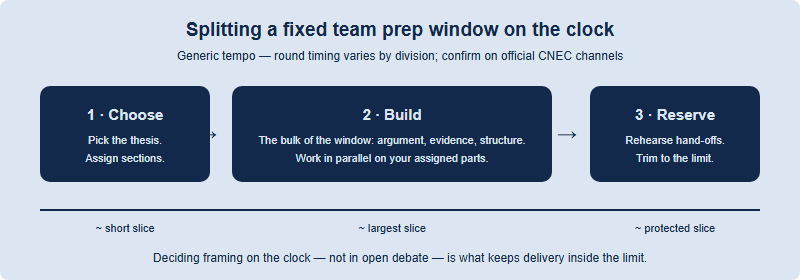
The durable principle is to pre-decide roles so the clock is spent reasoning, not coordinating. On fast buzzer rounds, agree before you start who is primary on which sub-topic and a simple rule for when to risk an early buzz versus wait for the full question — hesitation and double-talk are pure time leaks. On applied or presentation rounds where a team has a fixed prep window, split it on the clock: an opening slice to choose the thesis and assign sections, the bulk to build, and a protected final slice to rehearse the hand-offs so delivery lands inside the limit. The table maps the clock risk per round family to a concrete habit.
| Round family | Where the clock leaks | Pre-decided habit |
|---|---|---|
| Individual gate (Qualifying Test) | Over-investing in one stubborn question | Seconds-per-question budget + 1.5× skip rule + reserved guessing sweep |
| Buzzer / knowledge-under-pressure | Hesitating, or two members talking over each other | Assign topic ownership and a buzz-vs-wait rule in advance |
| Applied analysis (fixed prep window) | Debating the framing until prep time is gone | Split the window: choose → build → reserve to check |
| Presentation / defence (timed delivery) | Running long; no time to rehearse hand-offs | Hold back a final slice to rehearse and trim to the limit |
How to train the clock before the day
Pacing is a trained reflex, not a plan you read once and recall under pressure. The most useful preparation is to practise under the real time limit from early on, so the seconds-per-question feel is in your hands before the day. Run timed past-style sets where the goal is not only the right answers but holding the budget: did you hit the halfway checkpoint on schedule, did you obey the skip rule, did you leave any blank in the sweep? Each of those is a measurable habit you can review afterwards. As the official China test centre (CNEC), Hanlin's mentor support and timed practice are built around exactly this kind of pacing discipline — but the method above stands on its own, and the gains come from the reps, not from any one resource. For the current format, schedule and rules to practise against, start from the CNEC home page and confirm the specifics there.
FAQ
How many seconds should I spend per Qualifying Test question?
Divide your working time (total time minus a reserved review block) by the question count for your division. Confirm both numbers on the official CNEC channels.
When should I skip a question?
When it isn't yielding within about 1.5× your per-question budget. Flag it, move on, and return in your reserved end block.
Should I guess on questions I can't solve?
Leave nothing blank if there is no penalty for wrong answers. Whether NEC penalises errors is set by the organiser — confirm it on the official CNEC channels.
Does pacing matter in the team rounds too?
Yes. Pre-decide roles and split any prep window on the clock so time goes to reasoning, not coordinating. Round timing varies by division.
Published by the NEC / CNEC editorial desk, operated by Hanlin Education as the officially authorized China National Economics Challenge (CNEC) test center. The NEC is run by the Council for Economic Education, which sets the official rules — always confirm current dates, divisions, fees and awards on the official CNEC channels. Any error will be corrected within 7 working days.