
The National Economics Challenge (NEC) tests elasticity less as a formula to recite and more as a sign-and-magnitude reasoning task. Questions hand you a percentage change in price, income or a related good and ask you to compute a coefficient, classify it, and read what it means for revenue or demand. The errors that cost points are almost always the same: a dropped negative, a confused numerator, or “elastic” and “inelastic” swapped. This guide maps the traps.
The three elasticity coefficients NEC actually uses
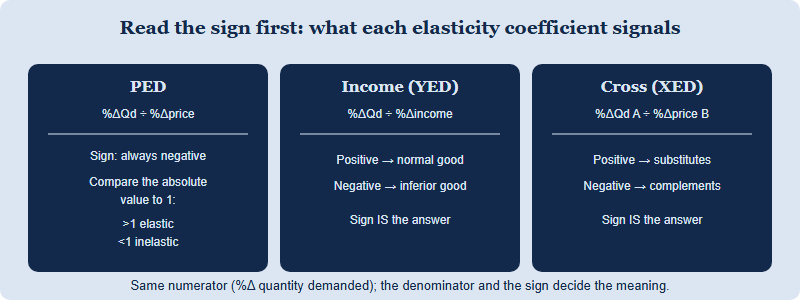
Across its microeconomics content, the NEC draws on three elasticity measures, and the first defence against errors is keeping their numerators straight. All three put a percentage change in quantity demanded on top; what changes is the variable on the bottom.
- Price elasticity of demand (PED): %Δ quantity demanded ÷ %Δ price of the same good. By the law of demand its raw value is negative, which is exactly where the sign traps live.
- Income elasticity of demand (YED): %Δ quantity demanded ÷ %Δ consumer income. Its sign is the whole point — positive for normal goods, negative for inferior goods.
- Cross-price elasticity of demand (XED): %Δ quantity demanded of good A ÷ %Δ price of good B. Positive means substitutes, negative means complements.
Notice the pattern: for PED the sign is a nuisance you must handle; for YED and XED the sign is the answer. A question that asks “are these goods substitutes or complements?” is really asking “what is the sign of XED?” Get the numerator and the sign right and most NEC elasticity items resolve themselves. You can see the round-by-round structure these appear in on the CNEC site.
| Coefficient | Formula (numerator ÷ denominator) | Typical sign | What the sign tells you |
|---|---|---|---|
| PED | %Δ Qd ÷ %Δ price (same good) | Negative | Always negative by the law of demand; usually read as an absolute value |
| YED — normal good | %Δ Qd ÷ %Δ income | Positive | Demand rises as income rises |
| YED — inferior good | %Δ Qd ÷ %Δ income | Negative | Demand falls as income rises |
| XED — substitutes | %Δ Qd of A ÷ %Δ price of B | Positive | B dearer → more A bought |
| XED — complements | %Δ Qd of A ÷ %Δ price of B | Negative | B dearer → less A bought |
The classic sign traps NEC questions exploit
Item-writers know where students slip, and NEC multiple-choice and quiz formats are designed so that a careless sign lands you on a plausible-looking wrong answer. Four traps recur.
Trap 1 — dropping the PED negative, then mis-reading it. PED is negative, but most courses compare its absolute value to 1 to label demand elastic or inelastic. Trouble starts when a question asks for the signed coefficient and you give the absolute value (or the reverse). Read the stem: “calculate PED” usually wants the signed number; “is demand elastic or inelastic?” wants the magnitude.
Trap 2 — flipping income and cross elasticity. A negative YED means an inferior good; a negative XED means complements. Under time pressure students blur these. Anchor the rule by the denominator: if income moved, it is YED (normal vs inferior); if another good's price moved, it is XED (substitutes vs complements).
Trap 3 — confusing the elastic/inelastic boundary. |PED| > 1 is elastic (quantity reacts more than price); |PED| < 1 is inelastic (quantity reacts less). The boundary value of exactly 1 is unit elastic. Many wrong answers swap these or treat 1 as “elastic.” Memorise: bigger-than-one means quantity is the bigger mover.
Trap 4 — assuming a single good has one fixed PED. Along a straight-line demand curve, PED varies point to point — more elastic at high prices, less elastic at low prices. A question that quotes two different PED values for the same good is usually testing whether you know elasticity is local, not a single constant. Treat “the elasticity of good X” as depending on where on the curve you measure.
Worked calculation patterns: point versus midpoint
NEC items typically give you percentage changes or two price-quantity points. Two methods appear, and choosing the wrong one for the data is a quiet source of lost marks.
The simple (point) method divides the percentage change in quantity by the percentage change in price using one base. It is quick but gives a different number depending on whether you measure a price rise or the reverse fall — an asymmetry the exam can probe.
The midpoint (arc) method fixes that by using the average of the two quantities and the average of the two prices as the base, so the coefficient is the same in both directions. When a question supplies two full points and especially when it hints that direction “shouldn't matter,” it is steering you toward the midpoint formula.
| Situation in the stem | Method to use | Why |
|---|---|---|
| Percentages already given (e.g. “price up 10%, quantity down 20%”) | Point method: divide the two percentages | The base is already implied; just compute the ratio |
| Two full price-quantity points given | Midpoint (arc) method | Uses averages so the answer is direction-independent |
| Asked for elasticity “at a point” on a curve | Point method at that price | Elasticity is local; the question fixes the location |
| Stem stresses a rise and a fall give the same value | Midpoint (arc) method | Only the arc method removes the direction asymmetry |
Whichever method, keep the sign discipline: compute first, then decide whether the final answer should be reported signed or as a magnitude based on what the question asked.
The total-revenue test and the interpretation traps
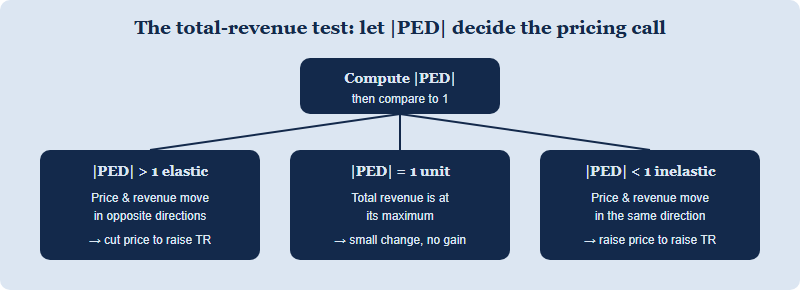
Beyond computing a number, NEC loves the interpretation step — most often the link between PED and a firm's total revenue. The total-revenue test is the fastest way to answer “should the firm raise or cut price?” without re-deriving anything.
- Demand elastic (|PED| > 1): price and total revenue move in opposite directions. Cut the price to raise revenue.
- Demand inelastic (|PED| < 1): price and total revenue move in the same direction. Raise the price to raise revenue.
- Unit elastic (|PED| = 1): total revenue is at a maximum and barely moves with small price changes.
The trap here is reasoning from intuition (“higher price always means more money”) instead of from the coefficient. The whole reason the question gives you elasticity is to force the revenue conclusion through the elasticity, not around it. A related interpretation trap is treating determinants and values as the same question: the number of substitutes, the share of income spent, and the time horizon shift how elastic demand is, but they are explanations, not a substitute for the computed |PED|. If a stem asks “why is demand for this good inelastic?”, answer with determinants; if it asks “is it inelastic?”, answer with the coefficient.
How to drill elasticity for the NEC rounds
Elasticity rewards pattern recognition under a clock, which is exactly the NEC environment — the Qualifying Test and the rapid Quiz Bowl punish hesitation. A first-party drilling routine we use with CNEC teams:
- Separate “compute” from “classify” reps. Spend one block only computing coefficients (point and midpoint), a second only labelling sign and elasticity. Mixing them early is where confusion sets in.
- Build a sign reflex. Flash drills: given a scenario, say “YED, negative, inferior” or “XED, positive, substitutes” in under five seconds. The rounds reward instant classification.
- Always finish with the revenue read. After every PED you compute, state the total-revenue implication. It converts a number into the conclusion examiners actually ask for.
- Keep a personal trap log. Write down every elasticity question you missed and why — dropped sign, wrong method, swapped boundary. Most students miss the same trap repeatedly until they name it.
Elasticity is one micro topic, but it threads through the whole NEC syllabus alongside macroeconomics and the world economy, so the discipline you build here pays off across rounds. To see where these microeconomics items sit in the wider format and timeline, start from the CNEC home page and confirm the current structure on the official CNEC channels before relying on any specific detail.
FAQ
Is price elasticity of demand positive or negative in NEC answers?
Raw PED is negative by the law of demand, but elastic-vs-inelastic comparisons use its absolute value against 1.
What does a negative cross-price elasticity mean?
A negative XED indicates complements: when one good's price rises, demand for the other falls. Positive XED means substitutes.
When should I use the midpoint elasticity formula?
Use the midpoint (arc) method when two full price-quantity points are given, so the coefficient is the same whether price rose or fell.
How does elasticity connect to total revenue?
If demand is elastic, cut price to raise revenue; if inelastic, raise price; at unit elasticity, total revenue is maximised.
Published by the NEC / CNEC editorial desk, operated by Hanlin Education as the officially authorized China National Economics Challenge (CNEC) test center. The NEC is run by the Council for Economic Education, which sets the official rules — always confirm current dates, divisions, fees and awards on the official CNEC channels. Errors are corrected within 7 working days.