
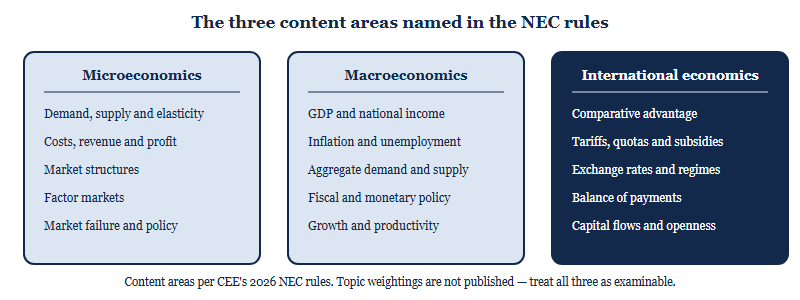
NEC tests international economics as a named content area alongside microeconomics and macroeconomics. The Council for Economic Education’s 2026 rules state that the content covered at the Online National Semi-Finals “includes Microeconomics, Macroeconomics, and International Economics.” In practice that means comparative advantage, trade policy, exchange rates and the balance of payments — and it is the block most China-based teams revise last, if at all.
Why international economics is the block teams under-train
CEE describes NEC competitors as being “tested on key micro and macroeconomic principles, as well as their knowledge of the world economy.” The 2026 rules name the third area outright: the semi-final paper draws on micro, macro and international economics. CEE does not publish a section structure or topic weightings, so plan on the assumption that there is no block you can skip.
The reason so many rosters arrive under-prepared here is curricular, not intellectual. Advanced Placement splits economics into two separate courses, and the open-economy material — balance of payments, foreign exchange markets, capital flows — sits at the very end of AP Macroeconomics, in the weeks most likely to be compressed before the May exam. The IB Economics course gives the global economy its own section, but many schools teach it in the second year. A capable student who has taken only AP Microeconomics may have seen almost none of this content, and a student mid-way through IB Year 1 may have seen the trade half but not the finance half.
So the gap is predictable, which also makes it the cheapest points on the paper to recover. Four weeks of focused work on one content block moves a score more than a fifth pass over demand and supply. Before you plan that work, it helps to know where these questions actually appear: our guide to the seven NEC rounds and how each one works sets out which stages test recall under a clock and which reward extended reasoning.
One caveat to hold throughout. The rules quoted here are CEE’s published rules for the United States pathway. The paper structure and timings used in the CNEC China rounds are set by the China organising committee, and you should confirm current details on official CNEC channels rather than assuming the two are identical.
Comparative advantage: the calculation that must be automatic
Almost every international economics set opens with a two-country, two-good table. The scored skill is not knowing what comparative advantage means — it is computing opportunity cost the right way round, under thirty seconds, from whichever direction the table is presented.
Absolute advantage asks who produces more with the same resources. Comparative advantage asks who gives up less of the other good. A country can hold absolute advantage in everything and still gain from trade, because it cannot hold comparative advantage in everything: opportunity costs are reciprocals, so if one country’s cost of cloth is lower, its cost of wine must be higher.
| Output per worker-day | Cloth | Wine | Opportunity cost of 1 cloth | Opportunity cost of 1 wine |
|---|---|---|---|---|
| Country A | 20 units | 10 units | 0.5 wine | 2 cloth |
| Country B | 6 units | 6 units | 1 wine | 1 cloth |
| Reading: A has absolute advantage in both goods. A gives up only 0.5 wine per cloth against B’s 1 wine, so A exports cloth. B gives up only 1 cloth per wine against A’s 2 cloth, so B exports wine. Mutually beneficial terms of trade lie strictly between 0.5 and 1 wine per unit of cloth. | ||||
Two habits protect you here. First, check what the table measures. An output table gives units produced per worker or per hour, and opportunity cost is the ratio of the other good’s output to this good’s output. An input table gives hours required per unit, and the ratio flips. Students who memorise one procedure and apply it to the other format lose the question before they start reasoning. Second, sanity-check the answer: the two opportunity costs for any one country must multiply to one. If A’s cost of cloth is 0.5 wine, A’s cost of wine must be 2 cloth.
Expect follow-ups on the terms of trade. A proposed exchange rate between goods only produces gains for both parties if it sits between the two domestic opportunity costs; outside that band, one country is better off producing for itself. Questions often present four candidate ratios and ask which is feasible — that is a comparison, not a computation.
Trade policy: tariffs, quotas and who actually pays
Trade policy questions test distribution as much as efficiency. For a small importing country facing a world price below its domestic equilibrium, imports fill the gap between domestic quantity demanded and domestic quantity supplied. Impose a tariff and the internal price rises by the amount of the duty: domestic producers expand, domestic consumers contract, and the import gap narrows.
The welfare accounting is where marks are won and lost. Consumer surplus falls by the whole area between the old and new prices under the demand curve. Part of that loss transfers to domestic producers as higher producer surplus, part transfers to the government as tariff revenue, and two triangles transfer to nobody. Those triangles — the production distortion from output shifted to higher-cost domestic suppliers, and the consumption distortion from purchases foregone — are the deadweight loss.
- Quotas versus tariffs. A quota that restricts imports to the same quantity produces the same price and quantity effects, but the revenue rectangle becomes quota rent captured by whoever holds the import licence — frequently foreign exporters — unless licences are auctioned. Same efficiency loss, different beneficiary.
- Export subsidies. These lower the price faced by foreign buyers and raise domestic prices; the cost falls on taxpayers and domestic consumers simultaneously.
- Non-tariff barriers. Standards, licensing regimes and local-content requirements restrict trade without appearing in a tariff schedule, which is why measured tariff rates understate protection.
- The standard arguments. Infant industry, national security, strategic trade and anti-dumping arguments all appear in questions. Know the case each makes, and know the standard efficiency counter-argument, because questions frequently ask which argument a described policy is invoking rather than whether it is right.
The trap to avoid is answering “protection helps the domestic economy” as though it were a single claim. Protection helps identifiable groups and harms others, and the net welfare effect for a small country is negative in the standard model. Questions are usually written to reward students who can name the gaining group, the losing group and the residual loss separately.
Exchange rates and the balance of payments
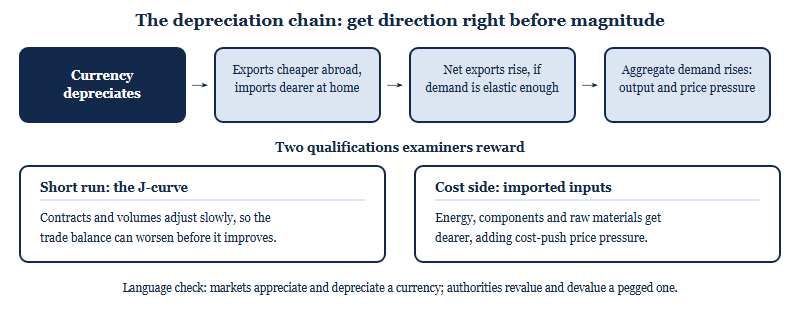
This is the half of the block that AP and IB students most often meet last. Start with vocabulary, because the wrong verb signals the wrong regime. Currencies appreciate and depreciate when markets move them; authorities revalue and devalue when they reset a peg. Using “devalue” for a floating currency is a regime error, not a style slip.
Model a currency like any other good. Demand for a country’s currency comes from foreigners buying its exports and its assets; supply comes from residents buying imports and foreign assets. From there, the standard drivers follow: relative interest rates pull capital in or out, relative inflation erodes purchasing power over time, relative growth raises import demand, and expectations move flows ahead of fundamentals.
| If this happens… | Currency effect | The reason the marker wants |
|---|---|---|
| Domestic interest rates rise relative to abroad | Appreciation | Financial inflows raise demand for the currency |
| Domestic inflation runs above trading partners | Depreciation over time | Relative purchasing power falls; exports lose price competitiveness |
| Domestic income grows faster than abroad | Depreciation pressure | Import demand rises, increasing supply of the currency |
| Central bank buys foreign reserves | Depreciation pressure | Supplying domestic currency into the market |
| Confidence in domestic assets falls | Depreciation | Capital outflow reduces demand for the currency |
Then the balance of payments. The current account records trade in goods and services plus primary income (investment income, compensation) and secondary income (transfers). The capital and financial accounts record transactions in assets. Under the accounting identity, the accounts sum to zero once reserve movements and statistical discrepancies are included: a current account deficit is financed by net inflows on the financial account.
That identity carries the most useful editorial point in the whole block. A trade deficit is not a scoreboard on which a country is losing. It is the accounting mirror of net capital inflows, and the national accounting identity — the current account equals national saving minus domestic investment — says the same thing from the other side. Questions that describe a deficit and ask what “must” be true are testing whether you reach for the identity or for a political reflex.
A four-week international block for the CNEC season
Treat this as one concentrated cycle rather than a topic sprinkled through general revision. Four weeks at roughly three hours a week is enough to close the gap described at the top of this article. The drills below need material to run on: we keep our own collected set of international-economics problems — two-country tables, tariff diagrams and exchange-rate direction drills, with worked solutions for many of them — alongside the rest of our preparation resources, and China-based teams can ask us for a copy.
- Week 1 — comparative advantage. Thirty two-country problems, deliberately alternating output-format and input-format tables. Finish each with the terms-of-trade band. Target: forty seconds per problem with no written working beyond the two ratios.
- Week 2 — trade policy. Draw the tariff diagram from a blank page ten times, labelling every area, and state in one sentence who receives each one. Then repeat with a quota and articulate the single difference. Add the standard protection arguments as a one-page table.
- Week 3 — exchange rates. Twenty direction drills in the form “X happens: does the currency appreciate or depreciate, and what follows for net exports?” Add fixed, floating and managed regimes, and the trade-off between a fixed rate, free capital movement and independent monetary policy.
- Week 4 — balance of payments and mixed pace. Build the account structure from memory, rehearse the identity in both directions, then sit a mixed timed set at roughly one question per minute, which is the pace implied by the 45-question, 45-minute format in CEE’s semi-final rules.
Two structural notes for a team. Allocate content ownership if you like, but examine everyone on everything, because the Online National Semi-Final paper is answered individually, not collaboratively; how the CNEC preliminary is scored should be confirmed on official CNEC channels. And calibrate depth to your division: teams in the advanced bracket should expect the international material to be pushed further, which our guide to the Adam Smith division sets out in more detail.
Finally, remember what kind of competition you are training for. NEC rewards fast, accurate recall and applied reasoning under a clock, which is a different discipline from the extended written argument rewarded elsewhere — a contrast we unpack in NEC versus the economics essay prizes. If your instinct after reading a trade question is to start composing an argument, you are preparing for the wrong format.
Frequently asked questions
Is international economics really a separate part of the NEC test?
CEE’s 2026 rules list the semi-final content as microeconomics, macroeconomics and international economics. CEE does not publish a section structure, so treat every named area as examinable.
How much of the paper is international economics?
CEE does not publish topic weightings. Treat all three named areas as fully examinable and confirm current details on councilforeconed.org.
Do I need the J-curve and elasticity conditions for trade?
Know the intuition: a depreciation can worsen the trade balance before improving it, because volumes adjust more slowly than prices do.
Are calculators allowed for exchange-rate conversions?
No. CEE’s rules prohibit books, notes, calculators and internet use during competition, so practise conversions by hand.
Published by the NEC (CNEC) editorial desk, operated by Hanlin Education for China-based international-school students. Official rules are set by the competition and change yearly — confirm current details on councilforeconed.org. Errors reported to us are corrected within 7 working days.