
Field four. CEE’s 2026 rules permit teams of three or four members and explicitly encourage four, and the scoring design explains why. Only the top three individual scores count towards the team total, so the fourth member is insurance rather than ballast — and in a tie, a three-person team automatically forfeits the first tiebreaker before any economics is compared.
What the published rules actually say about team size
Three provisions do the work here, and they interact in a way that is easy to miss when you read them separately.
- Composition. CEE’s rules state that teams “shall be comprised of three (3) or four (4) members” and that it “is encouraged to compete in teams of four members.”
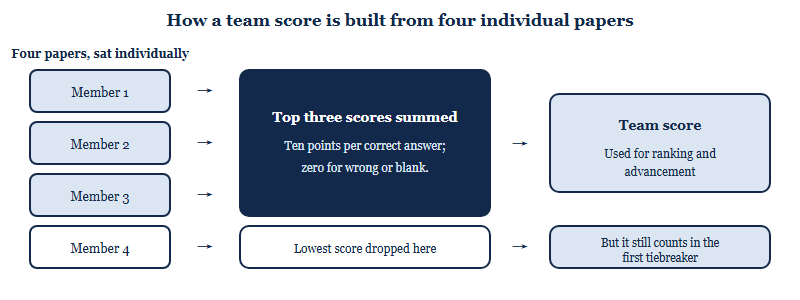
- Scoring. At the Online National Semi-Finals, students answer 45 four-option multiple-choice questions in 45 minutes, scored at ten points for a correct answer and zero for an incorrect answer or a blank. Crucially, members answer “individually, not collaboratively,” and the team score is the sum of the top three individual scores.
- Membership. All members must come from the same public school, private school, community organisation or club, or afterschool programme — which means students from different schools can share a team, provided they belong to one of those shared groupings. Every team also needs a coach who is an associate of that school, district, organisation or programme.
Two caveats before the analysis. First, these are CEE’s published rules for the United States pathway, which runs state competition, then online national semi-finals, then in-person national finals. The CNEC China season runs four divisions for 2027 — Pre, David Ricardo, Adam Smith and the new Herbert Simon AI division, the last of which is open only to students already registered in one of the other three — and its team rules and round structure are set by the China organising committee. They differ from CEE’s on precisely this point: in the CNEC season, David Ricardo and Adam Smith require a team of exactly four members, while only the Pre division may be entered individually or as a team of two to four. So for most readers of this site the three-or-four choice below is not live — four is mandatory — and what the scoring arithmetic explains is why that requirement exists and how much the fourth seat is actually worth. Confirm current China-round requirements on official CNEC channels rather than assuming the two pathways match. Second, the reasoning below is about roster construction, not about which rounds exist; for that, see our breakdown of the seven NEC rounds and how each one works.
Why “top three of four” is insurance, not redundancy
The phrase “only the top three count” is regularly misread as “the fourth member is optional.” It means the opposite. Because the team total drops the lowest of four scores, adding a fourth member does not dilute the team — it removes your worst result on the day from the arithmetic entirely.
The effect is largest exactly when you most need it: when a strong student has a bad sitting. Work through two rosters with identical talent, one fielding three and one fielding four, on a day when one member underperforms.
| Illustrative sitting | Member 1 | Member 2 | Member 3 | Member 4 | Counted scores | Team total |
|---|---|---|---|---|---|---|
| Team A — three members | 380 | 360 | 210 | — | All three, including the weak one | 950 |
| Team B — four members | 380 | 360 | 340 | 210 | Top three; the 210 is dropped | 1,080 |
| Reading: the two rosters have the same top two performers and the same weak day. The 130-point gap comes entirely from Team B having a fourth score to drop. Figures are illustrative, built on the ten-points-per-correct scale in CEE’s semi-final rules; they are not results data. | ||||||
The strategic point follows directly. You cannot know in advance which member will post the dropped score, because the test is sat individually on a single day and form varies. In the mock cycles we run with China-based squads, the identity of the lowest scorer changes between sittings more often than teams expect — the student who is fourth on one mock is frequently second on the next. That is precisely why the “reserve who does not really need to prepare” model fails: the drop is decided by scores on the day, not by a ranking you assigned in October.
So the correct reading of the rule is that a fourth member converts a single bad sitting from a scoring event into a non-event — but only if that fourth member has been trained to the same standard as the other three.
The tiebreaker that punishes three-person teams
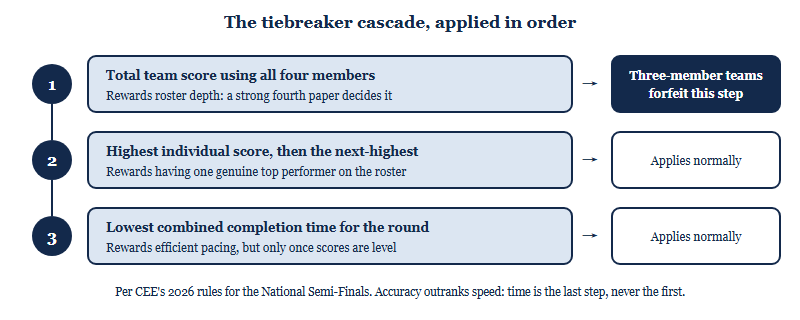
This is the provision most rosters have never read, and it is decisive. CEE’s rules set out three tiebreakers, applied in order, and the first one states that placement is determined by the total team score calculated using all four members — adding that teams with fewer than four members “automatically forfeit this tiebreaker, as no fourth score is available.”
| Order | Tiebreaker | What it rewards | Effect on a three-person team |
|---|---|---|---|
| First | Total team score using all four members | Roster depth — a strong fourth paper | Automatically forfeited; no fourth score exists |
| Second | Highest individual score, then the next-highest, and so on | Having one genuine top performer | Applies normally |
| Third | Lowest combined completion time for the round | Efficient pacing once answers are secure | Applies normally |
Read the cascade honestly and three practical conclusions fall out.
- A three-person team can only lose the first step. It cannot win it and cannot draw it. Every tie it enters begins one rung down.
- There is a genuine trade-off between depth and a star. Four evenly matched scorers are strong on the first tiebreaker and weaker on the second; one outstanding performer plus three solid ones is the reverse. Neither is universally better, but you should know which profile your squad has before you sit, rather than discovering it in a results table.
- Completion time is a live variable, but the last one. Because time only breaks a tie that has already survived two score-based steps, accuracy always outranks speed. The practical rule is narrow: do not burn the clock re-reading questions you have already answered confidently, and do not rush a question to save seconds you will probably never need.
Choosing the fourth: the seat you are actually recruiting
Because the Online National Semi-Final paper is answered individually, not collaboratively, there is no “support” seat at that stage — and how the CNEC preliminary is scored should be confirmed on official CNEC channels. Whoever takes the fourth place must be an independent scorer capable of clearing a respectable mark on their own paper. That immediately rules out the most common recruitment shortcut — taking whoever is available and hoping the other three carry them.
Beyond raw scoring, two considerations should drive the choice. The first is content coverage. The cheapest marginal gain on most rosters is a member who genuinely owns the international economics material, because that is the block teams most often revise last. The second is finals-stage utility: the later rounds ask for different people than the test does. CEE’s rules give teams 25 minutes to prepare a Critical Thinking presentation, 12 minutes to present it to judges and 8 minutes to answer their questions, scored on completeness, economic analysis and insight, background knowledge, presentation and responses to judges’ questions. The Quiz Bowl asks the team to nominate a single spokesperson who confers for 20 seconds and then writes the answer on a whiteboard — once it is face down, it is final.
| Seat | Primary ownership | Finals-stage role to develop |
|---|---|---|
| 1 | Microeconomics: structures, costs, marginal analysis | Analytical lead in the Critical Thinking round |
| 2 | Macroeconomics: indicators, models, policy | Presenter — delivery is explicitly scored |
| 3 | International economics and data interpretation | Evidence and current-context support |
| 4 | Breadth across all three areas; second on the weakest block | Quiz Bowl spokesperson — decisiveness under 20 seconds |
| This allocation is our editorial suggestion for training purposes, not an official rule. CEE does not assign roles; teams organise themselves. | ||
Depth expectations differ by bracket, and squads competing in the advanced division need genuine specialists rather than four generalists — a difference we set out in our guide to the Adam Smith division.
Roster continuity, and a decision checklist
The rules also constrain how much you can change a team after it has qualified, which is another argument for building a real four-person squad early. Under CEE’s 2026 rules, a team qualifying for the National Semi-Finals may reconstitute its membership but “must retain at least two original team members,” and all members must still satisfy the eligibility and division conditions. Between the semi-finals and the finals, reconstitution is permitted only in extraneous circumstances such as illness, family emergency, graduation or an internship conflict, requires CEE approval, and any replacement must already have competed in their state competition at minimum in the first-round competition.
In other words, a late outside substitute is not a contingency plan. The people who can step in are the people who were already competing.
One further piece of context for China-based readers: CEE’s rules provide that the National Champion teams go on to an International Quiz Bowl round held with international students from China. The two pathways are connected at the top, which is part of why the round formats are worth understanding early.
A short checklist to close on:
- Under CEE’s US rules three is permitted but structurally disadvantaged, so field four whenever eligibility allows. In CNEC’s David Ricardo and Adam Smith divisions four is mandatory, so the question is not whether to field four but how strong your fourth is.
- Score all four individually in every mock, and record both the top-three total and the all-four total, so you can see your first-tiebreaker strength.
- Track the gap between those two numbers over the season. A narrowing gap means your fourth is closing on the others, which is exactly what you want.
- Time your mocks. Completion time is the final tiebreaker, so it should be measured — but never optimised ahead of accuracy.
- Assign content ownership for efficiency, then examine everyone on everything, because the semi-final paper is sat individually.
- Decide your Quiz Bowl spokesperson well before finals week and rehearse the 20-second decision cycle.
- Confirm CNEC China-round team rules, divisions and deadlines on our China National Round (CNEC) page and on official CNEC channels before you finalise a roster, then enter the completed roster through the official China test-centre registration guide.
The team dimension is also, straightforwardly, part of the appeal. A four-person competitive squad produces a different kind of experience and a different kind of record from an individually written submission, which is one of the honest points of difference we draw out in NEC versus the economics essay prizes. If you want the team credential, build the team properly — all four of it.
Frequently asked questions
Can an NEC team have five members?
No. CEE’s 2026 rules set teams at three or four members and encourage four. In the CNEC China season, David Ricardo and Adam Smith require exactly four members, and only Pre may be entered individually or as a team of two to four — confirm current requirements on official CNEC channels.
Does the fourth member’s score count for anything?
Not in the team total, which uses the top three. It counts in the first tiebreaker, which three-person teams automatically forfeit.
Can teammates come from different schools?
Yes, if all members belong to the same school, community organisation, club or afterschool programme under CEE’s team composition rules.
Can we change members after qualifying?
CEE’s rules permit reconstitution but require at least two original members to remain; changes later in the pathway need approval.
Published by the NEC (CNEC) editorial desk, operated by Hanlin Education for China-based international-school students. Official rules are set by the competition and change yearly — confirm current details on councilforeconed.org. Errors reported to us are corrected within 7 working days.