
On the National Economics Challenge (NEC), market structures are tested less as definitions to recite and more as a decision logic to apply: given a market, you should be able to predict the firm's price and output, judge its efficiency, and — the skill that separates strong scorers — identify the structure from the wording of a prompt. This guide walks through perfect competition, monopolistic competition, oligopoly and monopoly the way NEC microeconomics frames them.
Why market structures sit at the centre of NEC microeconomics
The NEC is run by the Council for Economic Education (CEE), founded in 1949, which sets the academic standard the contest is built on. Its three subject pillars are microeconomics, macroeconomics and world / international economy, and market structure is one of the load-bearing topics inside the micro pillar. The reason is simple: almost every micro question — pricing, profit, consumer welfare, regulation — depends on which kind of market you are standing in.
For students entering through CNEC — the official China National Round operated by Hanlin (SKT) since 2016, and the only official path from China to the NEC global rounds — this is also where many first-time competitors lose easy marks. They can recite the definition of a monopoly but freeze when a prompt describes "a single seller facing the entire market demand curve" without ever using the word monopoly. The classification is the test. You can review how the wider contest is organised on the CNEC homepage.
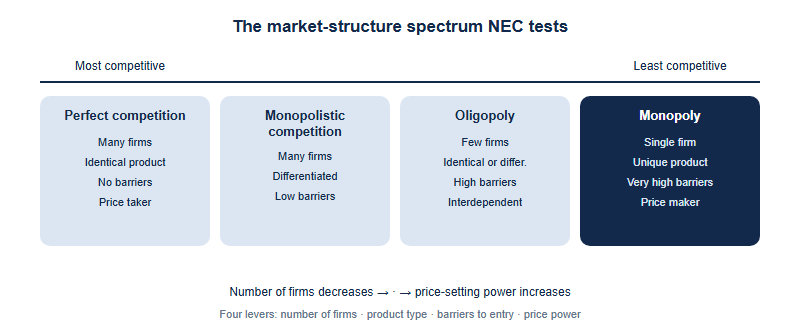
The four structures form a spectrum from most competitive to least competitive, defined by four levers: the number of firms, whether products are identical or differentiated, the height of barriers to entry, and how much price-setting power a single firm holds. Master those four levers and you can place any market.
Price and output: how each structure sets the firm's decision
Every profit-maximising firm in NEC's framework obeys the same underlying rule — produce where marginal revenue equals marginal cost (MR = MC). What changes across structures is the shape of the demand curve the firm faces, and that single difference drives everything about price and output.
- Perfect competition: the firm is a price taker. It faces a perfectly elastic (horizontal) demand curve at the market price, so price equals marginal revenue (P = MR). It produces where P = MC and, in the long run, earns only normal profit because free entry competes any abnormal profit away.
- Monopolistic competition: product differentiation gives each firm a downward-sloping demand curve, so it has some price-setting power and MR lies below price. It earns short-run abnormal profit, but low barriers let new entrants erode it down to normal profit in the long run.
- Oligopoly: a few large firms are interdependent — each firm's best price depends on what rivals do. Outcomes range from near-competitive (price wars) to near-monopoly (tacit coordination), which is why oligopoly resists a single tidy equilibrium.
- Monopoly: a single firm is the market, facing the whole downward-sloping market demand curve. It is a price maker, sets output where MR = MC, and — protected by high barriers — can sustain abnormal profit in the long run.
A reliable NEC exam habit: when a question gives you a scenario, first ask "is this firm a price taker or a price maker?" That one distinction immediately separates perfect competition (taker) from the other three (makers, in varying degrees), and tells you whether to expect P = MR or MR below price.
Efficiency: the welfare verdict NEC asks you to deliver
Once you have placed the structure, NEC frequently wants the efficiency verdict — is the market allocating resources well, and what is the cost to consumers? Two standards recur: allocative efficiency (price equals marginal cost, P = MC, so the last unit's value to consumers equals its cost to produce) and productive efficiency (production at the lowest point of the average cost curve).
| Structure | Firms & product | Price power | Long-run profit | Efficiency verdict |
|---|---|---|---|---|
| Perfect competition | Many; identical | Price taker (P = MR) | Normal only | Allocatively & productively efficient |
| Monopolistic competition | Many; differentiated | Some (MR < P) | Normal (entry erodes) | Neither, fully; some excess capacity |
| Oligopoly | Few; identical or differentiated | Significant; interdependent | Can be abnormal | Depends on conduct; often inefficient |
| Monopoly | One; unique | Price maker | Abnormal sustained | Allocatively inefficient; deadweight loss |
The headline result NEC rewards: perfect competition is the efficiency benchmark, because P = MC delivers allocative efficiency and long-run output sits at minimum average cost. A monopoly restricts output and raises price above marginal cost, creating a deadweight loss — the standard welfare criticism. But strong answers add nuance: a monopoly may achieve economies of scale a fragmented market cannot, and may fund research and development from its sustained profit. The grader is looking for the trade-off, not a one-sided condemnation.
Monopolistic competition is the most commonly misjudged case. Because firms face downward-sloping demand, they do not reach allocative efficiency (price exceeds marginal cost) and operate with excess capacity — yet consumers gain real variety. NEC questions often probe exactly this tension: efficiency lost versus choice gained.
Identifying the structure from a prompt: the classification drill
This is the practical core. NEC scenario questions rarely hand you the answer word. They give signals, and you decode them. Train yourself to scan a prompt for four cues, in order:
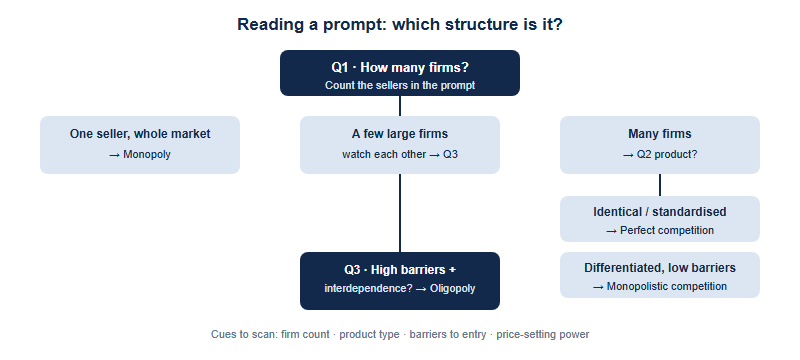
Some keyword tells that show up repeatedly in scenario wording:
- "Price taker" / "cannot influence the market price" / "standardised commodity" → perfect competition (think a single wheat or currency trader).
- "Brand loyalty" / "many similar but distinct products" / "easy to enter" → monopolistic competition (cafés, hair salons, restaurants).
- "A few dominant firms" / "match a rival's price" / "high start-up costs" → oligopoly (think a handful of large carriers or network operators).
- "Sole provider" / "patent" / "no close substitutes" / "sets its own price" → monopoly (a patented drug, a single regulated utility).
Note the deliberate guardrail here: NEC does not reward inventing a number where none is given. If a prompt says a firm "faces little competition" without specifying how many rivals exist, the disciplined answer states what the wording supports and flags the assumption — it does not assert "therefore it is a monopoly." The same discipline applies to the contest's own rules: eligibility, divisions, rounds, dates, fees and awards are set by the organiser, so confirm those on the official CNEC channels rather than inferring them.
A first-party note from the CNEC desk: where students lose marks
As the officially authorized China test center for the NEC, our coaching desk sees the same three slips on market-structure questions every cycle. First, students memorise the four definitions but cannot map an unlabelled scenario onto them — the classification drill above is what closes that gap. Second, they treat monopoly as simply "bad" and monopolistic competition as "good," missing that NEC grades the trade-off: deadweight loss against scale and innovation, efficiency against variety. Third, under time pressure they skip the price-taker-versus-price-maker check, which is the single fastest way to halve the possibilities.
A practical study sequence we use with CNEC teams: learn the four-lever framework, then practise only classification — read scenarios and name the structure — before touching the diagrams. Once placing the market is automatic, the price, output and efficiency answers follow naturally. The CEE sets the underlying academic standard the NEC is built on; the live contest structure for your cycle is published on the official CNEC homepage. This article covers the microeconomics of market structures only — game theory and externalities are separate topics.
Frequently asked questions
What are the four market structures NEC tests?
Perfect competition, monopolistic competition, oligopoly and monopoly — a spectrum defined by firm count, product type, barriers to entry and price-setting power.
Which market structure is the efficiency benchmark?
Perfect competition: price equals marginal cost (allocative efficiency) and long-run output is at minimum average cost (productive efficiency).
How do I identify a market structure from an exam prompt?
Scan four cues in order — number of firms, product differentiation, barriers to entry, and price power — rather than waiting for the structure to be named.
Are market structures part of NEC microeconomics?
Yes. Market structure is a core micro topic; NEC's three subjects are microeconomics, macroeconomics and world economy. Confirm current scope on the official CNEC channels.
Published by the NEC / CNEC editorial desk, operated by Hanlin Education as the officially authorized China National Economics Challenge (CNEC) test center. The NEC is run by the Council for Economic Education, which sets the official rules — always confirm current dates, divisions, fees and awards on the official CNEC channels. Any errors will be corrected within 7 working days.