
The National Economics Challenge (NEC) tests monopoly and oligopoly pricing as one decision rule applied under different competitive pressure. A firm with market power still maximises profit where marginal revenue equals marginal cost (MR=MC), but because its MR sits below price, it charges a markup over marginal cost. Questions then probe how price discrimination, and in oligopoly the pull of collusion, change that markup. This guide maps the pricing math and the intuition.
The one rule underneath every NEC pricing question: MR=MC
Whatever the market structure, NEC items reward students who reach for the same profit-maximising condition: produce the quantity where marginal revenue equals marginal cost, then read the price off the demand curve at that quantity. The trap is forgetting the second step — the firm sets quantity at MR=MC but prices off demand, which for a price-maker sits strictly above MR.
This is the single most important distinction the exam draws between a competitive firm and a firm with market power. For a perfectly competitive firm, price equals marginal revenue, so MR=MC also means price=MC and there is no markup. For a monopolist or an oligopolist facing a downward-sloping demand curve, marginal revenue is below price, so MR=MC leaves a gap between price and marginal cost. That gap is the whole story of market power.
- Step 1 — quantity: find the output where MR=MC. Below it, the next unit adds more to revenue than to cost; above it, the reverse. Profit peaks where they cross.
- Step 2 — price: go vertically up to the demand curve at that quantity and read the price. Do not read price off the MR curve — that is the classic lost mark.
- Step 3 — the markup: the vertical distance between that price and marginal cost is the markup market power creates.
A second-order trap NEC exploits: MR=MC tells you the profit-maximising quantity, not whether the firm makes a profit at all. Profit depends on price versus average total cost, not marginal cost. A monopolist can satisfy MR=MC and still make a loss in the short run if price sits below average cost — so a question that asks “is this firm profitable?” needs the ATC comparison, while “what quantity?” needs MR=MC. You can see where these microeconomics items sit in the round structure on the CNEC site.
| Market structure | Profit-max rule | Relation of price to MR | Markup over MC? |
|---|---|---|---|
| Perfect competition | MR=MC (and price=MR) | Price = MR | None: price = marginal cost |
| Monopoly | MR=MC, price off demand | Price > MR | Yes: price > marginal cost |
| Oligopoly | MR=MC each firm, but rivals react | Price > MR | Yes, but size depends on rivalry vs collusion |
| Monopolistic competition | MR=MC, price off demand | Price > MR | Small markup; competed away long run |
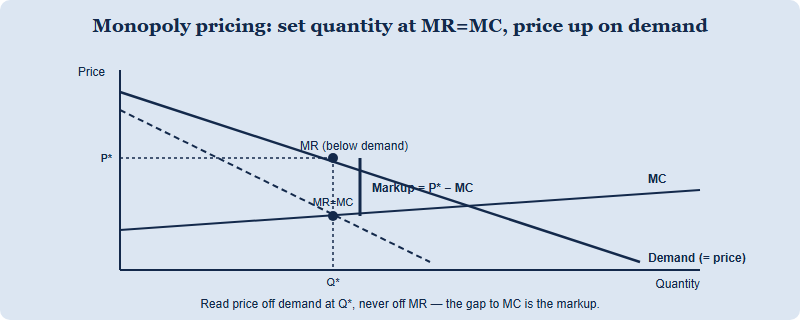
Why marginal revenue sits below price — and the markup that follows
The reason a price-maker charges above marginal cost is a fact about marginal revenue that NEC questions test directly. When a monopolist sells one more unit, it must lower the price — and that lower price applies to every unit, not just the last. So marginal revenue is the new price minus the revenue lost on all the units that now sell for less. That subtraction is exactly why MR is below the demand-curve price, and it grows as output expands.
The size of the markup is not arbitrary. The more inelastic the demand a firm faces, the larger the markup it can sustain, because customers respond little to a higher price. A firm facing very elastic demand — close substitutes, easy switching — can mark up only slightly before losing the sale. This is the bridge between two micro topics: elasticity is what governs how far above marginal cost a price-maker can profitably set price. NEC items frequently hand you the elasticity and ask which firm has the bigger markup; the answer is the one facing the more inelastic demand.
- Inelastic demand → large markup. Few substitutes, necessity, brand lock-in — the firm raises price with little volume loss.
- Elastic demand → small markup. Many substitutes, easy switching — even a modest markup drives customers away.
- The marginal-cost floor. A profit-maximising firm never prices below marginal cost on the relevant unit; the markup is positive whenever it has market power.
Price discrimination: charging different prices to lift the markup
A favourite NEC extension is price discrimination — charging different buyers different prices for the same good to capture more of the value they place on it. The questions test the conditions, not just the definition, so anchor the three things a firm needs: market power (it sets price), the ability to separate buyers by willingness to pay, and a way to prevent resale between the groups. Remove any one and discrimination collapses.
The economics is that a single uniform price leaves money on the table: some buyers would have paid more, and some who valued the good above marginal cost are priced out. By charging the high-willingness group more and the low-willingness group less, the firm converts some of that lost value into revenue. NEC scenarios often dress this up as student-versus-adult tickets, peak-versus-off-peak pricing, or regional pricing — all the same mechanism. The exam reward is recognising that price discrimination raises the firm’s revenue and can expand output relative to a single monopoly price, which is why its welfare effects are ambiguous rather than purely harmful.
| Condition | What it means | If it fails |
|---|---|---|
| Market power | The firm is a price-maker, not a price-taker | No power to set different prices at all |
| Separable markets | Buyers can be sorted by willingness to pay (age, time, location) | Cannot tell who would pay more |
| No resale | The cheap group cannot resell to the dear group | Arbitrage collapses both prices to one |
Oligopoly: the collusion temptation and why it breaks
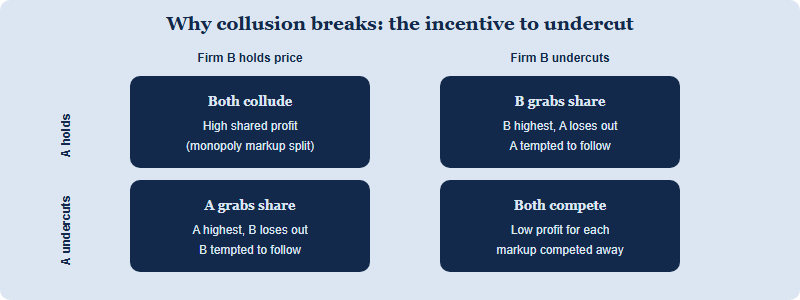
Oligopoly is where NEC pricing gets strategic, because each firm’s best price depends on what rivals do. The recurring insight the exam tests is the tension between two outcomes. If the few firms collude — formally as a cartel or informally as tacit coordination — they can act like a single monopolist, restrict total output, and share the large monopoly markup. That is the jointly best outcome for the firms (though not for consumers).
The problem is that collusion is unstable, and the reason is pure incentive. Once rivals hold the high collusive price, any single firm can cheat — shave its price a little, win a big slice of the market, and earn more than its share of the cartel profit. Because every firm faces the same temptation, the cooperative price tends to unravel toward more competitive levels. This is the classic prisoner’s-dilemma structure NEC items invoke: the dominant strategy for each firm is to undercut, even though all firms would be better off holding the line. The exam wants you to name the trade-off — collude and split monopoly profit, or defect and grab share — and to explain why defection is individually rational and collectively self-defeating.
- Collude: firms jointly restrict output and price like a monopoly; markup is high, profit is shared.
- Defect / cheat: one firm undercuts the collusive price, captures share, and earns more — until others retaliate.
- Why it matters for NEC: the question is usually “is the collusive price stable?” The answer hinges on each firm’s incentive to deviate, not on goodwill.
A common wrong answer treats a cartel as permanently stable. The better answer notes that without enforcement, the individual payoff to cheating erodes the agreement, which is why real cartels need monitoring, repeated interaction, or punishment strategies to survive. For where these strategic-interaction items sit alongside the rest of the syllabus, start from the CNEC home page.
How to drill imperfect-competition pricing for the NEC rounds
Pricing under market power rewards a fixed procedure applied fast, which suits the NEC format — the Qualifying Test and the rapid Quiz Bowl punish hesitation, while Critical Thinking rewards the strategic read on collusion. A first-party drilling routine we use with CNEC teams:
- Always run the two-step. For every market-power question, set quantity at MR=MC, then price off demand. Saying both steps out loud kills the “price off MR” error.
- Separate quantity from profit. Drill “what quantity?” (MR=MC) apart from “is it profitable?” (price vs ATC). Mixing them is the most common monopoly slip.
- Link markup to elasticity. After finding a markup, state whether the demand is elastic or inelastic and why that markup size makes sense. It connects two topics examiners pair.
- Name the collusion trade-off. In oligopoly items, articulate the collude-versus-cheat payoff and conclude on stability through the incentive to deviate — not a vague “firms might cooperate.”
Monopoly and oligopoly pricing is one slice of microeconomics, but it threads through the whole NEC syllabus alongside macroeconomics and the world economy, so the MR=MC discipline you build here transfers across rounds. To see where these microeconomics items sit in the wider format and timeline, confirm the current structure on the official CNEC channels before relying on any specific detail.
FAQ
What price does a profit-maximising monopolist charge in NEC questions?
Set quantity where MR=MC, then read the price up on the demand curve at that quantity — never off the MR curve.
Why is a monopolist's marginal revenue below its price?
Selling one more unit forces a lower price on all units, so MR equals the new price minus revenue lost on existing units.
What conditions does price discrimination need?
Market power to set price, separable buyers by willingness to pay, and no resale between the groups; remove one and it fails.
Why is collusion in oligopoly unstable?
Each firm can earn more by undercutting the collusive price, so the dominant strategy is to defect, eroding the agreement.
Published by the NEC / CNEC editorial desk, operated by Hanlin Education as the officially authorized China National Economics Challenge (CNEC) test center. The NEC is run by the Council for Economic Education, which sets the official rules — always confirm current dates, divisions, fees and awards on the official CNEC channels. Errors are corrected within 7 working days.