
The National Economics Challenge (NEC) tests game theory as a fixed solving routine, not a topic to memorise. Faced with a payoff matrix, you first check each player for a dominant strategy, then locate the Nash equilibrium — the cell where neither player can do better by switching alone. Many items are dressed-up prisoner's dilemmas. This guide gives you a repeatable method for reading the grid fast and choosing the right cell under time pressure.
Why game theory shows up across NEC microeconomics items
The NEC is run by the Council for Economic Education (CEE), founded in 1949, and its question set spans microeconomics, macroeconomics and the world economy. Game theory sits inside the microeconomics strand because it models strategic interdependence — situations where your best move depends on what someone else does. That makes it a favourite for multiple-choice items: a single 2×2 grid can test whether a student can read payoffs, reason about a rival's incentives, and reach a stable outcome, all in under a minute.
Across the China National Round, students meet game theory in two formats. In the timed multiple-choice portions it appears as a small payoff matrix with one correct equilibrium cell. In the discussion-style and analytical rounds — the parts of the NEC built around reasoning out loud — a panel may ask why an outcome is stable or why two firms fail to cooperate. The underlying skill is identical; only the answer format changes. You can see where these microeconomics items sit in the round structure on the CNEC overview page.
A first-party note from running the China round: the students who lose marks here rarely misunderstand the economics — they misread the grid. They confuse whose payoff is whose, or they stop at a dominant strategy for one player and forget to check the other. The fix is procedural, which is exactly why a checklist beats re-reading the theory.
Reading a payoff matrix fast: who gets which number
A standard 2×2 matrix has one player choosing rows and the other choosing columns. Each cell holds a pair of payoffs. The convention NEC items follow is (row player, column player) — the first number belongs to the player on the side, the second to the player on top. Getting this orientation right before you reason about strategy prevents the single most common error.
| Column player: Left | Column player: Right | |
|---|---|---|
| Row player: Up | (3, 3) | (0, 5) |
| Row player: Down | (5, 0) | (1, 1) |
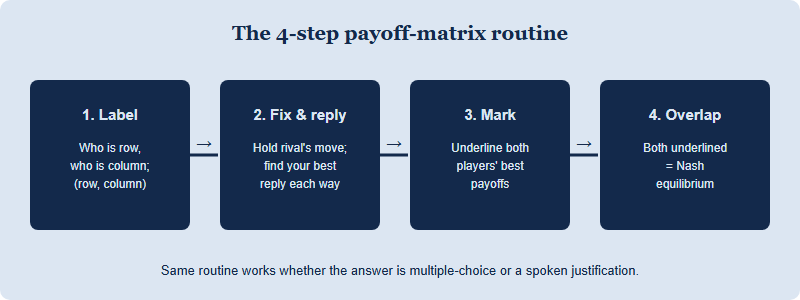
Read the grid in this order under exam conditions:
- Label the players and moves — mark which side is the row player and which numbers belong to whom. Ten seconds here saves the whole question.
- Hold one player's choice fixed — ask: if the column player picks Left, what is the row player's best reply? Then repeat for Right.
- Underline best replies — physically mark the row player's best payoff in each column, then the column player's best in each row.
- Find the overlap — a cell where both numbers are underlined is a Nash equilibrium. No further reading required.
Dominant strategies: the shortcut that solves many items instantly
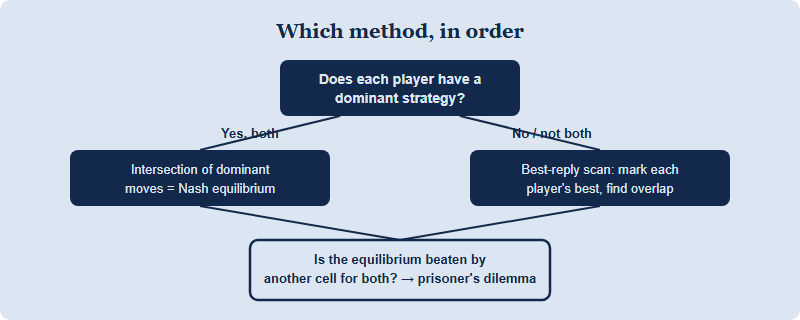
A dominant strategy is a move that gives a player a higher payoff no matter what the opponent does. When a player has one, you do not need to reason about the rival's choice for that player — the move is settled. Spotting dominance is the fastest route through a payoff-matrix item, because if both players have a dominant strategy, their intersection is the Nash equilibrium and the question is over.
Test for dominance the same way every time. Compare a player's payoffs row-by-row (or column-by-column) against each rival choice. In the worked grid above, the row player earns 5 versus 3 if the column player plays Left, and 1 versus 0 if the column player plays Right — Down beats Up in both cases, so Down is dominant. By symmetry, Right dominates Left for the column player. The intersection, (Down, Right) = (1, 1), is the Nash equilibrium even though both players would prefer the (3, 3) outcome.
Two distinctions NEC items test deliberately:
- Strict vs weak dominance — a strictly dominant strategy is strictly better against every rival move; a weakly dominant one is at least as good and sometimes better. Items occasionally hinge on this wording.
- Dominant strategy vs dominated strategy — eliminating a dominated strategy (one that is always worse) can simplify a 3×3 grid step by step. This “iterated elimination” is a legitimate shortcut when no single move dominates outright.
A common trap: not every game has a dominant strategy, so do not force one. If neither player has a dominant move, skip straight to the best-reply method to find the Nash equilibrium — the grid may still have a clean answer.
Nash equilibrium: the cell no one wants to leave
A Nash equilibrium is an outcome where each player's choice is a best reply to the other's, so no single player can improve by switching alone. It is the concept NEC items return to most, and the precise wording matters: stability is defined against unilateral deviation. A cell can be a Nash equilibrium even when both players could do better by moving together — cooperation requires a joint switch, which the equilibrium concept does not allow.
Find it without dominance by the best-reply scan: in each column, mark the row player's highest payoff; in each row, mark the column player's highest. Any cell carrying both marks is a Nash equilibrium. This method always works, handles games with no dominant strategy, and reveals when a game has more than one equilibrium — a feature NEC sometimes uses to test whether students assume there is always exactly one.
| Concept | One-line definition | Fastest exam test |
|---|---|---|
| Dominant strategy | Best move regardless of the rival's choice | Compare your payoffs against each rival move; same move wins both? |
| Dominated strategy | A move that is always worse than another | Cross it out, then re-read the smaller grid |
| Nash equilibrium | Each player best-replies; no profitable solo switch | Mark best replies; find the cell with both marks |
| Prisoner's dilemma | Dominant strategies lead to a worse-for-both outcome | Equilibrium cell is jointly dominated by another cell |
The prisoner's dilemma: the structure behind so many questions
The prisoner's dilemma is the single most-tested game structure because it captures a clean paradox: both players have a dominant strategy, they both play it, and the result is worse for both than if they had cooperated. The worked grid above is a prisoner's dilemma — (Down, Right) at (1, 1) is the equilibrium, yet (Up, Left) at (3, 3) would leave both better off. Cooperation is unstable because each player is individually tempted to deviate.
NEC dresses this structure in different stories. The same matrix can describe two countries deciding whether to cut tariffs, two firms deciding whether to advertise heavily, or two rivals deciding whether to hold a quiet, cooperative arrangement or break it. (We keep the focus here on the game-theory mechanics; the pricing math of firms with market power is a separate microeconomics topic.) Whatever the wrapper, recognise the prisoner's-dilemma signature: a dominant strategy for each player, and an equilibrium cell that is jointly beaten by another cell.
One nuance worth carrying into the analytical rounds: the dilemma loosens when the game is repeated. If players interact again and again, the threat of future retaliation can sustain cooperation that a one-shot game destroys. A panel question asking “why might these two actually cooperate in practice?” is usually pointing at repetition and reputation — a higher-order point that distinguishes strong answers. Structured drilling of these item types is exactly what our China-round preparation resources are built around.
Frequently asked questions
Is a dominant-strategy outcome always a Nash equilibrium?
Yes. If both players play a dominant strategy, neither can improve by switching alone, so that cell is by definition a Nash equilibrium.
Can an NEC game have more than one Nash equilibrium?
Yes. Some grids have two pure-strategy equilibria. Use the best-reply scan and mark every cell where both players best-reply — do not assume there is only one.
How do I read the payoff pair (a, b)?
By convention the first number is the row player's payoff and the second is the column player's. Label this before reasoning to avoid the most common error.
Where do game-theory items appear in the China round?
In timed multiple-choice and in analytical rounds. Confirm the current round format and dates on the official CNEC channels.
Published by the NEC / CNEC editorial desk, operated by Hanlin Education as the officially authorized China National Economics Challenge (CNEC) test center. The NEC is run by the Council for Economic Education, which sets the official rules — always confirm current dates, divisions, fees and awards on the official CNEC channels. Any error is corrected within 7 working days.