For students new to economics, the NEC Pre Division personal entry option offers a low-pressure way to test your knowledge without the logistical hurdle of finding teammates. Starting in the 2026-2027 season, the Preliminary stage of the National Economics Competition (NEC/CNEC) explicitly permits individual registration for the Pre Division. This change removes a significant barrier for beginners who may not yet have a study group.
Who Is Eligible for the Pre Division?
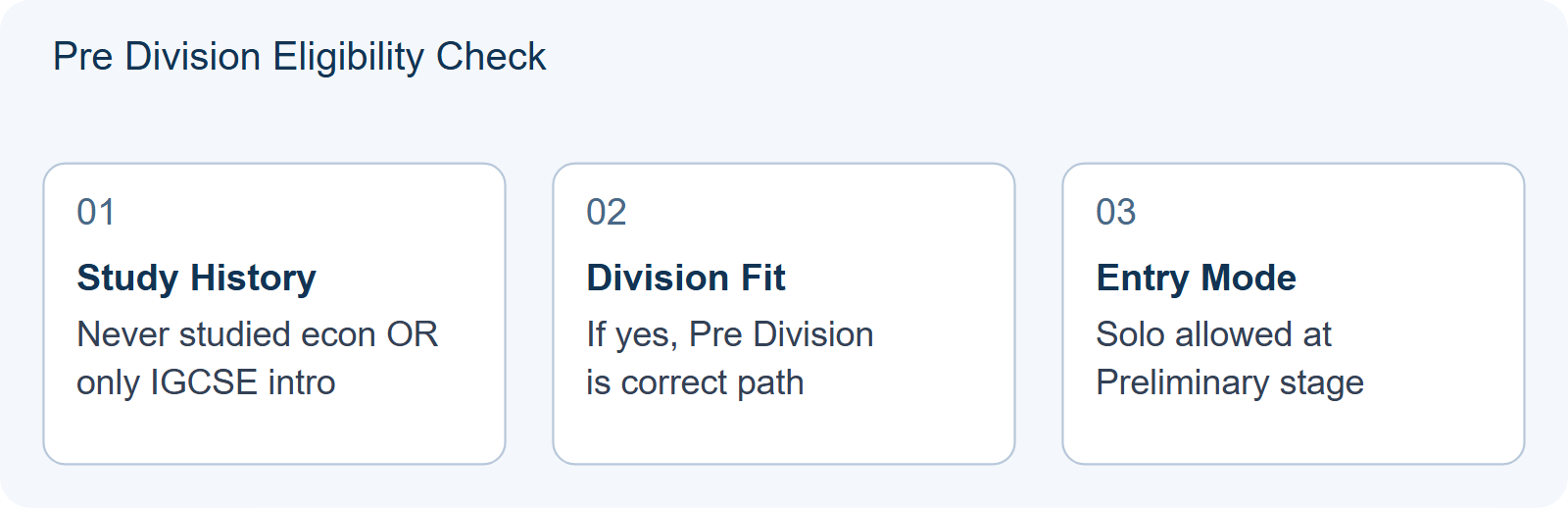
Eligibility is defined by prior study history, not strictly by grade level. According to the 2027 guidelines, the Pre Division is designed for students who have never studied economics or have only completed introductory IGCSE economics. This means older students who are true beginners can still compete in this division, provided they meet the study criteria. If you have taken IB, AP, or A-Level micro/macro courses, you likely belong in the DR or AS divisions instead.
Solo vs. Team: What Changes?
The core difference lies in award recognition. At the Preliminary stage:
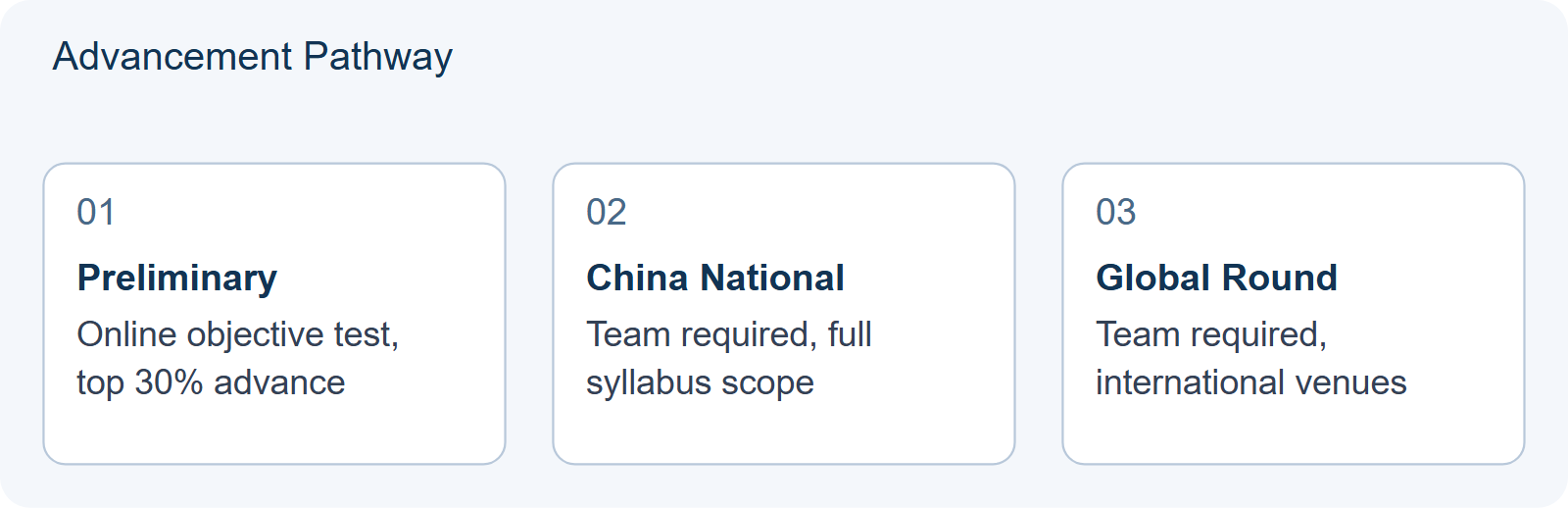
- Personal Entry: You compete individually. You are eligible for individual honors and advancement to the China National Round if you score in the top 30%. However, you do not receive team awards.
- Team Entry: You form a squad of 2-4 students. You compete for both individual and team honors. Team members must be in the same division and complete registration before the deadline.
Crucially, while you can start solo, the China National Round and Global Round require team participation. Therefore, entering personally at the Preliminary stage is a strategic choice to secure advancement first, then build a team for later rounds.
Test Format and Content
The Preliminary stage is an online objective test (multiple choice). It does not include a Critical Thinking presentation component; those elements appear in later rounds or different divisions. The 2027 syllabus adjustment reduces the overall scope to 70% of the original curriculum for the Preliminary stage, focusing on foundational concepts.
| Component | Question Count | Focus Area |
|---|---|---|
| Microeconomics | 28 Questions | Supply/Demand, Market Structures, Consumer Choice |
| Macroeconomics | 8 Questions | GDP, Inflation, Basic Policy Concepts |
| Total Score | 360 Points | Each question worth 10 points |
Strategic Advice for Prospective Entrants
If you are confident in your self-study ability but lack a partner, NEC Pre Division personal entry is ideal. It allows you to gauge your standing against peers immediately. Use the Mock CNEC dates (December 5-6) to practice under timed conditions. Remember, the actual testing window is 60 minutes within a two-hour slot, so time management is critical.
For those considering team entry, ensure all members register before the deadline. Cross-school teams are permitted, but you must designate a home school for team honor attribution during registration.
Preparation Resources
To succeed in the objective test, focus on graph interpretation and definition precision. Reviewing past papers helps identify common traps. For specific topic drills, consider studying How NEC Tests Consumer Choice to master marginal utility concepts, which frequently appear in the micro section. Additionally, understanding the timeline is key; see CNEC 2027 Preliminary Slots for details on mock days and test windows. Finally, if you are unsure about your division fit, read NEC Pre 2027 for IGCSE Students to map your current syllabus to the exam questions.
Hypothetical Decision Case: The “Solo Sprint” vs. “Team Anchor” Strategy
To illustrate how to apply the strategic advice regarding NEC Pre Division personal entry, consider a hypothetical scenario involving two students, Alex and Jordan, both preparing for the 2027 Preliminary stage. Neither has studied economics beyond introductory IGCSE concepts, making them eligible for the Pre Division. Their primary dilemma is whether to register solo immediately or delay registration to form a team with classmates.
Alex chooses the Solo Sprint approach. He registers individually as soon as the window opens. His reasoning is risk mitigation: he wants to secure his spot in the exam without depending on others’ schedules. He dedicates his preparation time to mastering the 36 objective questions, focusing heavily on graph interpretation and definition precision, knowing that individual advancement to the China National Round depends solely on his score being in the top 30%. He treats the Preliminary stage as a diagnostic tool for his own knowledge gaps.
Jordan, conversely, opts for the Team Anchor strategy. She waits three weeks to coordinate with two friends who are also beginners. Her goal is not just advancement, but immediate access to team-based study dynamics. She believes that discussing macroeconomic policy concepts with peers will deepen her understanding faster than solitary review. However, this choice introduces logistical friction; if one friend fails to complete registration before the deadline, Jordan’s entire plan collapses, potentially forcing her into a last-minute solo scramble or missing the opportunity entirely.
The decision changes based on two critical factors: reliability of peers and personal confidence in self-study. If you have highly motivated, reliable partners who can commit to strict deadlines, team entry offers collaborative learning benefits during the preparation phase. However, if your potential teammates are inconsistent or if you thrive under independent pressure, solo entry is superior. It removes external variables from your control. Remember, while team awards are attractive, they are secondary to the primary goal of advancing to the next round, which requires individual excellence regardless of entry type.
Use this reusable self-check to decide your path:
| Self-Check Question | Choose Solo Entry If… | Choose Team Entry If… |
|---|---|---|
| How do you handle deadlines? | You prefer controlling your own timeline and fear others’ delays. | You trust your group to manage administrative tasks collectively. |
| What is your study style? | You learn best through quiet, focused repetition of past papers. | You learn best by debating concepts and explaining ideas to others. |
| What is your primary goal? | Guaranteed participation and individual score benchmarking. | Building a long-term study group for future rounds. |
In this illustrative case, Alex’s solo route ensures he takes the test regardless of external chaos, aligning with the article’s advice to use personal entry as a low-pressure barrier remover. Jordan’s team route maximizes collaborative depth but risks administrative failure. For most beginners new to economics, the stability of solo entry often outweighs the social benefits of team formation at the Preliminary stage, allowing you to focus purely on mastering the foundational micro and macro concepts required for the objective test.
Frequently Asked Questions
Can I enter the NEC Pre Division alone?
Yes, for the 2027 Preliminary stage, the Pre Division allows personal entry. However, you will not receive team awards, and you must form a team to participate in the China National and Global Rounds.
Is there a Critical Thinking component in the Preliminary test?
No. The Preliminary stage is an online objective multiple-choice test. Critical Thinking presentations are part of later rounds or different divisions, not the initial Pre Division screening.
What defines eligibility for the Pre Division?
Eligibility is based on prior study, not grade. You qualify if you have never studied economics or have only taken introductory IGCSE economics. Students with IB/AP/A-Level experience typically belong in DR or AS divisions.