The 2027 CNEC preliminary takes place on 12 or 13 December 2026, one full week after the Mock CNEC on 5 or 6 December. Both events use identical two-hour blocks—Pre Division at 8:30–10:30, DR and AS Divisions at 14:00–16:00—yet the actual assessment inside each block is 60 minutes, not 120. Students must confirm their chosen day in the Bloom task card before 30 November; after that date the slot locks.
Two Weekends in December: Mock CNEC and the Preliminary Are Separate Events
The most common scheduling confusion at this stage of the season is treating the Mock CNEC and the CNEC Preliminary as a single weekend or as interchangeable sessions. According to the CNEC 2027 organizer briefing, they are distinct events separated by seven days. Mock CNEC is scheduled for 5 or 6 December 2026; the scored CNEC Preliminary follows on 12 or 13 December 2026. In both cases, each student selects one of the two available days through the Bloom task card.
The Mock exists as a full-format rehearsal. It replicates the division structure, the time blocks and the online delivery format so that students can troubleshoot their technical setup, practise logging in under time pressure and experience the pacing of a real session. The Mock is a rehearsal, not the advancement assessment; the Preliminary one week later is the session that determines progression to the China National Round in March 2027.
Because the two events share the same daily schedule, a student who registers for the Pre Division and picks Saturday for both weekends would sit at 8:30 on 5 December for the Mock and at 8:30 on 12 December for the Preliminary. The clock, the division and the format look identical; only the stakes differ. Students who assume the Mock is “the real thing” or who skip it because they believe the Preliminary is the only session that matters miss the single best opportunity to eliminate technical surprises before the scored day. For a broader view of how the Mock fits into a multi-week preparation sequence, see Prep Test to Mock CNEC: The Five-Stage Ladder, and How to Tell Which Rung You Are On.
Division Time Blocks: Pre at 8:30, DR and AS at 14:00
The CNEC 2027 briefing publishes the same two-block schedule for both the Mock and the Preliminary. Pre Division students are assigned the morning window of 8:30–10:30. DR and AS Division students are assigned the afternoon window of 14:00–16:00. There is no cross-division scheduling: a Pre student does not sit at 14:00, and a DR or AS student does not sit at 8:30.
| Detail | Mock CNEC 2027 | CNEC Preliminary 2027 |
|---|---|---|
| Dates (choose one day) | 5 or 6 December 2026 | 12 or 13 December 2026 |
| Pre Division block | 8:30 – 10:30 | 8:30 – 10:30 |
| DR & AS Division block | 14:00 – 16:00 | 14:00 – 16:00 |
| Actual assessment time | 60 minutes | 60 minutes |
| Day selection | Bloom task card | Bloom task card |
| Slot lock-in deadline | Before 30 November 2026 (confirm exact cutoff and timezone in Bloom) | |
| Purpose | Full-format rehearsal | Scored preliminary for advancement |
For Pre Division students, this morning slot aligns with the 28-micro, 8-macro question structure introduced for the 2027 season. If you are coming from an IGCSE Economics background, the syllabus mapping in NEC Pre 2027 for IGCSE Economics Students: The 28-Micro, 8-Macro Paper Mapped to Your Syllabus shows exactly which topics fill those 36 questions.
The Two-Hour Window Is Not 120 Minutes of Answering
This is the single most consequential operational detail in the briefing, and the one most likely to distort a student’s preparation if misunderstood. The published block—8:30 to 10:30 for Pre, 14:00 to 16:00 for DR and AS—spans two hours. However, the CNEC 2027 organizer briefing states explicitly that the two-hour window includes entry and environment-checking time. The actual assessment is 60 minutes.
In practical terms, the first portion of the block is consumed by entry and environment-checking procedures as confirmed in the briefing. The specific technical requirements (camera, microphone, room setup) are not detailed in the briefing; students should follow the instructions provided in Bloom for the exact check-in procedure. Only after those checks are complete does the 60-minute timed paper begin. A student who rehearses at home for 120 continuous minutes of question-answering is training for the wrong duration. The pacing target is 60 minutes, and the preparation should reflect that. An earlier article, 45 Questions in 45 Minutes: The Pacing and Guessing Strategy NEC Scoring Actually Rewards, addressed a previous season’s format (45 questions in 45 minutes) and does not reflect the current 60-minute, 36-question Pre Division structure. Treat it as historical context only; do not apply its pacing arithmetic to the 2027 paper.
The environment check also has a practical implication: students should log in early within the block, not at the last minute. Arriving at 8:29 for an 8:30 start leaves no margin for the check-in sequence. Treat the published start time as the moment you should already be present and ready, not the moment you begin connecting.
For Pre Division students specifically, the 60-minute paper in the 2027 season contains 36 questions—28 microeconomics and 8 macroeconomics—set in English with key stem terms provided in bilingual annotation. The difficulty is calibrated closer to the IGCSE Economics syllabus than in previous seasons, per the CNEC 2027 organizer briefing. That works out to roughly 100 seconds per question on average, leaving a small buffer for review. DR and AS students face a broader syllabus that adds international economics and current affairs to the micro-macro core, but the 60-minute clock is the same. Whichever division you sit, the pacing target is 60 minutes of active answering, not the full two-hour window. For general multiple-choice pacing principles used in NEC-style assessments, see The Pacing and Guessing Strategy NEC Scoring Actually Rewards.
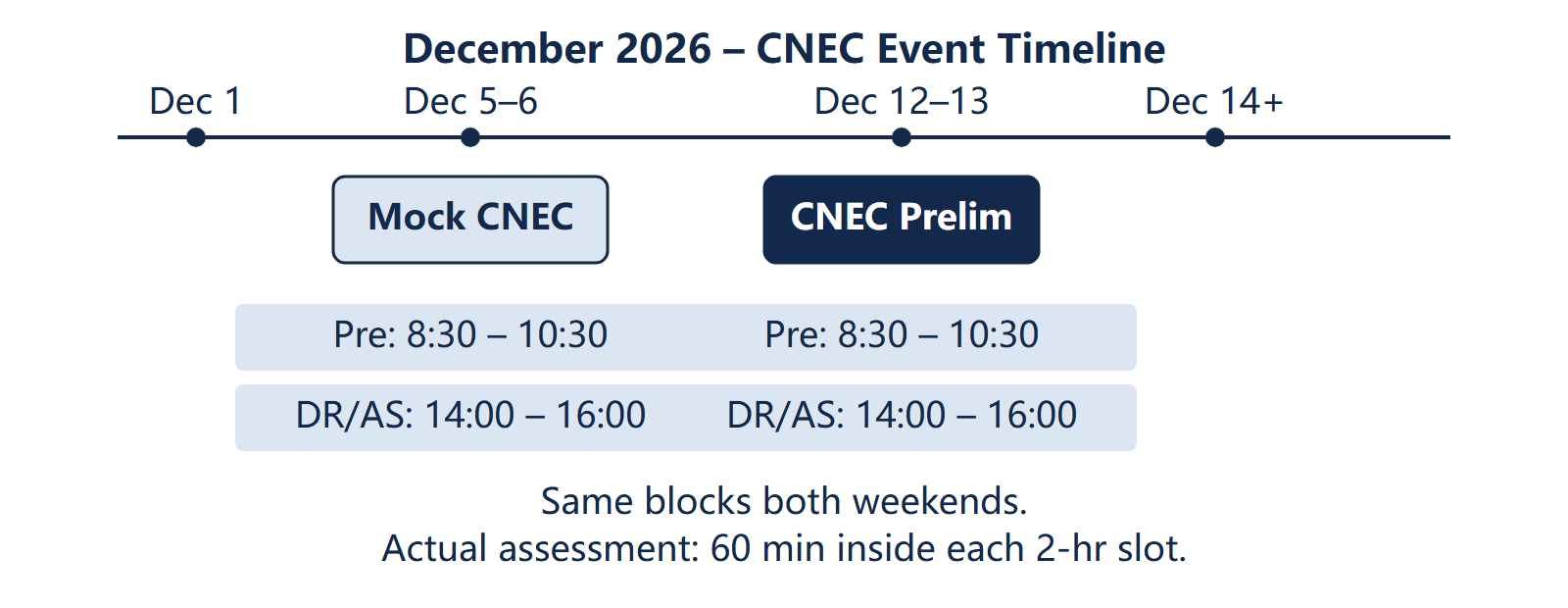
Figure 1 – Mock CNEC (5–6 Dec) and CNEC Preliminary (12–13 Dec) share identical division time blocks. Source: CNEC 2027 organizer briefing.
Choosing Your Day in Bloom: The 30 November Lock-In
Day selection for both the Mock and the Preliminary is handled through the Bloom task card. Each student picks one of the two available dates for each event. The CNEC 2027 briefing states that students should choose before 30 November 2026 and that no changes are permitted after that date. complete your selection well before 30 November and confirm the precise cutoff and timezone in Bloom. Three rules apply from that point forward:
- Unchosen students are assigned. Any student who has not selected a day in Bloom before 30 November may be randomly allocated to one of the two dates. The student does not get to pick after the fact.
- No changes after the deadline. Once 30 November passes, all students are locked into their assigned or chosen day. Swapping from Saturday to Sunday, or vice versa, is not permitted.
The practical implication is straightforward: confirm your Mock day and your Preliminary day in Bloom well before 30 November. As a coordination recommendation, DR and AS team members may wish to select the same date so they can sit the session together; however, the briefing does not explicitly mandate same-day selection for teammates. Confirm any team-scheduling requirements in Bloom. For the full sequence of season deadlines and how to back-plan from mid-December, see The 2027 CNEC Season Calendar: Every Deadline, and How to Back-Plan From a Mid-December Preliminary.
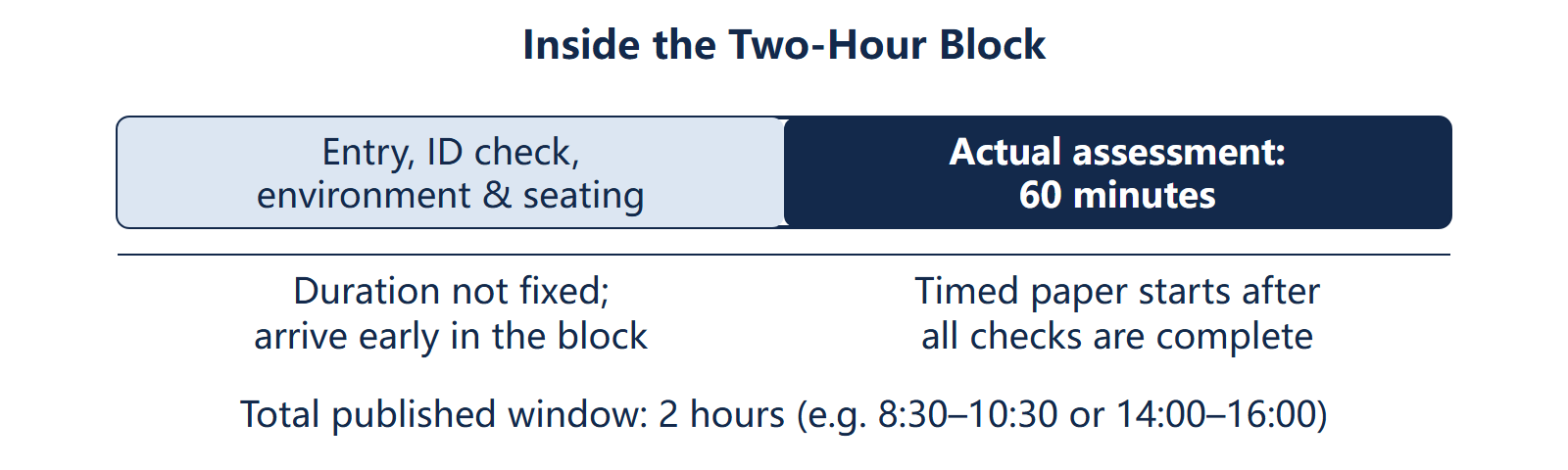
Figure 2 – The two-hour block includes admission and environment checks before the 60-minute paper begins. Source: CNEC 2027 organizer briefing.
A Final Checklist Before You Log In on Test Day
Pulling the operational details together, here is the short list every CNEC 2027 entrant should verify before December. Items sourced from the CNEC 2027 organizer briefing are noted; other items are editorial recommendations for practical readiness.
- Division confirmed. Pre, DR or AS. Pre students may enter individually at the preliminary stage, but individual entrants are not eligible for team honours; DR and AS require exactly four members per team, all in the same division.
- Teammate roster locked. DR and AS teams must have all four members registered and confirmed before the registration deadline. Cross-school teams should confirm their team-affiliation school in the Bloom interface.
- Day selected in Bloom. One day for Mock CNEC (5 or 6 December), one day for the Preliminary (12 or 13 December). Complete both selections well before 30 November; confirm the exact cutoff time and timezone in Bloom.
- Technical environment ready. The briefing confirms an environment check inside the two-hour block before the paper starts. Specific hardware and room requirements should follow the instructions in Bloom; a faulty setup eats into your window.
- One 60-minute timed rehearsal completed. Use the Mock CNEC on 5 or 6 December as the primary rehearsal. If additional practice is needed, run a 60-minute timed set at home under exam conditions—not a 120-minute set. The paper is 60 minutes; train for 60 minutes.
This checklist is deliberately operational. It does not replace content preparation, which should already be underway by early December. What it prevents is the category of error that has nothing to do with economics knowledge: showing up on the wrong weekend, logging in late, discovering a camera problem during the environment check, or pacing for a 120-minute paper that does not exist.
Frequently Asked Questions
Is the Mock CNEC on the same weekend as the CNEC Preliminary?
No. Per the CNEC 2027 organizer briefing, Mock CNEC takes place on 5 or 6 December 2026, while the CNEC Preliminary takes place on 12 or 13 December 2026. They are separate events one week apart, each requiring a separate day selection in the Bloom task card.
Does the two-hour time block mean 120 minutes of answering questions?
No. The CNEC 2027 briefing states that the two-hour window includes entry and environment-checking time. The actual assessment is 60 minutes. Students should rehearse at the 60-minute duration, not 120 minutes.
Can I change my chosen test day after 30 November?
No. According to the CNEC 2027 organizer briefing, students who have not selected a time before 30 November may be randomly assigned a day, and no changes are permitted after that date. complete your selection well before 30 November and confirm the precise deadline in Bloom.
Editorial note: This article is published by the CNEC operating team and draws on the CNEC 2027 organizer briefing and Student Handbook. Dates, time blocks and slot-selection rules reflect the briefing current as of September 2026. Students should verify their individual slot assignment in the Bloom task card. The National Economics Challenge is a programme of the Council for Economic Education (CEE).