The exact question in NEC comparative advantage problems is not “who is better at what?” but “who gives up less to produce it?” Students who skip the opportunity-cost calculation and jump to absolute productivity almost always misallocate production and select the wrong trade pattern. This article shows the verified calculation method, walks through a teaching illustration where the shortcut fails, and gives you a diagnostic check to apply before you finalize any answer.
Why Opportunity Cost Must Come First
Comparative advantage is defined by relative opportunity cost, not by absolute output. A country or producer can have an absolute disadvantage in every good and still hold comparative advantage in one of them. The NEC tests this distinction repeatedly in both multiple-choice and critical-thinking formats.
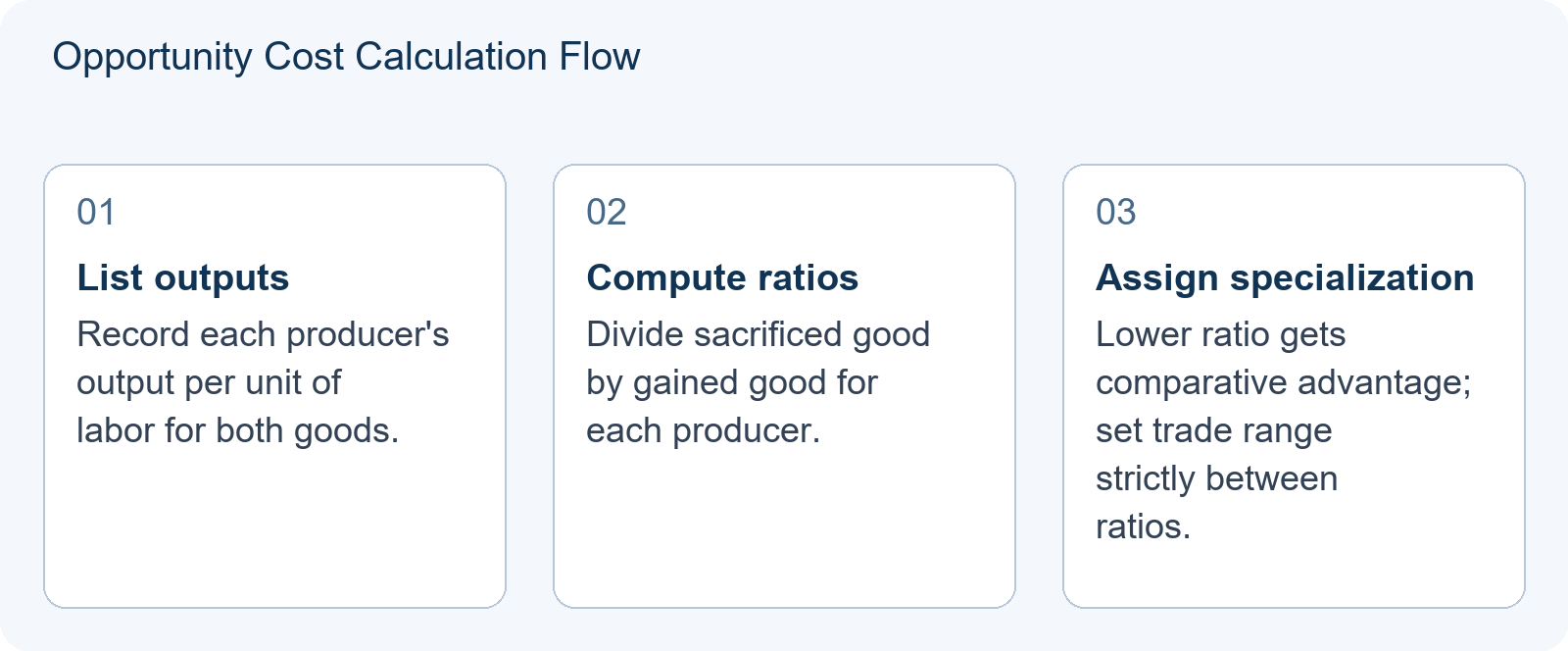
For two producers and two goods with constant linear production possibilities and full resource use, the procedure has three steps:
- Calculate the opportunity cost of each good for each producer.
- Identify which producer has the lower opportunity cost for each good.
- Allocate production accordingly and determine the mutually beneficial terms of trade.
Skipping step one and relying on raw output numbers leads to systematic errors. The following worked teaching illustration shows why.
Worked Teaching Illustration: Two Producers, Two Goods
Teaching illustration — not an official contest problem.
Consider two producers, Alpha and Beta, who can each allocate labor to wheat or cloth. The production possibilities per unit of labor are:
| Producer | Wheat (units) | Cloth (units) |
|---|---|---|
| Alpha | 10 | 5 |
| Beta | 6 | 4 |
At first glance, Alpha produces more of both goods. A student might conclude Alpha has nothing to gain from trade. This is the trap.
Step 1: Calculate opportunity cost of one unit of wheat in terms of cloth.
For Alpha: 10 wheat costs 5 cloth, so 1 wheat = 5/10 = 0.5 cloth.
For Beta: 6 wheat costs 4 cloth, so 1 wheat = 4/6 = 2/3 cloth.
Alpha has the lower opportunity cost for wheat (1/2 < 2/3). Alpha should specialize in wheat.
Step 2: Calculate opportunity cost of one unit of cloth in terms of wheat.
For Alpha: 5 cloth costs 10 wheat, so 1 cloth = 10/5 = 2 wheat.
For Beta: 4 cloth costs 6 wheat, so 1 cloth = 6/4 = 3/2 wheat.
Beta has the lower opportunity cost for cloth (3/2 < 2). Beta should specialize in cloth.
Step 3: Verify whether specialization yields gains and determine the terms of trade.
Without trade, if Alpha splits labor evenly, it produces 5 wheat and 2.5 cloth. If Beta splits evenly, it produces 3 wheat and 2 cloth. Total world output: 8 wheat, 4.5 cloth.
With full specialization, Alpha produces 10 wheat and 0 cloth; Beta produces 0 wheat and 4 cloth. Total world output: 10 wheat, 4 cloth. Wheat rises by 2 units; cloth falls by 0.5 units. This does not Pareto improve both baskets — cloth output falls. Without trade, Alpha would have 10 wheat and 0 cloth (more wheat but less cloth than its even split), and Beta would have 0 wheat and 4 cloth (less wheat but more cloth than its even split). Neither is unambiguously better off.
However, consider partial specialization: Alpha devotes 90% of labor to wheat and 10% to cloth, yielding 9 wheat and 0.5 cloth; Beta devotes all labor to cloth, yielding 0 wheat and 4 cloth. Combined output: 9 wheat, 4.5 cloth. This matches baseline cloth output and exceeds baseline wheat output by 1 unit.
Now trade can create mutual gain. At a rate of 0.6 cloth per wheat (equivalently, 5/3 wheat per cloth), trade 10/3 wheat for 2 cloth:
- Alpha ends with: 9 − 10/3 = 17/3 ≈ 5.667 wheat, and 0.5 + 2 = 2.5 cloth.
- Beta ends with: 10/3 ≈ 3.333 wheat, and 4 − 2 = 2 cloth.
Compare to baseline even-split baskets (Alpha: 5, 2.5; Beta: 3, 2):
- Alpha: 17/3 > 5 wheat and 2.5 = 2.5 cloth — weakly better off (more wheat, same cloth).
- Beta: 10/3 > 3 wheat and 2 = 2 cloth — weakly better off (more wheat, same cloth).
Any terms of trade strictly between the two opportunity costs — that is, between 1/2 and 2/3 cloth per wheat — can support mutually beneficial trade. The exact distribution of gains depends on preferences and bargaining, not on the production technology alone.
The Contrasting Case: Where the Same Numbers Mislead
Teaching illustration — not an official contest problem.
Now consider a superficially similar problem that produces the opposite conclusion if you apply the same mechanical steps without checking the arithmetic.
| Producer | Wheat (units) | Cloth (units) |
|---|---|---|
| Gamma | 8 | 2 |
| Delta | 9 | 6 |
Here Delta has an absolute advantage in both goods. The temptation is to assume Delta should produce everything. Let us check.
Opportunity cost of wheat:
Gamma: 2/8 = 1/4 = 0.25 cloth per wheat.
Delta: 6/9 = 2/3 ≈ 0.667 cloth per wheat.
Gamma has comparative advantage in wheat.
Opportunity cost of cloth:
Gamma: 8/2 = 4 wheat per cloth.
Delta: 9/6 = 3/2 = 1.5 wheat per cloth.
Delta has comparative advantage in cloth.
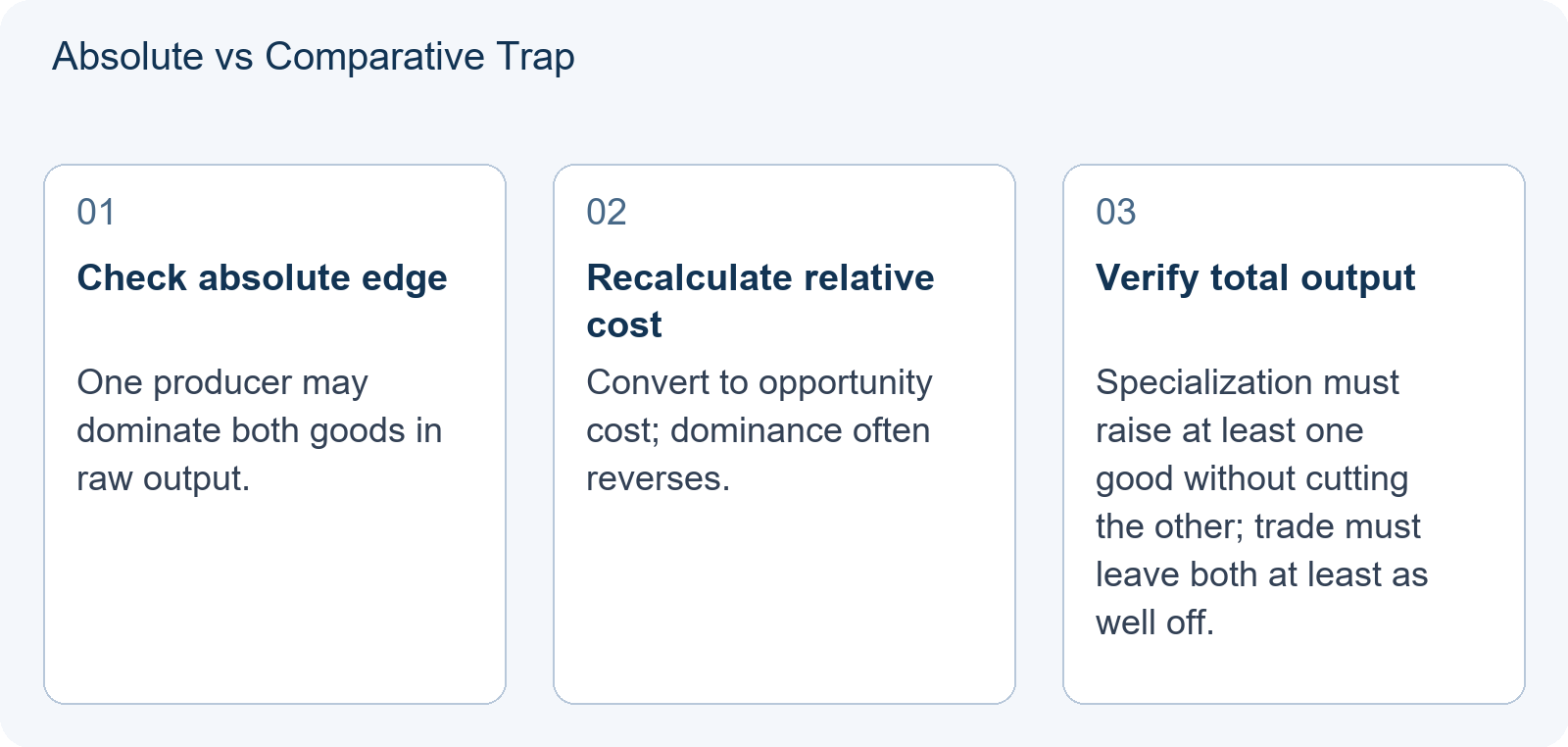
The surprising result: despite Delta’s absolute dominance, Gamma still holds comparative advantage in wheat because its disadvantage in cloth is even more severe. If a student allocated all production to Delta based on absolute advantage, total output would fall. With Gamma at 8 wheat and Delta at 6 cloth, the world gets 8 wheat and 6 cloth. If Delta tried to produce both, splitting labor to match Gamma’s wheat output of 8 would require 8/9 of Delta’s labor, leaving only 1/9 for cloth: 6 × 1/9 = 2/3 cloth. Total: 8 wheat and 2/3 cloth, far below the 6 cloth available under specialization.
This case is essential for NEC preparation because the test often presents producers with unequal absolute advantages and asks which trade pattern is efficient. The wrong answer—allocating everything to the apparently dominant producer—catches students who calculate ratios incompletely or reverse the numerator and denominator.
Common Calculation Errors and How to Catch Them
Three arithmetic mistakes appear frequently in practice:
- Reversing the ratio: Using output of good A over output of good B instead of the opportunity cost of good A in terms of good B. The correct form is: opportunity cost of X = (what you give up) / (what you gain). For wheat in terms of cloth, it is cloth given up divided by wheat gained.
- Comparing absolute outputs: Selecting the producer with higher raw output without converting to relative cost. This fails whenever absolute and comparative advantages diverge.
- Misidentifying the numeraire: Mixing up which good is the price and which is the quantity in the terms-of-trade range. The valid range for trade must lie strictly between the two producers’ opportunity costs.
A quick verification: after finding comparative advantage, check that the proposed specialization and trade pattern actually increases total output of at least one good without reducing the other below pre-trade levels, and that post-trade bundles make both parties at least as well off. If not, recalculate.
Diagnostic Practice: Apply the Method
Teaching illustration — not an official contest problem.
Try this problem before reading the solution:
Producer Epsilon can produce 4 computers or 8 tons of rice per worker. Producer Zeta can produce 3 computers or 9 tons of rice per worker. Which producer has comparative advantage in computers? What is the acceptable range for the terms of trade of one computer in terms of rice?
Solution:
Opportunity cost of one computer for Epsilon: 8/4 = 2 tons of rice.
Opportunity cost of one computer for Zeta: 9/3 = 3 tons of rice.
Epsilon has comparative advantage in computers (2 < 3). Zeta has comparative advantage in rice.
The terms of trade must satisfy both parties: more than 2 tons of rice per computer (Epsilon’s cost, so it demands at least this much) and less than 3 tons (Zeta’s cost, so it will pay no more). Valid range: 2 < rice per computer < 3.
Zeta’s comparative advantage here is rice, so assigning it to rice is consistent with the calculation. The error to avoid is deciding that result from raw computer output alone. Recompute the opportunity costs if either production capacity changes; the ratio comparison, not the initial impression, determines comparative advantage.
What Your Diagnostic Result Means for Next Steps
If you solved the diagnostic correctly in under three minutes, your opportunity-cost calculation is automatic. Your next task is speed under NEC time pressure: practice converting production tables to opportunity costs without writing full fractions, perhaps by noting that the lower ratio of (other good)/(this good) indicates comparative advantage directly.
If you hesitated or reversed the ratio, drill the definition: opportunity cost of X is what you sacrifice to get one more unit of X. Write it in words before calculating. Target ten verified problems where absolute and comparative advantage conflict, checking each answer against the total-output test.
If you misidentified the terms-of-trade range, focus on the inequality direction. The producer with comparative advantage in X will accept any price above its own cost; the trading partner will pay any price below its own cost of producing X. The overlap is the gains-from-trade region. Remember that for strict mutual gain, the price must be strictly between the two opportunity costs; equality leaves one party indifferent at best.
Connecting to Broader NEC Preparation
Comparative advantage questions in NEC rarely appear in isolation. They connect to How NEC Tests International Economics: Trade, Exchange Rates and the Balance of Payments, where tariffs and quotas alter the effective terms of trade; to NEC Opportunity Cost: Distinguishing Sunk Costs From the Next Best Alternative, where sunk costs must be separated from forward-looking decisions; and to NEC Economic News Analysis: Separating a Data Release From a Policy Explanation, where data releases about productivity or trade balances require interpretation through the comparative-advantage lens. The calculation method here is the foundation for those applications.
Preparing for Consultation: What to Bring
If you are considering personalized preparation support, come prepared with a specific comparative advantage problem you found confusing, your worked steps, and where your answer diverged from the solution. This allows focused diagnosis of whether the gap is conceptual (understanding the definition), procedural (calculation sequence), or strategic (application under time pressure). For self-study, prioritize verified practice problems with full worked solutions over volume of unchecked attempts.
Frequently Asked Questions
Can a producer have comparative advantage in both goods?
In the two-producer, two-good model with constant linear production possibilities, neither producer can have strictly lower opportunity cost in both goods. The opportunity costs are reciprocal. If the ratios are equal, neither has a strict comparative advantage. More general models require their own assumptions.
What if the terms of trade equal exactly one producer’s opportunity cost?
At exact equality, that producer is indifferent between trading and self-producing. For strict mutual gain, the terms of trade must lie strictly between the two opportunity costs. NEC questions typically ask for ranges, and the boundary case provides no strict gain for that party.
How does this apply when more than two goods or producers are involved?
With more goods or producers, compare opportunity costs together with resource constraints and the required output or demand. Pairwise comparisons can inform the analysis, but a separate ranking for every good need not produce a feasible or optimal allocation. State the model before generalising the two-by-two example.