The Specific Trap in NEC Opportunity Cost Questions
Opportunity cost is one of the most tested concepts in NEC, yet it produces a predictable mistake. Learners conflate sunk costs—resources already spent and irrecoverable—with the next best alternative they must now sacrifice. This article works through two teaching illustrations to isolate the error, shows where the shortcut fails, and offers a practice decision you can use immediately.
For structured review of your practice tests, see The NEC Error Log: How to Review a Practice Test So the Same Mistake Cannot Cost You Twice.
Case 1: The Manufacturing Decision
Scenario (Teaching Illustration)
A team must decide whether to continue producing a good or switch to a new product line. They have already spent ¥500,000 on specialized machinery with no resale value.
Step-by-step reasoning
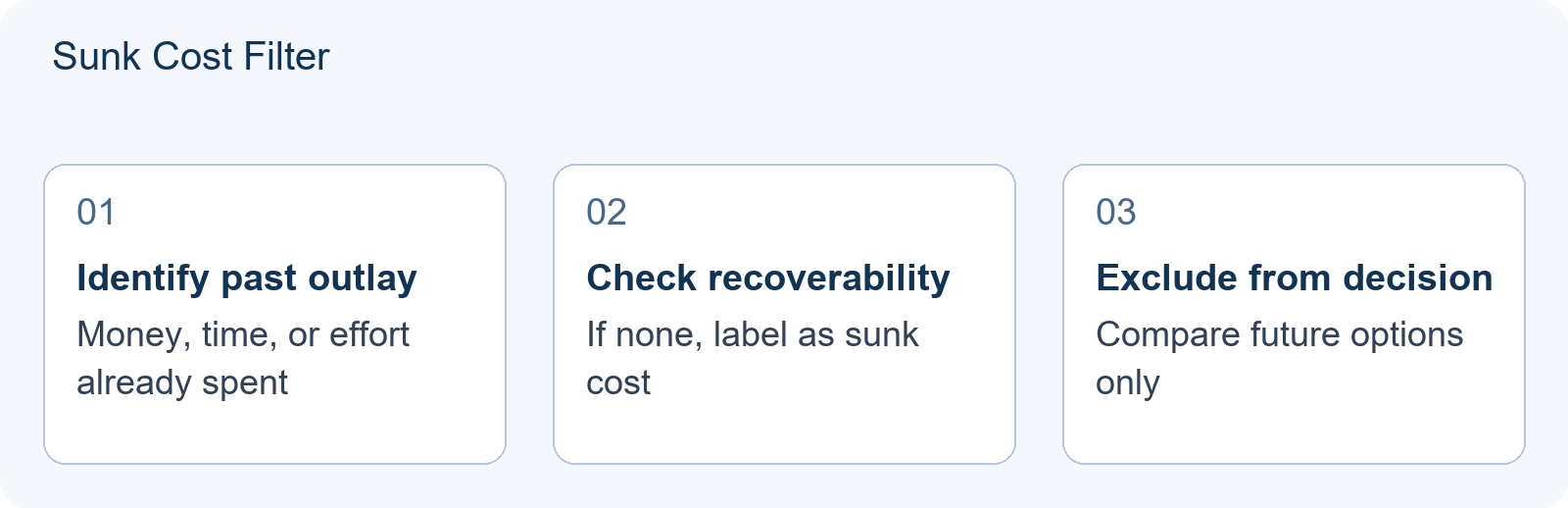
Step 1: Identify the decision point. The machinery is non-recoverable. In correct reasoning, this ¥500,000 is excluded from the current decision entirely.
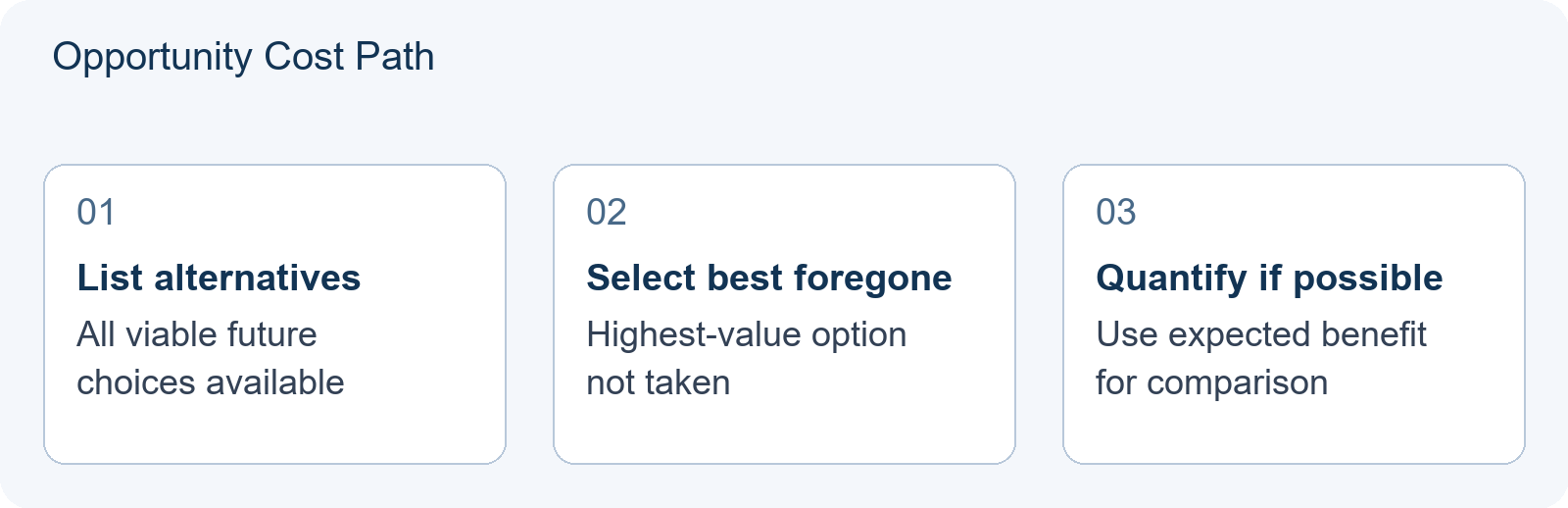
Step 2: Define the next best alternative. Suppose switching would yield ¥300,000 in net benefit, while continuing yields ¥200,000.
Step 3: Calculate opportunity cost. The opportunity cost of continuing production is ¥300,000—the foregone benefit of switching. The sunk ¥500,000 does not enter this calculation.
Correct decision: Switch. The ¥500,000 is gone regardless; only future differentials matter. Verification: ¥300,000 (switch benefit) > ¥200,000 (continue benefit), confirming switch is optimal.
Case 2: Where the Shortcut Fails
Scenario (Teaching Illustration)
A student preparing for NEC has spent 40 hours on macroeconomics review but feels weak in international economics. They consider reallocating remaining study time.
The tempting error
The student thinks: “I’ve already invested 40 hours in macro—I should finish it.” This treats sunk time as a reason to continue, violating the opportunity cost principle.
Correct application
Step 1: The 40 hours are irrecoverable. They are not part of the marginal decision.
Step 2: The next best alternative is using remaining time for international economics, where marginal improvement per hour may be higher.
Step 3: Opportunity cost of continuing macro review = the expected score gain from international economics study that is now foregone.
Key distinction from Case 1: Here the “sunk cost” is less visible (time, not money), so the error feels more natural. Competition questions often exploit this by embedding time-based or effort-based investments to test whether you mechanically exclude them. The psychological pull is stronger because personal investment of effort creates emotional attachment that monetary sunk costs may not.
Why Time-Based Sunk Costs Are Harder to Recognize
Research in behavioral economics consistently shows that individuals exhibit greater sunk cost fallacy with time investments than with monetary ones. For NEC competitors, this creates a specific vulnerability. When you have spent weekends on macroeconomics preparation, the thought of redirecting effort feels like waste. But this feeling is precisely the trap. The correct analytical move is identical regardless of investment type: strip away the irrecoverable, compare future options only.
The Critical Thinking Round particularly rewards this discipline. Under time pressure, your intuition will suggest honoring prior effort. Your trained response must override this: prior effort is gone; only comparative future returns matter.
Diagnostic Table: Sunk Cost vs. Opportunity Cost
| Feature | Sunk Cost | Opportunity Cost |
|---|---|---|
| Timing | Already incurred | Future-oriented |
| Recoverability | Non-recoverable | Hypothetical benefit given up |
| Decision relevance | Ignore it | Central to comparison |
| Common trap | “We must continue because we spent…” | “What do we sacrifice by choosing X?” |
| Example from cases | ¥500,000 machinery; 40 hours spent | ¥300,000 switch benefit; international economics gain |
A Practice Decision for Your Preparation
Try this teaching illustration: Your team has prepared extensively for one NEC round format, but preliminary scores suggest stronger potential in another round. You have limited remaining preparation hours.
Question: What is the opportunity cost of additional practice in your stronger round?
Self-check: If your answer includes “hours already spent,” re-examine. Those hours are sunk. The correct answer must identify the expected improvement in the other round that you forego by not reallocating that time.
For planning how NEC rounds fit your competition calendar, see NEC Global Round Singapore 2027: What the New Asia Stop Actually Adds to Your Calendar.
For deciding whether specialized tracks match your team, see NEC Herbert Simon Division AI Track: Deciding Whether It Fits Your Team.
For understanding solo versus team entry options, see NEC Pre Division Personal Entry: Should You Compete Solo or Wait for a Team in 2027.
Team-Level Application
The same logic applies when teams debate resource allocation. Suppose three members spent weeks on Quiz Bowl preparation while one member advocated for Critical Thinking Round focus. The team faces a decision: continue Quiz Bowl emphasis or reallocate. The correct analysis excludes all prior preparation time as sunk. The decision rests solely on which remaining path offers higher expected marginal return given current skill profiles and competition structure. This can feel harsh in team dynamics, but it is the only analytically defensible approach.
What You Should Demonstrate Next
After working through these cases, you should be able to: (1) automatically exclude sunk costs when reading any scenario, (2) articulate the next best alternative in concrete terms, and (3) apply this consistently under time pressure when the investment type shifts from monetary to temporal or effort-based.
Frequently Asked Questions
Why do competition questions keep using time-based sunk costs instead of money?
Time-based investments feel more psychologically salient, so they test whether you apply the principle mechanically rather than letting intuition override the rule.
Can opportunity cost ever include a sunk cost indirectly?
No. The entire analytical point is that sunk costs are definitionally excluded. If you find yourself including one, you have likely misidentified what is actually being sacrificed.
How does this apply to team decisions when members disagree on prior effort?
The same principle holds at team level. Prior effort by any member is sunk. The decision should rest on which remaining preparation path maximizes expected performance, not on who did what before.