
How hard is the National Economics Challenge (NEC)? Honestly: the difficulty is not one number — it is a gradient. The economics stays the same across all three divisions; what scales is depth of recall, speed under a clock, and how much applied reasoning you must improvise live. Most students overestimate the content and underestimate the format. This piece maps where the real spikes are so you can place yourself.
Two difficulty axes, not one
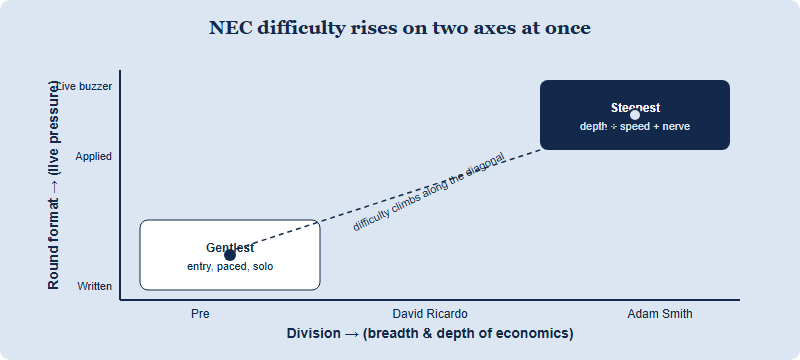
When students ask “is NEC hard?”, they are usually asking about content depth. But NEC difficulty actually moves along two independent axes, and treating them separately is the key to an honest self-assessment. The first axis is the division you enter — Pre, David Ricardo, or Adam Smith — which sets the breadth and depth of economics expected of you. The second axis is the round format, because the same economics question is far harder to answer on a live buzzer than on a written paper you can pace yourself through.
For context: the NEC is run by the Council for Economic Education (CEE), a non-profit founded in 1949, and reaches roughly 10,000 students a year in the United States. The CEE sets the official academic standard across microeconomics, macroeconomics, and world / international economics. In China, the National Round is operated as CNEC by Hanlin (SKT) — the officially authorized China test center since 2016, now spanning 20+ provinces and 300+ schools, and the only official path from China onto the NEC global rounds. The difficulty calibration below is our operator read; the binding rules, division definitions, scoring weights and dates always sit with the CEE and the official CNEC channels, because formats can change season to season.
Axis 1: the division gradient
The three divisions are scaled by experience rather than by age or grade alone, and the jumps between them are uneven — the gap is not linear. Here is the candid read on each rung.
- Pre (entry): the on-ramp, and genuinely the gentlest. It can be entered as an individual or a small team of 2–4, and it is built for students new to formal economics. The content rarely outruns a careful first pass through micro and macro. The honest difficulty here is mostly about nerve and unfamiliarity, not depth — a motivated student with no prior coursework can place themselves here without fear.
- David Ricardo (intermediate): a required team of four, positioned for first-time competitors with limited prior coursework. The step up from Pre is real but moderate: you are now expected to hold micro and macro at exam-grade depth, and you depend on three teammates, so the difficulty becomes partly a coordination problem. This is where most school teams should honestly start.
- Adam Smith (advanced): the advanced track, also a required team of four, with no eligibility barrier — which is exactly the trap. Because anyone may enter Adam Smith, ambitious students self-select into it before they are ready. The genuine spike is the world / international economy layer added on top of micro and macro, plus a field of returning, AP/IB-fluent competitors. The content ceiling and the competitor quality both rise at once.
The most common self-placement mistake we see is jumping to Adam Smith for the prestige of “advanced.” If you have not yet covered international economics with any rigour, the Adam Smith content gap will cost you more points than the division name will ever earn back. Place by your weakest teammate’s preparation, not your strongest.
| Division | Content scope | Team size | Where the difficulty really sits |
|---|---|---|---|
| Pre (entry) | Micro + macro, foundational | Individual or 2–4 | Unfamiliarity & nerves, not depth |
| David Ricardo (intermediate) | Micro + macro at exam depth | Team of 4 | Exam-grade recall + team coordination |
| Adam Smith (advanced) | Micro + macro + world economy | Team of 4 | Extra subject + strong returning field |
Axis 2: the round gradient
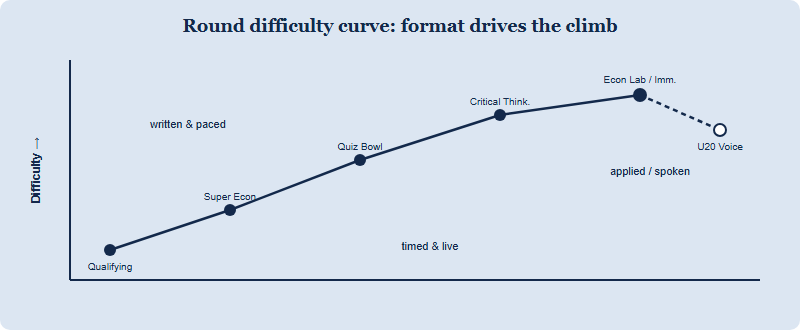
Hold the division fixed and the difficulty still swings widely depending on the round format. The NEC is built from seven events — Qualifying Test, Super Econ, Quiz Bowl, Critical Thinking, Econ Lab, Econ Immersion and U20 Youth Voice — and they sit on a clear difficulty curve. The driver of that curve is not how much economics each round tests; it is how little time and how much improvisation each one demands.
The Qualifying Test is the most “studyable” and therefore the most controllable round: it is an individual written assessment over the full syllabus, and systematic coverage reliably converts into marks. Difficulty then climbs through the timed and live formats — Super Econ rewards fast retrieval rather than careful derivation, and Quiz Bowl, the live buzzer round, adds nerve and team coordination on top of recall. The applied family — Critical Thinking, Econ Lab, Econ Immersion — sits at the top for most students because you cannot pre-memorise your way through; you must structure an argument or interpret data on the spot. U20 Youth Voice shifts the difficulty again, toward communication and rehearsed delivery rather than raw economics.
Putting the two axes together: a self-placement test
Combine the axes and your honest difficulty is the diagonal: a Pre student on the Qualifying Test faces the gentlest corner of NEC, while an Adam Smith team in a live applied round faces the steepest. Use these four questions to place yourself before you register through CNEC rather than after:
- Coverage check: Have you covered micro and macro at exam depth? If not, start at Pre or David Ricardo — division prestige will not rescue a content gap.
- The international economy test: Can your whole team reason about trade, exchange rates and global linkages, not just one strong member? If not, Adam Smith's extra layer will be your scoring leak.
- Speed vs. depth: Are you strong on a written paper but slow on a buzzer? Then your real training target is the live rounds, not more reading — your difficulty is on the format axis, not the content axis.
- Weakest-link audit: A team is only as strong as its lowest scorer on the shared written gate. Place by that person's readiness.
The reassuring conclusion from years of running the China round: NEC is hard in a predictable way. The content does not ambush prepared students; the difficulty spikes are in known places — the world-economy layer of Adam Smith, and the live, improvised rounds. Once you can name which axis is your bottleneck, the competition stops feeling like a wall and starts feeling like a map. For the current division and round structure, confirm details on the official CNEC channels before you commit a study plan to any of the calibrations above.
Frequently asked questions
Is the NEC content harder than AP or A-Level economics?
Not usually in raw content — the spike is the live, timed rounds and (in Adam Smith) the added world-economy layer, not the underlying theory.
Which NEC division is the hardest?
Adam Smith, because it adds international economics on top of micro and macro and draws the strongest returning field. Confirm division definitions on the official CNEC pages.
What is the single hardest round?
For most students the live applied rounds (Critical Thinking, Econ Lab, Econ Immersion), since you cannot pre-memorise them. Exact round mechanics vary by season.
Should beginners avoid the NEC?
No. The Pre division is a genuine on-ramp for students new to economics; difficulty there is mostly unfamiliarity, not depth.
Published by the NEC / CNEC editorial desk, operated by Hanlin Education as the officially authorized China National Economics Challenge (CNEC) test center. The NEC is run by the Council for Economic Education, which sets the official rules — always confirm current dates, divisions, fees and awards on the official CNEC channels. Any error is corrected within 7 working days.