
The National Economics Challenge (NEC) tests monetary policy as a chain of cause and effect, not a slogan. You have to know that the money market sets the interest rate where money demand meets a central-bank-controlled money supply, that the central bank moves that rate with a small set of tools, and that a change in the rate transmits through borrowing, investment and spending to output and the price level. The marks live in getting that sequence — and its direction — exactly right.
The money market: where the interest rate is set
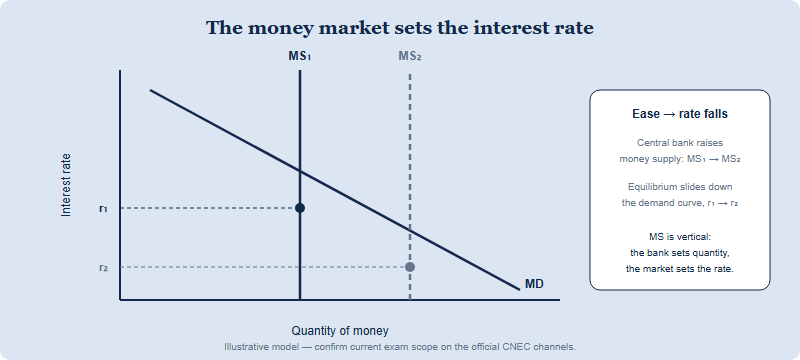
NEC monetary-policy items almost always start from one diagram: the money market. The demand for money slopes downward against the interest rate, because the rate is the opportunity cost of holding cash rather than interest-bearing assets — when rates are high, you hold less money. The supply of money is drawn as a vertical line, because the central bank, not the market, decides its quantity. The interest rate is simply the price that clears that market: the point where money demand crosses money supply.
From there, the examinable moves are predictable. If the central bank increases the money supply, the vertical line shifts right and the equilibrium interest rate falls; if it decreases the money supply, the rate rises. Money demand can also shift — a rise in real output or the price level raises the transactions demand for money and pushes rates up at any given supply. The Council for Economic Education (CEE), which founded in 1949 and sets the academic standard the NEC is built on, treats this market as core macroeconomics alongside the micro and world-economy material; you can see where these topics sit on the CNEC home page. Three distinctions earn marks and seed most distractors:
- Money supply is a vertical line — it does not respond to the interest rate, because the central bank fixes the quantity. Students who draw it upward-sloping lose the item.
- The interest rate is a price, not a policy dial the bank sets directly — the bank moves the supply, and the market translates that into a rate.
- Nominal versus real rate — monetary policy works on nominal rates in the short run, but borrowing decisions turn on the real rate (the nominal rate adjusted for expected inflation).
| Central bank action | Money supply curve | Equilibrium interest rate |
|---|---|---|
| Expansionary (ease) | Shifts right | Falls |
| Contractionary (tighten) | Shifts left | Rises |
| Output or price level rises | Unchanged; demand shifts right | Rises |
The three tools: how a central bank moves the rate
Once the market is clear, NEC items test how the central bank shifts the money-supply line. The textbook framework the CEE syllabus leans on gives a central bank three tools, and a discriminating question expects you to know both the mechanism and the direction of each. Open-market operations are the day-to-day workhorse: when the central bank buys government securities it pays banks with new reserves, expanding the money supply and lowering rates; when it sells securities it drains reserves and raises rates. The reserve requirement sets the fraction of deposits banks must hold rather than lend; lowering it frees banks to lend more and expands money, while raising it contracts. The discount rate (the rate the central bank charges banks to borrow reserves directly) works as a signal and a backstop: a lower discount rate encourages bank borrowing and easier credit.
Two further concepts surface in the harder rounds. The money multiplier explains why a small injection of reserves can support a larger change in the money supply: in a simple model it is roughly the reciprocal of the reserve ratio, so a 10% requirement implies a multiplier of about ten. And examiners distinguish expansionary from contractionary policy throughout — not as labels but as packages, because every tool can be pushed in either direction. A strong answer pairs the tool with its direction and its effect on the rate, rather than reciting a list.
- Open-market operations — buy securities to ease (more money, lower rates); sell to tighten. The most frequently used tool.
- Reserve requirement — lower it to expand lending and money; raise it to contract. Blunt but powerful.
- Discount rate — lower it to encourage bank borrowing and signal ease; raise it to discourage and signal restraint.
| Tool | To ease (expand money) | To tighten (contract money) |
|---|---|---|
| Open-market operations | Buy government securities | Sell government securities |
| Reserve requirement | Lower the required ratio | Raise the required ratio |
| Discount rate | Lower the rate | Raise the rate |
The transmission chain: from a policy rate to output and prices
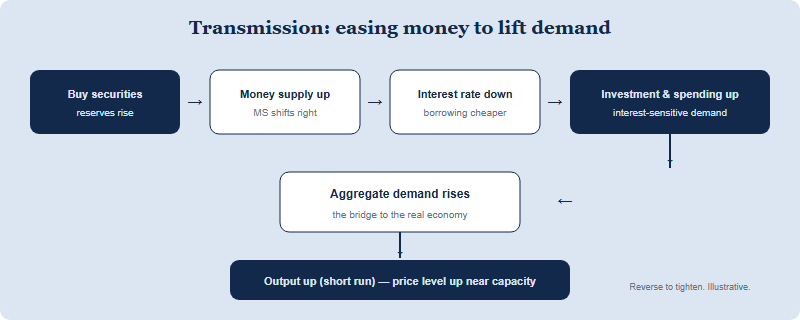
The skill that separates strong NEC competitors is tracing the transmission mechanism — the full chain from a tool to the real economy — without dropping a link or reversing a sign. The expansionary chain runs: the central bank buys securities, which raises bank reserves and the money supply, which lowers the interest rate, which makes borrowing cheaper, which raises interest-sensitive investment and consumption, which raises aggregate demand, which raises real output and (as the economy nears capacity) the price level. The contractionary chain is the same sequence run in reverse. Examiners love to hand you the first step and ask for the last, or give you the goal ("cool an overheating economy") and ask which tool and direction get you there.
Two qualifications mark a top answer. First, monetary policy is widely framed as working through interest-sensitive spending — business investment and big-ticket consumer borrowing react most, which is why the investment link is the heart of the chain. Second, the textbook view holds that monetary policy operates with time lags and that its effects are stronger on output in the short run than in the long run, where output returns toward its potential and the lasting effect is on the price level. These are the framings examiners reward; the specific magnitudes and any country-specific institutional details should always be checked against current official material rather than assumed. For how these macro threads connect across the syllabus, see the CNEC editorial section.
How central-bank scenarios appear across the NEC rounds
Monetary policy is not confined to one part of the competition; it surfaces in different forms across the seven rounds — Qualifying Test, Super Econ, Quiz Bowl, Critical Thinking, Econ Lab, Econ Immersion and U20 Youth Voice — and the skill the round prizes changes the kind of question it sets. In the timed multiple-choice and buzzer rounds, expect crisp directional items: which tool eases credit, which way the rate moves when the bank sells securities, what a lower reserve requirement does to the money multiplier. In the analytical and applied rounds, expect a central-bank scenario you must reason through — an economy in recession or overheating, and a prompt to choose a policy, trace its transmission, and weigh its lags and limits.
For a China team preparing through CNEC — the official China National Round, operated by Hanlin (SKT) since 2016 across 20+ provinces and 300+ schools, and the only official path from China into the NEC global rounds — the practical implication from running the round is concrete. The recurring slip our CNEC teams make is not naming the tools; it is reversing a link or stopping the chain too early — saying rates fall but never reaching investment, or treating the price-level effect as automatic rather than capacity-dependent. We coach teams to rehearse the transmission chain out loud, both directions, until each arrow is reflexive, and to always close the loop to output and prices. Round formats and weightings can change between seasons, so confirm the current structure on the official CNEC channels before building a prep plan around it.
- Directional register — match each tool to its effect on money and the rate, and read the money-market diagram both ways. Train to reflex for the buzzer.
- Chain register — trace the full transmission from tool to output and prices without dropping a link, in either direction.
- Judgement register — in open rounds, name the lags and limits: monetary policy acts on interest-sensitive spending, with a delay, and a long-run effect that leans on prices.
FAQ
How does a central bank lower the interest rate?
It increases the money supply — usually by buying government securities — which shifts the vertical supply line right, so the rate where it meets money demand falls.
What are the three monetary-policy tools NEC tests?
Open-market operations (buying or selling securities), the reserve requirement, and the discount rate. Each can be pushed to ease or to tighten.
What is the monetary-policy transmission mechanism?
The chain from a tool to the economy: money supply changes the rate, which changes investment and spending, which moves aggregate demand, output and prices.
Why is the money supply curve drawn vertical?
Because the central bank fixes the quantity of money; it does not vary with the interest rate, so the market sets the rate while the bank sets the quantity.
Published by the NEC / CNEC editorial desk, operated by Hanlin Education as the officially authorized China National Economics Challenge (CNEC) test center. The NEC is run by the Council for Economic Education, which sets the official rules — always confirm current dates, divisions, fees and awards on the official CNEC channels. Any factual error will be corrected within 7 working days.