
For the National Economics Challenge, the most efficient text for most students is Mankiw's Principles of Economics, read in a deliberate order rather than cover to cover: the micro half first, the macro half second, and an international block last — each chapter block closed with practice before you move on. This plan tells you which chapters carry the most NEC weight, the sequence that builds correctly, and how to turn passive reading into recall.
Why a reading plan beats reading cover to cover
A standard principles textbook is long, and the National Economics Challenge does not test every page equally. The NEC is run by the Council for Economic Education (CEE, founded 1949), draws roughly 10,000 students a year in the United States, and examines three content areas: microeconomics, macroeconomics and the world / international economy. The CEE sets that academic standard; from China, the official route into the competition is CNEC, the China National Round operated by Hanlin (SKT) since 2016 across 20+ provinces and 300+ schools, and the only official path to the NEC global rounds. None of that changes the syllabus — but it does mean your reading should be aimed at those three areas, not spread evenly across a 600-page book.
Mankiw's Principles of Economics earns its place as the default text because its structure maps almost one-to-one onto the NEC's content areas, and because it explains models in plain language before formalising them — ideal for a student who is reading to compete, not to pass a specific course. The reading plan below is organised around that book's familiar parts. Other standard texts (Krugman & Wells, McConnell, or your school's AP/A-Level text) cover the same ground and slot into the same sequence; if you already own one of those, you do not need to buy Mankiw — read the equivalent chapters in the same order.
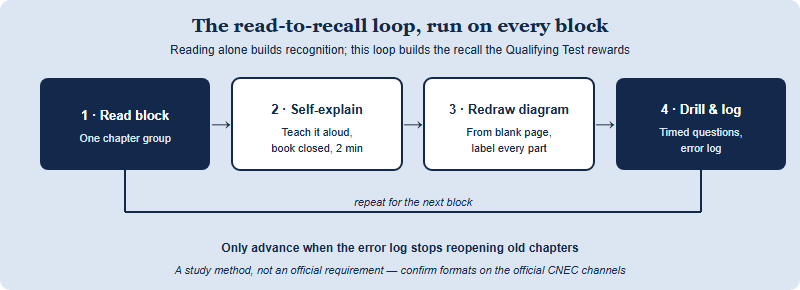
One rule governs the whole plan: read in blocks, then practise the block before advancing. Reading three chapters and moving on without testing yourself produces recognition, not recall — and the Qualifying Test that every team member sits rewards recall under time. Treat each block below as “read → self-explain → drill,” and only then turn the page.
The order that builds correctly: micro before macro before world
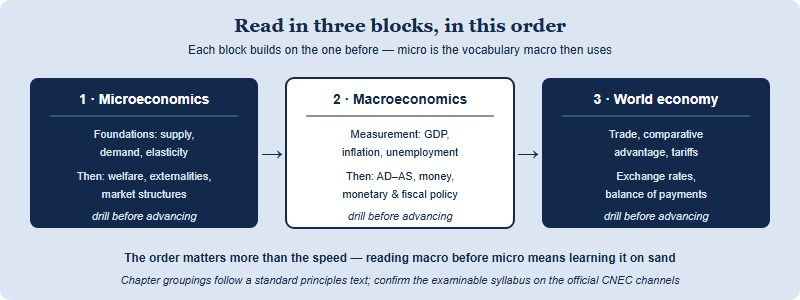
Sequence matters more than speed. Microeconomics underpins everything: supply, demand, elasticity and market structures are the vocabulary macroeconomics then uses, so reading macro first means learning it on sand. Within micro, foundations (how markets clear) come before applications (welfare, externalities, market structures). Macroeconomics follows — measurement (GDP, inflation, unemployment) before the models that move those measures (aggregate demand and supply, monetary and fiscal policy). The world / international economy comes last, because it assumes you already understand both halves: trade and exchange rates are micro and macro applied across borders.
The chapter map: what carries the most NEC weight
Within each block, some chapters are load-bearing and some are context. The table below groups a standard principles text (Mankiw's parts, or the equivalent in Krugman & Wells or your AP/A-Level book) into the NEC's three content areas and flags where to spend the most reading time. Use it as a priority map, not a ceiling: if your diagnostic shows a gap, read the surrounding context chapters too. Exact examinable topics should always be confirmed against the official CNEC syllabus, since emphasis can shift by season and division.
| NEC content area | Standard-text chapter block | Highest-leverage topics to master | Priority |
|---|---|---|---|
| Microeconomics | Market foundations | Supply & demand, price elasticity, consumer/producer surplus | Read first · very high |
| Microeconomics | Markets & welfare / firm behaviour | Externalities, public goods, the four market structures (perfect competition → monopoly) | High |
| Macroeconomics | Measuring the economy | GDP, CPI & inflation, unemployment, real vs nominal values | Read before models · very high |
| Macroeconomics | Short-run models & policy | Aggregate demand & supply, the money market, monetary & fiscal policy | High |
| World / international | The open economy | Comparative advantage, gains from trade, tariffs & quotas, exchange rates, balance of payments | Read last · medium–high |
Two reading habits multiply the value of these chapters. First, own the diagrams, not just the prose. Economics is a visual subject: a supply-and-demand shift, an AD–AS diagram, a cost-curve family, a tariff's welfare triangle. For each key chapter, be able to redraw the central diagram from memory and label every axis and area — that single skill carries across the Qualifying Test and the applied rounds alike. Second, keep a one-page sheet of definitions and formulas per block — elasticity, the GDP identity, the quantity theory, the multiplier — built in your own words as you read. Building the sheet is the learning; the sheet itself is just the by-product you revise from later.
Turning reading into recall: pair every block with practice
A reading plan that ends at “I read it” fails the competition. Each block should close with a deliberate practice loop that converts pages into points. The cycle is the same regardless of which text you use, and it is where reading becomes competition-ready:
- Self-explain. After each chapter, close the book and explain the core model aloud in two minutes as if teaching it. If you stall, that chapter is not done — reread the section you stumbled on, not the whole chapter.
- Redraw the diagram. Reproduce the chapter's central diagram from a blank page and label it fully. Diagram fluency is the cheapest marks in the syllabus and the easiest to lose under time.
- Drill end-of-chapter and past-style questions. Work the textbook's own problems, then timed multiple-choice and short-answer sets across the block, so recall speeds up before you add the next topic.
- Log every error. Keep a running list of what you got wrong and why. When the same mistakes stop reappearing, the block is genuinely closed; when new chapters keep reopening old errors, you read too fast.
Beyond the textbook: reading that adds the marks a textbook can't
A principles text gives you the models; the NEC's applied and current-events material asks you to use them on the real world. Once your three blocks are solid, widen your reading deliberately — but keep it disciplined, because unfocused news reading is a time sink. Read one quality economics source regularly (a serious newspaper's economics section, or a central-bank or institutional explainer) and, for each piece, name the textbook concept it illustrates: a rate decision is monetary policy and AD–AS; a trade dispute is comparative advantage and tariffs. That “spot the model” habit is what separates a student who memorised definitions from one who can deploy them in the Critical Thinking and applied rounds.
A note on question-setters, since students often ask: the organiser's materials name well-known economists — Mankiw and Shiller among them — in connection with the competition. Treat that as an organiser claim to confirm officially rather than a reason to read any one author exclusively. What matters for your preparation is mastering the standard principles syllabus those economists teach, not chasing a particular name. The CEE sets the academic standard; the safest anchor for “what is examinable” is always the official CNEC channels.
From running the China National Round since 2016, the reading mistake we see most is not choosing the wrong book — it is reading the right book passively. Students arrive having “finished Mankiw” but unable to redraw an AD–AS diagram under time or explain elasticity aloud, because they read for recognition, not recall. The fix is structural, not heroic: smaller blocks, the four-step loop on every one, and the diagram drawn from a blank page. To see which content areas each division leans on as you build your reading plan, start from our CNEC overview, and map your blocks onto the live competition with our preparation resources. The reading plan is yours to own; the official syllabus, divisions and rules stay with the CEE and CNEC — confirm them on the official CNEC channels.
Frequently asked questions
Is Mankiw enough to prepare for the NEC?
For the core micro, macro and world-economy content, a standard principles text like Mankiw covers it well — but only if read in blocks and paired with timed practice, not read passively.
What order should I read the chapters in?
Microeconomics first, then macroeconomics, then the world / international economy. Macro and trade both build on micro, so reading them first means learning on shaky foundations.
Do I have to use Mankiw specifically?
No. Krugman & Wells, McConnell or your AP/A-Level text cover the same syllabus. Read the equivalent chapters in the same micro → macro → world order.
Which chapters matter most for the NEC?
Market foundations and elasticity in micro, and GDP, inflation and AD–AS in macro, carry the most weight. Confirm the examinable syllabus on the official CNEC channels.
Published by the NEC / CNEC editorial desk, operated by Hanlin Education as the officially authorized China National Economics Challenge (CNEC) test center. The NEC is run by the Council for Economic Education, which sets the official rules — always confirm current dates, divisions, fees and awards on the official CNEC channels. Any factual error will be corrected within 7 working days.