
The Econ Immersion round is the National Economics Challenge’s scenario-based, experiential event: instead of recalling definitions or crunching a dataset, a team is dropped into a richer real-world situation and asked to apply economic thinking in context. It rewards transfer — spotting which economic ideas are in play in an unfamiliar case and reasoning through them under time pressure. This article explains what the round involves and how to approach it.
What the Econ Immersion round actually is
The National Economics Challenge (NEC) is run by the Council for Economic Education (CEE), founded in 1949, and it tests microeconomics, macroeconomics, and the world/international economy across roughly 10,000 US students each year. CNEC — the China National Economics Challenge, operated by Hanlin (SKT) since 2016 across 20+ provinces and 300+ schools — is the official China National Round and the only official path from China to the NEC global rounds. Econ Immersion sits within that round structure as one of the applied, presentation-style events rather than a written exam.
As the name suggests, Econ Immersion drops a team into a scenario or experiential task and asks them to apply economic reasoning to it, rather than answer abstract questions. The skill it isolates is transfer: looking at a new market, a policy shift, or a real-world case the team has never seen, and recognising which economic concepts the situation is actually about. A student can know every definition of price elasticity and still freeze when an unfamiliar scenario quietly turns on it; Econ Immersion is built to find — and reward — the students who don’t freeze.
Because the exact mechanics of any single round can change from season to season, treat the description here as a working model of how a scenario-based, experiential round of this kind tends to run. Always confirm the current format, time allowance, deliverable and scoring for Econ Immersion on the official CNEC channels before you prepare — start from the round overview on the CNEC home page.
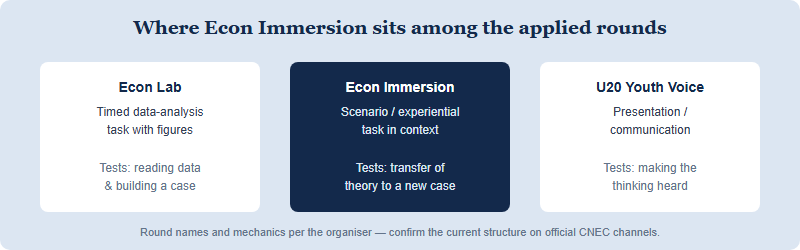
Immersion vs. Lab: why these two applied rounds are not the same
Students often blur Econ Immersion and Econ Lab because both are “applied” and neither is a multiple-choice exam. But they reward different muscles, and training them as one thing is a common mistake. Econ Lab hands you figures and asks you to interrogate them — deflate a nominal series, find the mechanism, defend a recommendation built on the numbers. Econ Immersion hands you a situation and asks the prior question: which economic ideas does this case even turn on? One is analysis of given data; the other is recognition and transfer in a context where the relevant theory is not labelled for you.
| Dimension | Econ Immersion | Econ Lab |
|---|---|---|
| Core skill | Transfer — map theory onto a new case | Analysis — turn data into an argument |
| What you’re given | A scenario / experiential situation | A dataset around an annual theme |
| First question | “Which concepts are in play here?” | “What do these figures actually say?” |
| Failure mode | Forcing a familiar model that doesn’t fit | Reporting numbers without a mechanism |
| How to train it | Breadth of varied scenarios; name the concept each time | Repeated data drills; deflating, comparing, defending |
The practical takeaway: a team can be excellent at Econ Lab and still under-perform in Econ Immersion if it has only ever practised on labelled, data-heavy prompts. Recognition is its own skill. Note, too, that the precise way each round is run is set by CNEC and can shift year to year — the contrast above is about the kind of thinking each rewards, not a fixed rulebook.
How a transfer-style scenario tends to unfold
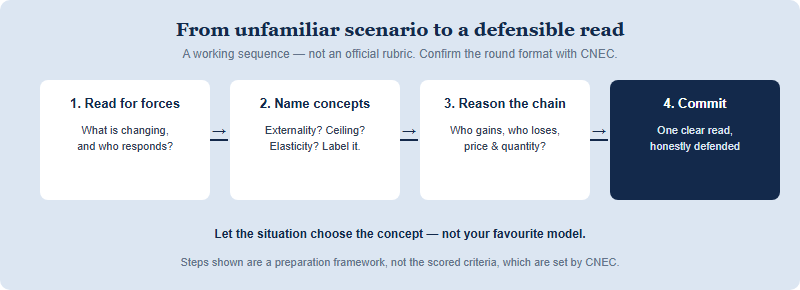
Whatever the exact prompt, a scenario-based economics task of this type usually moves through four mental steps. Knowing the shape stops a team from staring at an unfamiliar case wondering where to begin.
- Read the situation, not for facts but for forces. Skim the scenario once asking a single question: what is changing, and who responds to it? A new tax, a supply shock, a platform entering a market — each one is an economic force wearing everyday clothes.
- Name the concepts out loud. Explicitly label what you see: “this is a negative externality,” “this is a price ceiling,” “this is income elasticity at work.” Putting a name on the mechanism is the act the round is testing.
- Reason through the chain. Trace what the named concept predicts — who gains, who loses, what happens to price, quantity, or welfare — and check it against the specifics of the scenario rather than the textbook diagram.
- Commit to a defensible read. Scenarios are deliberately ambiguous, so there is rarely one “right” answer. Judges reward a clear interpretation, honestly reasoned, over a hedged list of every concept you can remember.
The trap that sinks otherwise strong economists is the opposite of not knowing enough: it is reaching for the most familiar model and forcing the scenario to fit it. A team that has drilled monopoly hardest will see monopolies everywhere. Econ Immersion rewards the discipline to let the situation choose the concept, not the other way round.
A short illustration: the same scenario, two reads
To make “transfer” concrete, picture an Econ Immersion-style prompt: a city introduces a flat per-ride fee on a popular bike-share scheme to fund road repairs, and ridership falls more sharply among low-income commuters than the planners expected. The example below is illustrative — invented to show the reasoning, not real CNEC material — but the moves are the ones the round rewards.
A surface read says, “the fee reduced demand; demand curves slope down.” True, but thin. A transfer-literate team names more than one concept and lets the scenario discipline the choice: the steeper drop among low-income riders points to price elasticity varying by income group; funding repairs through the fee raises a question of tax incidence (who really bears the cost); and a possible knock-on rise in car use hints at a negative externality the policy may have worsened. The winning answer doesn’t list all three as trivia — it picks the one or two that best explain the specific outcome described and reasons them through. That selectivity, under ambiguity, is exactly the skill Econ Immersion isolates and the written exams never test.
How to prepare — and where a China team has an edge
Because Econ Immersion tests recognition rather than recall, you train it with breadth and reps, not by re-reading one textbook chapter. CNEC’s David Ricardo (intermediate) and Adam Smith (advanced) divisions compete as teams of four, while the Pre division can enter individually or in small groups — so for most competitors this is also a team-coordination skill. A few habits travel well across any season’s format:
- Build a scenario diet. Work through varied cases — a new market, a policy change, a real-world news story — and, every single time, force the team to name the economic concepts in play before discussing anything else.
- Keep a concept-trigger list. For each core idea (externalities, elasticity, price controls, public goods, information asymmetry), write the one or two “tells” that signal it’s present. Recognition speeds up when you know what to look for.
- Practise picking, not piling. Rehearse committing to one or two relevant concepts and defending the choice, rather than reciting everything. Judges read a focused argument as confidence; a long list as uncertainty.
- Rotate who leads the read. In a team round, the strongest interpretation sometimes comes from the quietest member. Give each student turns at “naming the forces” so the team isn’t hostage to one person’s pattern-matching.
This is where the CNEC route is genuinely useful rather than just convenient. Recognition and transfer are hard to self-teach because they need feedback on judgement — someone to say “you forced monopoly there; the scenario was really about a price ceiling.” Mentored practice can rehearse the read-name-reason sequence on dozens of fresh scenarios before competition day, which is precisely the part a student cannot cram alone the night before. For how Econ Immersion fits with the written exams, Quiz Bowl, Critical Thinking and Econ Lab across the David Ricardo and Adam Smith divisions, start from the CNEC overview and confirm the current-season round line-up before building a study plan around it.
What a strong Econ Immersion performance looks like
Exact scoring criteria for Econ Immersion are set by CNEC and should be confirmed officially. But the qualities that distinguish strong applied, scenario-based economics are consistent, and worth aiming a team at:
- The right concept, named clearly. Identifying the economic idea the scenario actually turns on — and saying so plainly — beats a vaguer answer that gestures at “supply and demand.”
- Reasoning that fits the specifics. The chain of logic should track the details of this case, not recite the generic textbook story. Judges notice when an answer would apply to any scenario equally — that usually means it engaged with none.
- A committed, honest read. Under ambiguity, a clear interpretation with its limits acknowledged reads as economic maturity. Hedging across every possibility reads as not having decided.
- Discipline over display. Bringing in three concepts where one explains the outcome dilutes the answer. Restraint — the right idea, well reasoned — is the mark of a team that understands transfer.
Treat Econ Immersion as the round that asks, “can you actually use what you know when nobody labels it for you?” That is the same question top-university economics interviews and supervisions ask — which is why the skill it builds outlasts the competition itself.
Frequently asked questions
Is the Econ Immersion round a written exam?
No. Per the organiser it is a scenario-based, experiential round where a team applies economic thinking to a real-world situation, separate from the micro, macro and international written exams.
How is Econ Immersion different from Econ Lab?
Econ Lab is a timed data-analysis task; Econ Immersion is a scenario that tests transfer — recognising which economic concepts an unfamiliar case turns on. Confirm both formats with CNEC.
How long does the Econ Immersion round last?
The format and time allowance can change by season and are set by CNEC, so confirm the current duration and deliverable on the official CNEC channels.
How do you prepare for Econ Immersion?
Practise on varied scenarios and name the economic concepts in play each time, so transferring theory to a new case becomes a habit rather than a leap.
Published by the NEC / CNEC editorial desk, operated by Hanlin Education as the officially authorized China National Economics Challenge (CNEC) test center. The NEC is run by the Council for Economic Education, which sets the official rules — always confirm current dates, divisions, fees and awards on the official CNEC channels. Any errors are corrected within 7 working days.