
A mock-exam routine for the National Economics Challenge (NEC) is a weekly cycle: sit a timed paper under real conditions, review every mistake into an error log, then re-test the same weak spots a week later. The point is not to do more questions — it is to convert each practice sitting into measured gains in speed and accuracy. This guide lays out that practice-and-review system, not the content syllabus or the official schedule.
Why a routine beats random practice
The NEC is run by the Council for Economic Education (CEE), founded in 1949, and tests microeconomics, macroeconomics, and the world/international economy across roughly 10,000 US students each year. CNEC — the China National Economics Challenge, operated by Hanlin (SKT) since 2016 across 20+ provinces and 300+ schools — is the official China National Round and the only official path from China to the NEC global rounds. Whichever division you enter, the constraint on competition day is the same: a fixed clock. Knowing economics is necessary; retrieving the right idea fast enough, without careless slips, is what a routine builds.
Most students practise by working through a question bank from start to finish, checking answers at the end, and feeling productive. That habit improves familiarity but rarely improves a score, because it never isolates why marks were lost or confirms the gap was closed. A mock-exam routine fixes this by treating every sitting as a measurement, not just an exercise. The three moving parts — simulate, review, re-test — each do a job the others cannot.
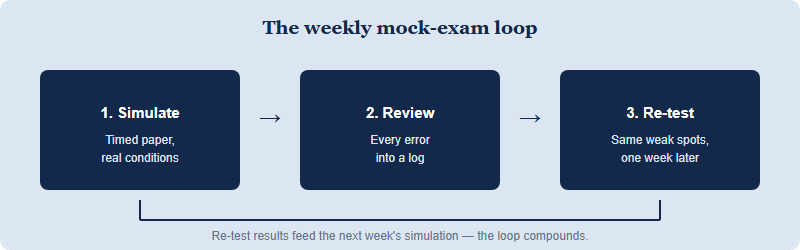
Stage 1: simulate the conditions, not just the questions
A mock is only useful if it reproduces the pressure you will actually face. The NEC runs through several distinct formats — among them a written Qualifying Test, the rapid Quiz Bowl, the Critical Thinking case, and the applied Econ Lab — so “simulating a round” means matching the specific format you are training, not a generic worksheet. Confirm the exact timing, question count and structure for your division and round on the official CNEC channels before you build a mock; the rules can change by season, so do not assume last year’s format carries over.
With the real parameters confirmed, hold these conditions every time:
- Strict timer, visible. Set the clock to the official duration and finish when it stops, even mid-question. Stopping at the buzzer is the single most important habit a mock builds.
- One sitting, no pauses. No breaks, no looking up a formula, no second pass after checking an answer. The first attempt under time is the data that matters.
- Match the input format. If the real round is multiple-choice, practise on multiple-choice; if it is a buzzer round, rehearse with a teammate calling questions aloud. Format-specific reflexes do not transfer.
- Log your finish time. Note not just your score but how much of the clock you used. Running out with questions blank, and finishing early with errors, are two different problems with two different fixes.
A frequent first-party observation from CNEC coaching is that students who only ever practise untimed plateau the moment they hit a real clock: they know the material but freeze on pace. The fix is exposure. Even one strictly-timed mock a week retrains the internal sense of “how long a question should take,” which is exactly the instinct an untimed question bank never develops.
Stage 2: the error-review log is where scores actually move
Reviewing a mock is not re-reading the answer key. It is diagnosing each lost mark precisely enough to act on it. The most efficient tool is a simple error log — a running table you add to after every sitting. The discipline is to record not just what was wrong but why, because the “why” determines the fix.
Sort every mistake into one of a few error types. The category matters more than the question, because each type has a different remedy:
| Error type | What it looks like | The fix it points to |
|---|---|---|
| Knowledge gap | You genuinely did not know the concept or formula | Study that topic — this is a content fix, not a speed fix |
| Application slip | You knew the idea but applied it to the wrong case | Drill mixed questions so you recognise which tool fits |
| Careless error | Misread the question, sign error, wrong row of a table | Slow the first read; underline what is actually asked |
| Time-out | You could have solved it but ran out of clock | A pacing problem — practise skipping and returning |
This sorting is the whole game. A student who “got 18 wrong” learns nothing actionable; a student who sees “11 careless, 4 knowledge, 3 time-out” knows immediately that the priority is reading discipline, not more revision. Careless errors and time-outs are usually the fastest marks to recover, because they do not require learning new economics — only changing a habit. Add a one-line note for each entry on the exact trigger (“read ‘increase’ as ‘decrease’”, “spent four minutes on Q7”), so the pattern across weeks becomes visible.
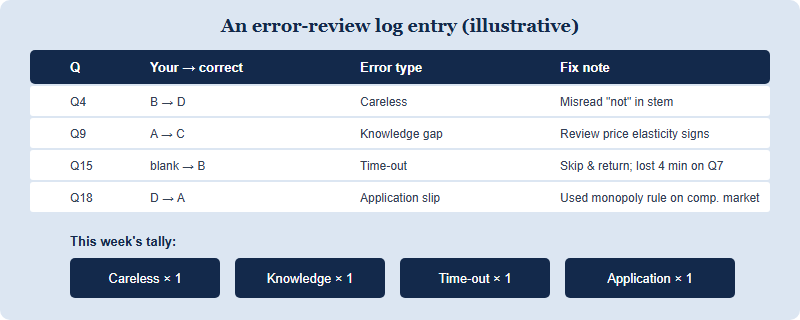
Stage 3: re-test to confirm the gap actually closed
Marking and logging a mock feels like the finish line, but the gap is not closed until you prove it. Re-testing is the step most students skip, and it is the one that turns review into retained improvement. The principle is spaced retrieval: revisit a weak spot after a delay, so your brain has to reconstruct the answer rather than recognise a fresh memory.
A workable re-test rhythm:
- Same week, light: within a day or two, re-attempt the specific questions you got wrong — from memory, not by re-reading the solution. If you still cannot do it, the gap is real, not just a slip.
- Next week, embedded: in your next full mock, deliberately include questions on the same weak topics. Clearing them under fresh time pressure is the actual proof of progress.
- Retire only when stable: a topic leaves your active error log only after you have answered it correctly, under time, on two separate sittings. One lucky correct attempt is not evidence.
This is also where a team routine pays off. CNEC’s David Ricardo (intermediate) and Adam Smith (advanced) divisions compete as teams of four, while the Pre division can enter individually or in small groups. A team can pool error logs so members quiz each other on one another’s weak topics — the person who keeps missing exchange-rate questions gets drilled by the teammate who finds them easy, and vice versa. Distributed re-testing covers more ground than four students each revising alone.
Tracking improvement: the numbers worth watching
Because every mock is timed and every error is categorised, you can track a few simple metrics across weeks and see whether the routine is working — rather than relying on a vague feeling of “getting better.” Watch the trend, not any single sitting.
| Metric | What it tells you | Good trend |
|---|---|---|
| Raw score | Overall standing on that paper | Rising, but noisy — read it alongside the others |
| Careless-error count | Reading and checking discipline | Falling toward near-zero |
| Time used / questions left blank | Pacing under the clock | Fewer blanks; clock not fully exhausted |
| Repeat-error rate | Whether review is sticking | Old log items not reappearing |
The most revealing of these is the repeat-error rate: how many mistakes this week were on topics already in your log. A high repeat rate means you are sitting mocks but not truly closing gaps — the review or re-test stage is too shallow. A repeat rate trending to zero means the loop is compounding. Raw score, by contrast, is the noisiest signal: a hard paper can dip your score while your underlying speed and accuracy are still improving, which is why the diagnostic metrics matter more than the headline number. To see how this prep system fits around the season and the different rounds, start from the CNEC home page and check the current-season structure before locking your weekly plan.
A simple weekly schedule you can run
You do not need hours every day — you need one disciplined cycle per week, repeated. A realistic version:
- Day 1 — Simulate. Sit one full timed mock for your target round under strict conditions. Mark it the same day while the experience is fresh.
- Day 2 — Review. Log every error by type, write the one-line trigger note, and update your tally. Identify the top one or two error categories to attack.
- Days 3–5 — Targeted fix. Spend short sessions on those categories: re-attempt missed questions from memory, and for knowledge gaps, study the specific concept — not the whole syllabus.
- Day 6 — Light re-test. Re-do the week's missed questions cold to confirm what stuck and what did not.
- Day 7 — Reset. Plan next week's mock to embed the topics still failing, and rest.
Scale the intensity to how long you have before competition day — more weeks mean you can rotate through every round format; fewer weeks mean prioritise the round that carries the most weight for your division. Confirm which rounds your division actually sits, and their formats, on the official CNEC channels, and align your weekly mock to whichever is next. For an overview of how the rounds and divisions connect across the season, the CNEC overview is the place to start.
Frequently asked questions
How often should I sit a full timed NEC mock?
One strict, full-length mock per week is enough for most students, paired with short review and re-test sessions on the days between. Quality of review beats raw volume.
What is an error-review log?
A running table where you record each wrong answer by error type — knowledge gap, application slip, careless, or time-out — plus a one-line note, so you fix causes rather than symptoms.
How do I know if my mock practice is working?
Track careless-error count, blanks left, and repeat-error rate across weeks. A repeat-error rate trending toward zero is the clearest sign review is sticking.
What timing should I set for an NEC mock?
Match the official duration and format for your division and round, which can change by season — confirm the current parameters on the official CNEC channels before building a mock.
Published by the NEC / CNEC editorial desk, operated by Hanlin Education as the officially authorized China National Economics Challenge (CNEC) test center. The NEC is run by the Council for Economic Education, which sets the official rules — always confirm current dates, divisions, fees and awards on the official CNEC channels. Any errors are corrected within 7 working days.